

Main Points :
- Retail investors injected approximately $48 billion into U.S. equities over 21 days, surpassing previous crisis-era peaks.
- U.S. household equity allocation has reached roughly 45–49%, exceeding dot-com and pre-2008 levels.
- Historical precedents show that extreme retail optimism often coincides with major market tops.
- Similar “last buyer” dynamics appear in Bitcoin and broader crypto cycles.
- Institutional exposure appears to be moderating while retail FOMO intensifies.
- Risk management and capital rotation strategies are becoming increasingly critical.
1. A Historic Surge in Retail Inflows
According to data shared by former Fidelity fund manager George Noble, retail investors poured approximately $48 billion into U.S. equities over the most recent 21-day period. This figure exceeds the previous record—set during the April 2025 crash—by roughly $5 billion.
Such an aggressive inflow is not merely a statistical anomaly; it represents a behavioral inflection point. Historically, when retail investors accelerate buying into markets already trading near highs, it often signals a late-cycle expansion phase rather than the beginning of a new bull market.
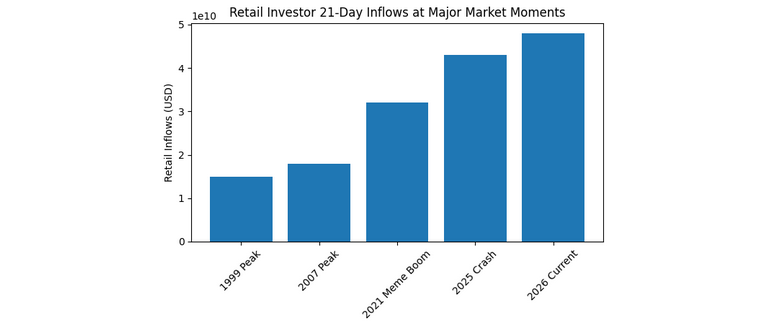
This surge mirrors patterns seen during:
- The 1999 dot-com peak
- The 2007 pre-Global Financial Crisis high
- The 2021 meme stock boom
In each instance, retail capital entered aggressively near market tops.
2. Household Equity Allocation: A Structural Warning Sign
Current U.S. household financial asset allocation to equities is estimated at 45–49%. For perspective:
- 1999 dot-com peak: 40.2%
- 2007 bull market peak: 38.1%
- Current levels: approximately 47%
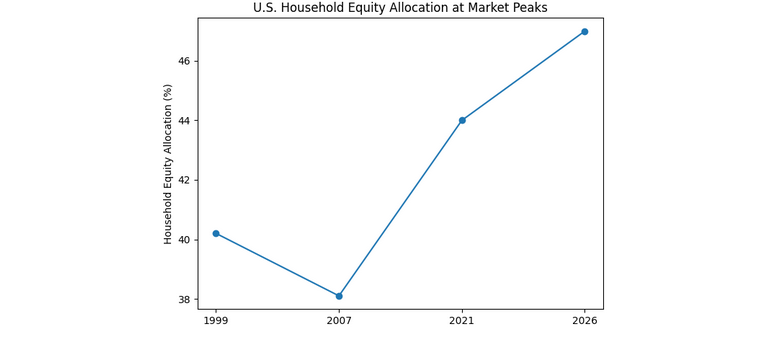
When households allocate nearly half of financial assets to equities, two structural risks emerge:
- Marginal buyers diminish — fewer new participants remain to push prices higher.
- Downside sensitivity increases — any shock forces disproportionate selling.
JP Morgan analysis indicates retail sentiment has exceeded even 2021 meme stock levels. Barclays data similarly shows retail equity exposure at the highest level since 1997.
3. The “Last Buyer” Problem
George Noble has warned that retail investors may be acting as the “last buyer” at elevated price levels.
History offers sobering parallels:
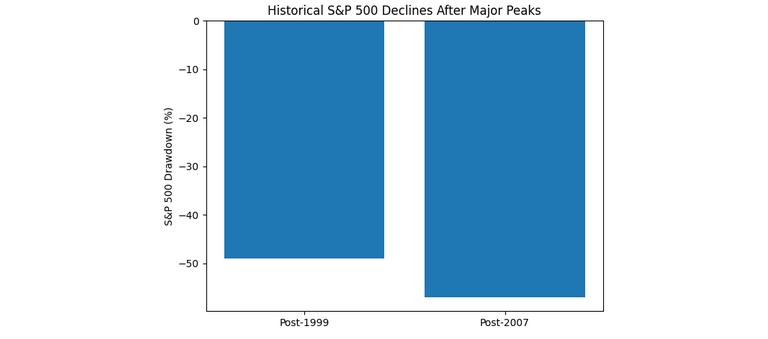
After the 1999 peak:
- S&P 500 declined approximately 49%.
After the 2007 peak:
- S&P 500 declined approximately 57%.
In both cases, institutional exposure had begun moderating while retail enthusiasm remained strong. The same divergence appears to be forming again.
When institutions quietly reduce risk while retail capital accelerates into equities, the probability of volatility spikes increases significantly.
4. Parallels with Bitcoin and Crypto Cycles
This phenomenon is not unique to equities. Crypto markets repeatedly demonstrate similar patterns:
- 2017 Bitcoin peak near $20,000
- 2021 Bitcoin peak near $69,000
In both cases, retail participation surged late in the cycle.
The mechanism is psychological:
- Prices rise steadily.
- Media coverage intensifies.
- Retail FOMO accelerates.
- Liquidity becomes saturated.
- Price momentum exhausts.
Bitcoin’s funding rate turning negative recently, while price stabilizes, suggests leveraged positioning dynamics are once again building beneath the surface.
Retail-driven parabolic expansions in crypto frequently precede sharp drawdowns of 60–80%. The lesson from equities and crypto remains consistent: when participation becomes universal and optimism extreme, upside asymmetry compresses.
5. Macro Backdrop: Liquidity, Rates, and Risk Appetite
Macro conditions remain complex:
- U.S. rates remain structurally higher than the zero-rate era.
- Fiscal deficits continue expanding.
- Liquidity injections fluctuate alongside geopolitical tensions.
Retail investors often extrapolate recent performance into the future without fully pricing macro fragility.
If economic data weakens or liquidity tightens unexpectedly, markets heavily owned by retail capital can become unstable quickly.
6. Is This a Crash Signal or a Melt-Up Precursor?
Extreme retail inflows do not always immediately precede crashes. Sometimes they fuel final melt-up rallies.
Two possible scenarios emerge:
Scenario A: Blow-Off Top
- Retail continues buying aggressively.
- Prices accelerate vertically.
- Institutional liquidity exits gradually.
- Sharp correction follows.
Scenario B: Gradual Distribution
- Markets stall at highs.
- Volatility increases.
- Retail buyers absorb institutional selling.
- Structural downturn develops over months.
Both scenarios require disciplined capital management.
7. Strategic Implications for Crypto-Focused Investors
For investors seeking new digital assets or blockchain-based income opportunities, the key is not fear—but preparation.
- Avoid leverage during sentiment extremes.
- Accumulate high-quality assets during volatility expansions.
- Consider capital rotation into undervalued sectors (AI infrastructure tokens, real-world asset tokenization platforms, stablecoin yield protocols).
- Maintain liquidity reserves.
The next cycle leaders may not be yesterday’s winners.
When retail capital saturates blue-chip equities, capital often rotates into alternative markets. Historically, crypto benefits from liquidity overflow—but also suffers amplified downside during risk-off phases.
8. Risk Management Over Prediction
Attempting to time a crash precisely is less productive than building resilient portfolios.
Professional investors focus on:
- Position sizing
- Cash buffers
- Correlation management
- Volatility-adjusted allocation
Retail investors often focus on narrative momentum.
When the gap between those two approaches widens, structural fragility increases.
9. Final Thoughts
Retail inflows into U.S. equities have reached historic extremes. Household equity exposure is at levels unseen in modern financial history. Sentiment is stretched. Institutions appear more cautious.
This does not guarantee a crash tomorrow.
But it does suggest that asymmetric upside may be narrowing while downside convexity increases.
For crypto investors, the lesson is clear:
Euphoria cycles repeat across asset classes.
Liquidity expansion creates opportunity.
Liquidity exhaustion creates volatility.
The intelligent investor prepares for both.
Capital preservation today creates strategic advantage tomorrow.


