
Main Points :
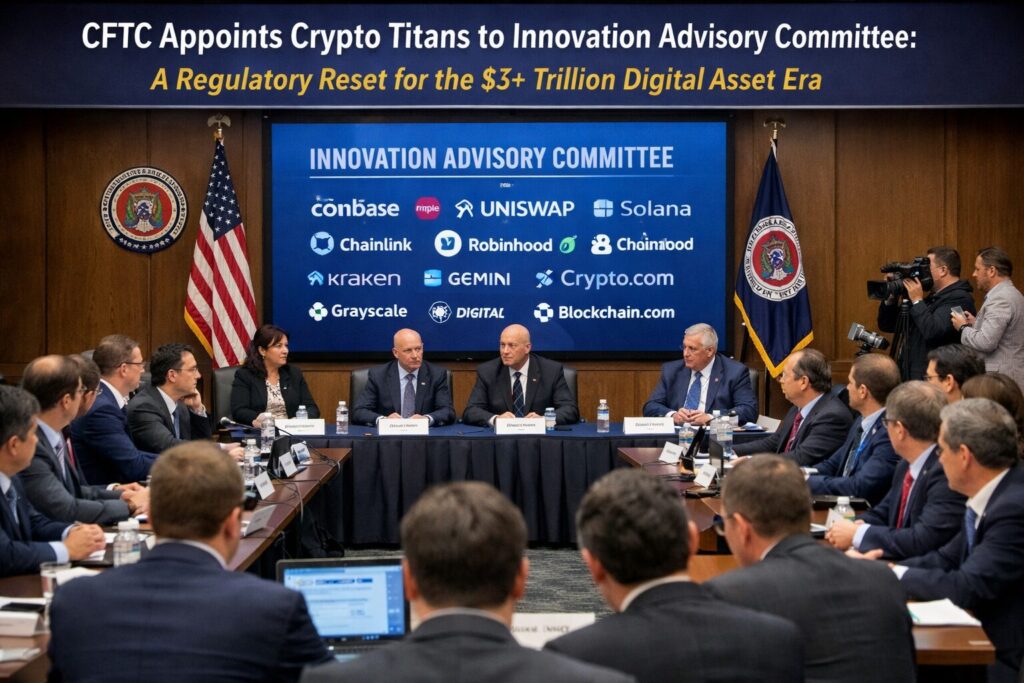
- The U.S. Commodity Futures Trading Commission (CFTC) has formed a 35-member Innovation Advisory Committee (IAC) including CEOs from leading crypto and financial firms.
- Members include executives from Coinbase, Uniswap, Ripple, Robinhood, Chainlink, Solana, Kraken, Gemini, Crypto.com, Anchorage Digital, Grayscale, and Blockchain.com.
- The committee aims to shape future regulatory frameworks for blockchain, AI, cloud systems, and next-generation trading infrastructure.
- The CFTC is signaling a shift toward clearer regulatory boundaries in coordination with the SEC through “Project Crypto.”
- A controversial 2024 proposal banning certain event contracts has been withdrawn, reflecting a more innovation-friendly approach.
- This development may reduce regulatory friction and create new growth pathways for crypto-based financial products, derivatives, and prediction markets.
1. A Structural Shift in U.S. Digital Asset Regulation
In February 2026, the Commodity Futures Trading Commission (CFTC) announced the formation of its Innovation Advisory Committee (IAC), a 35-member body tasked with advising on emerging technologies impacting derivatives and commodity markets.
The announcement marks one of the most significant structural realignments in U.S. digital asset regulation in recent years. Unlike prior advisory bodies dominated by academics and traditional finance executives, this committee integrates frontline Web3 leadership directly into the regulatory discussion.
The formation of the IAC comes at a time when global digital asset market capitalization fluctuates above $3 trillion, with derivatives accounting for the majority of trading volume. Crypto perpetual futures, options, structured yield products, and prediction markets now represent multi-billion-dollar daily flows, largely operating across fragmented regulatory frameworks.
The CFTC appears to recognize that rulemaking in isolation from industry innovation is no longer sustainable.
2. The Composition: Crypto CEOs at the Regulatory Table
The IAC roster reads like a who’s who of the digital asset ecosystem:
- Coinbase CEO Brian Armstrong
- Uniswap Labs CEO Hayden Adams
- Ripple CEO Brad Garlinghouse
- Robinhood CEO Vlad Tenev
- Chainlink Labs CEO Sergey Nazarov
- Solana Labs CEO Anatoly Yakovenko
- Executives from Kraken, Gemini, Crypto.com, Anchorage Digital, Grayscale, and Blockchain.com
This composition is strategic. It spans centralized exchanges (CEX), decentralized finance (DeFi), custody infrastructure, asset management, and Layer-1 blockchain protocol developers.
For investors and builders, this signals that regulatory conversations will increasingly account for on-chain liquidity, oracle systems, cross-chain interoperability, and decentralized governance.
3. From Technical Advisory to Innovation Command Center
The IAC evolved from the former Technology Advisory Committee, reactivated in late 2025. However, the scope has expanded significantly.
Rather than focusing narrowly on technical risk, the IAC will evaluate:
- Artificial Intelligence in trading and compliance
- Blockchain infrastructure
- Cloud-based clearing systems
- New trading venues (including decentralized exchanges)
- On-chain derivatives protocols
- Predictive event markets
This reflects the reality that derivatives are no longer confined to traditional futures exchanges. On-chain perpetual swaps alone often generate daily volume exceeding $50 billion during volatile periods.
The question is no longer whether DeFi derivatives matter—but how they should be supervised.
4. Withdrawal of the 2024 Event Contract Ban
One of the most symbolic shifts involves the withdrawal of the 2024 proposal to ban sports-, political-, and awards-based event contracts.
The CFTC had previously argued that such contracts could violate public interest principles. However, the reversal indicates a willingness to re-examine prediction markets within a broader Web3 innovation context.
Prediction markets represent a fast-growing sector, potentially exceeding $10 billion annually in combined volume across centralized and decentralized platforms.
For entrepreneurs, this opens doors to compliant prediction infrastructure, tokenized outcome markets, and hedging tools tied to real-world events.
5. Coordination with the SEC: “Project Crypto”
The CFTC has also taken steps to clarify jurisdictional boundaries with the Securities and Exchange Commission (SEC).
In January 2026, the two agencies discussed regulatory responsibility allocation and launched “Project Crypto,” a joint initiative aimed at modernizing digital asset oversight.
This cooperation could reduce one of the biggest risk factors facing U.S.-based crypto innovation: regulatory ambiguity.
Historically, overlapping enforcement actions created compliance uncertainty for token issuers and exchanges. A clearer commodity-versus-security classification process would unlock institutional participation in tokenized commodities, stablecoin derivatives, and tokenized treasury markets.
6. Market Impact: Institutional Pathways Expand
For readers seeking new revenue sources and practical blockchain applications, this development matters for three reasons:
(1) Regulated On-Chain Derivatives
Clearer CFTC engagement may pave the way for compliant perpetual futures and options protocols operating under defined commodity frameworks.
(2) Tokenized Commodities
If digital assets classified as commodities fall under CFTC purview, tokenized gold, energy derivatives, and agricultural futures could expand on-chain.
(3) AI-Driven Trading Infrastructure
The IAC explicitly includes AI in its mandate. Expect increased integration of algorithmic risk management, automated compliance engines, and real-time blockchain analytics.
Evolution of U.S. Digital Asset Regulatory Coordination (2023–2026)
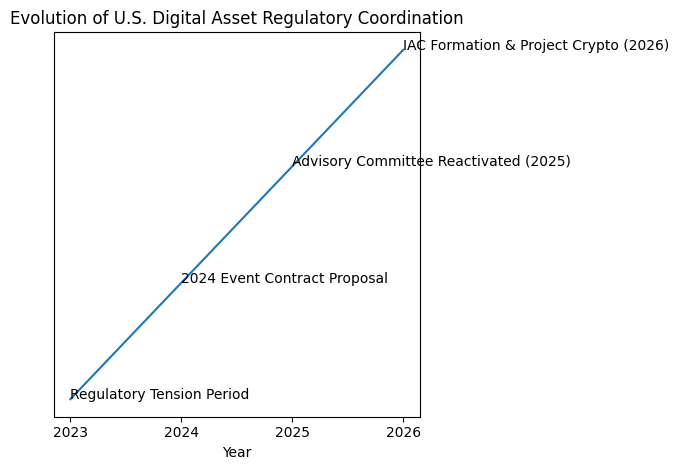
This timeline illustrates:
- 2024 Event Contract Proposal
- 2025 Reactivation of Advisory Committee
- January 2026 SEC–CFTC Joint Discussions
- February 2026 IAC Formation
Estimated Breakdown of Global Crypto Derivatives Volume (2026)
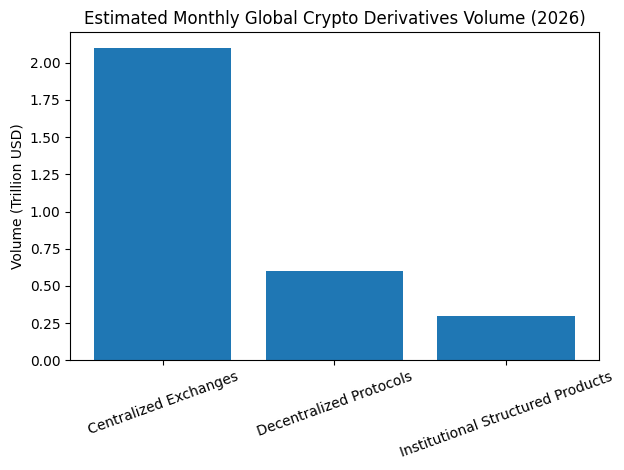
Illustrates:
- Centralized Exchanges: ~$2.1 trillion monthly
- Decentralized Protocols: ~$600 billion monthly
- Institutional Structured Products: ~$300 billion monthly
(All figures expressed in USD)
7. Regulatory Acceptance of Web3 Innovation
Chair Michael Selig emphasized the need for “clear rules of the road” that reflect market realities while maintaining U.S. leadership.
This language signals a departure from enforcement-led policymaking toward collaborative rule design.
Such positioning may attract global crypto firms seeking regulatory clarity. In the medium term, this could drive:
- Increased U.S.-based token listings
- Expansion of compliant DeFi protocols
- Institutional stablecoin adoption
- Growth of blockchain-based clearing infrastructure
Conclusion: A Turning Point for Crypto–Regulator Relations
The creation of the CFTC Innovation Advisory Committee marks more than a procedural update—it represents a philosophical shift.
For years, the relationship between regulators and crypto firms oscillated between uncertainty and confrontation. Now, the direct inclusion of major industry CEOs at the advisory level suggests recognition that innovation cannot be regulated effectively without collaboration.
For investors and builders, this environment may produce:
- Greater capital inflows
- Reduced regulatory tail risk
- Expanded derivative product design
- Institutional-grade DeFi adoption
If Project Crypto succeeds in clarifying SEC–CFTC boundaries, the United States could reassert leadership in blockchain-based financial infrastructure.
The digital asset market is entering a new phase—less defined by regulatory fear, and more shaped by structured integration.


