

Main Points :
- Former Binance CEO Changpeng Zhao (CZ) argues that lack of privacy is the biggest structural barrier to mainstream crypto payments.
- Fully transparent blockchains expose salary data if companies pay employees on-chain.
- Industry leaders including Chamath Palihapitiya and Barry Silbert agree that transparency designed for trust becomes problematic at scale.
- Without confidential transaction mechanisms, enterprises will resist full on-chain payroll and treasury management.
- Privacy-preserving technologies (zk-proofs, confidential transactions, L2 privacy layers) may unlock enterprise adoption.
- The next growth wave in crypto may come from practical privacy infrastructure rather than speculation tokens.
The Structural Problem: Radical Transparency Meets Corporate Reality
On February 15, Changpeng Zhao (CZ), former CEO of Binance, publicly stated on X that insufficient privacy protection is one of the largest structural barriers preventing cryptocurrency payments from achieving mainstream adoption.
His example was simple but powerful:
If a company pays employee salaries on-chain, anyone can click the receiving address and view the amount transferred. Over time, salary hierarchies, compensation gaps, and organizational structure become visible to the public.
This is not a minor inconvenience. It is a structural incompatibility between:
- The transparent design of blockchains like Bitcoin and Ethereum
- The confidentiality requirements of real-world corporations
Blockchain transparency was designed to solve the trust problem. But enterprise finance is built on selective disclosure.
When those two philosophies collide, adoption stalls.
Why Transparency Was Designed — and Why It Now Creates Friction
Public blockchains like Bitcoin were intentionally designed as transparent ledgers. Anyone can verify transactions. This architecture guarantees:
- Trust minimization
- Auditability
- Resistance to corruption
- Predictable monetary issuance
However, what works for a censorship-resistant currency does not automatically work for enterprise payroll.
Investor and “All-In Podcast” host Chamath Palihapitiya commented that Bitcoin’s transparent ledger was designed to establish credibility. But at scale, the same transparency introduces new systemic friction.
Corporate payroll requires:
- Confidential salary structures
- Competitive compensation strategies
- Controlled disclosure
- Protection of employee financial security
An entirely open ledger conflicts with all four.
The Salary Exposure Problem in Practice
Let’s model a simple scenario:
A company with 200 employees pays salaries in stablecoins on Ethereum.
Each transfer is visible:
- Employee wallet address
- Amount transferred
- Date
- Frequency
- Treasury wallet balance
If the company uses a single treasury address, anyone can reconstruct:
- Total payroll expense
- Executive compensation
- Organizational hierarchy (inferred via payment size)
- Financial health trends
This creates both internal and external risks.
Internal Risks
- Wage dissatisfaction
- Loss of morale
- Talent poaching
- Competitive intelligence leakage
External Risks
- Targeted theft
- Extortion risk
- Address clustering analysis
- Asset mapping for criminal activity
CZ warned that adversaries could build asset maps of high-value wallets.
This is not theoretical. Blockchain forensic firms already cluster addresses using heuristic analysis.
Industry Support: Not a Lone Opinion
CZ’s statement was widely supported.
Barry Silbert, CEO of Digital Currency Group and Chairman of Grayscale Investments, reposted CZ’s comments with a succinct: “This.”
Former Kaspa business development specialist Avidan Abitbol added that institutions will not adopt blockchain unless transaction privacy is guaranteed.
This is crucial:
Enterprise adoption requires predictable confidentiality.
Without it, crypto remains speculative rather than infrastructural.
Why This Matters for the Next Growth Cycle
For readers seeking new crypto assets and revenue opportunities, this debate signals something important:
The next wave of crypto growth may not come from meme tokens or speculative DeFi yields.
It may come from privacy infrastructure.
Historically, bull markets followed new primitives:
- 2017: ICO tokens
- 2020: DeFi and yield farming
- 2021: NFTs
- 2024: ETF-driven Bitcoin institutionalization
The next infrastructure cycle may center on:
- Zero-knowledge proofs
- Confidential Layer-2 networks
- Enterprise-grade privacy chains
- Hybrid public-private settlement systems
Transparency vs. Privacy in Blockchain Adoption
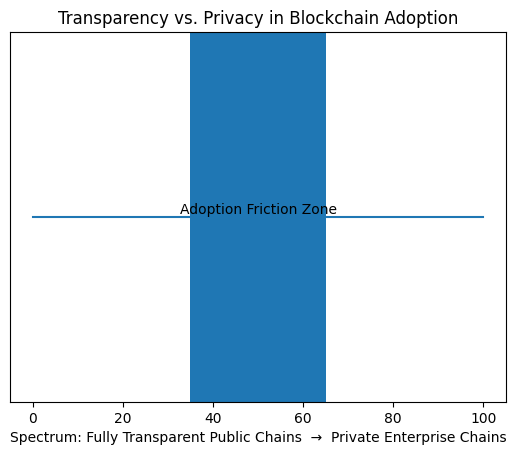
Graph shows spectrum from fully transparent public chains to private enterprise chains, illustrating adoption friction zone.
Technologies That May Solve the Problem
Several emerging approaches attempt to reconcile transparency with privacy:
1. Zero-Knowledge Proofs (ZKPs)
Allow verification of correctness without revealing transaction details.
Applications:
- zk-rollups
- Shielded transfers
- Confidential payroll verification
2. Confidential Transactions
Used in privacy-focused blockchains where amounts are hidden but validity is preserved.
3. Layer-2 Privacy Solutions
Payroll could settle on L2 with encrypted details, while L1 anchors hash commitments.
4. Enterprise Sidechains
Corporations may use permissioned chains that periodically settle to public networks.
Enterprise Payroll with zk-Privacy Layer
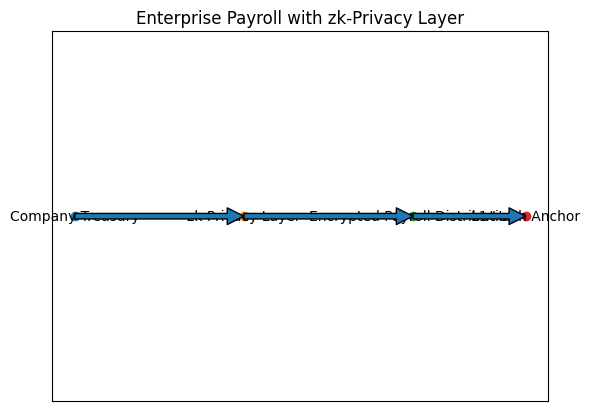
Flow : Company Treasury → zk Layer → Encrypted Payroll Distribution → L1 Hash Anchor
A Deeper Strategic Question: Can Crypto Scale Without Privacy?
Mass adoption requires:
- Consumer payments
- Corporate treasury management
- Cross-border settlements
- Payroll systems
- Supplier payments
If every transaction is publicly visible, adoption hits a ceiling.
The market already demonstrates this tension:
- Stablecoins like USDC are widely used for settlement.
- But corporate payroll in crypto remains niche.
- Most crypto compensation still uses hybrid fiat-crypto systems.
That suggests the privacy gap is real.
Investment Implications
For investors looking for the next cycle:
Watch projects focusing on:
- zk infrastructure
- Privacy Layer-2 protocols
- Enterprise settlement chains
- Secure multi-party computation
- Encrypted stablecoin rails
These may become foundational layers for enterprise adoption.
The opportunity is not just speculative price appreciation.
It is infrastructure positioning.
Competitive Advantage and Geopolitical Implications
If one jurisdiction successfully integrates privacy-compliant blockchain payroll systems, it may:
- Attract crypto-native companies
- Reduce cross-border friction
- Improve global talent mobility
- Strengthen fintech competitiveness
Countries balancing compliance and privacy may lead the next financial infrastructure wave.
The Security Dimension
Salary exposure is not merely corporate embarrassment.
It can translate into physical security risks.
Public salary tracking combined with KYC leaks can enable:
- Targeted scams
- Physical robbery
- Kidnapping in unstable regions
The transparency ideal must be reconciled with human safety.
The Philosophical Tension
Crypto began as radical transparency and decentralization.
But real-world finance requires:
- Selective opacity
- Controlled disclosure
- Regulatory oversight
- Privacy protection
The next generation of blockchain systems must synthesize both.
Not abandon transparency — but layer privacy where necessary.
Conclusion: Privacy Is Not Optional Infrastructure
CZ’s statement surfaces a structural truth:
Crypto will not become a global payroll or enterprise settlement standard without privacy guarantees.
Transparency built trust.
Privacy will enable scale.
For builders, this is a design challenge.
For regulators, this is a policy balancing act.
For investors, this is a signal.
The next major crypto infrastructure cycle may be defined not by speculation, but by confidential computation and enterprise-grade privacy rails.
The future of crypto payments depends not on eliminating transparency, but on making privacy programmable.


