
Main Points :
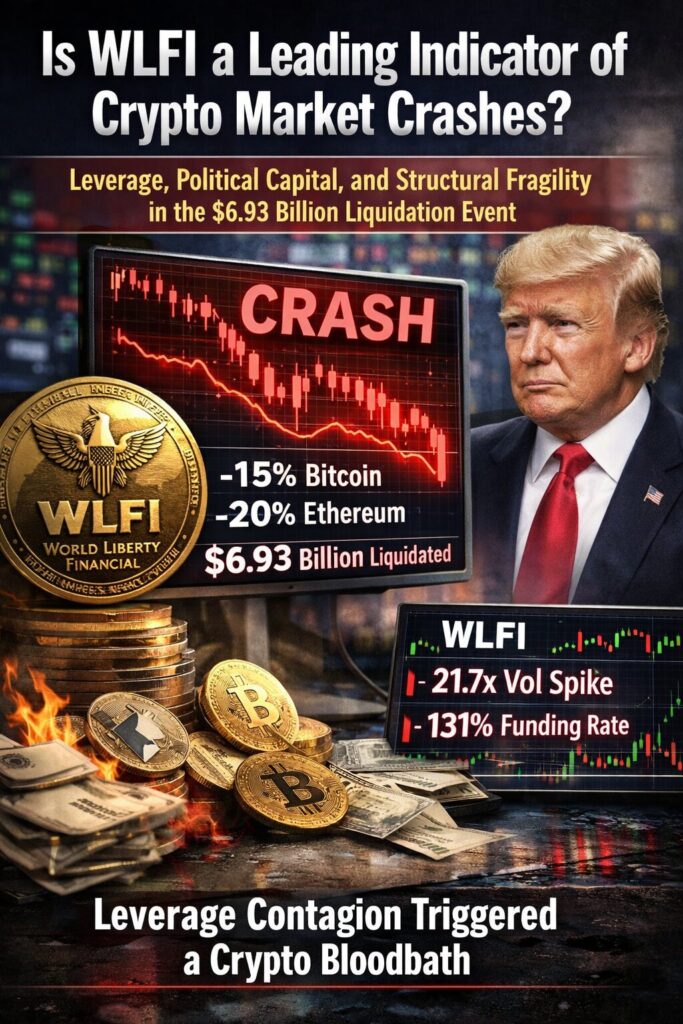
- WLFI (World Liberty Financial), a Trump-linked DeFi governance token, plunged more than five hours before the broader crypto market crash on October 10, 2025.
- Approximately $6.93 billion in leveraged crypto positions were liquidated within less than one hour.
- Bitcoin fell about 15% and Ethereum around 20%, while smaller-cap tokens dropped as much as 70%.
- WLFI exhibited abnormal trading activity: 21.7× volume spike and funding rates reaching 2.87% per 8 hours (~131% annualized).
- The crash transmission mechanism was leverage contagion—collateral erosion forced BTC and ETH selling.
- WLFI’s realized volatility was roughly 8× that of Bitcoin during the stress event.
- The phenomenon does not prove insider trading but highlights structural fragility in high-leverage tokens.
- The signal’s alpha may disappear once widely monitored.
Part I — The Event: A $6.93 Billion Liquidation Cascade
On October 10, 2025, the cryptocurrency market experienced one of the sharpest intraday deleveraging events in recent history. Within less than an hour, approximately $6.93 billion worth of leveraged positions were forcibly liquidated across derivatives exchanges.
Bitcoin was trading near $121,000 before the selloff began. At the peak of the cascade, BTC dropped roughly 15%, reaching around $102,850. Ethereum fell approximately 20%, sliding from the mid-$4,000 range to below $3,500. Smaller capitalization tokens declined by as much as 70%.
But what makes this episode remarkable is not merely the scale of liquidation—it is the timing.
According to data provider Amberdata, the governance token WLFI (World Liberty Financial) began collapsing more than five hours before Bitcoin showed visible stress.
WLFI (World Liberty Financial)
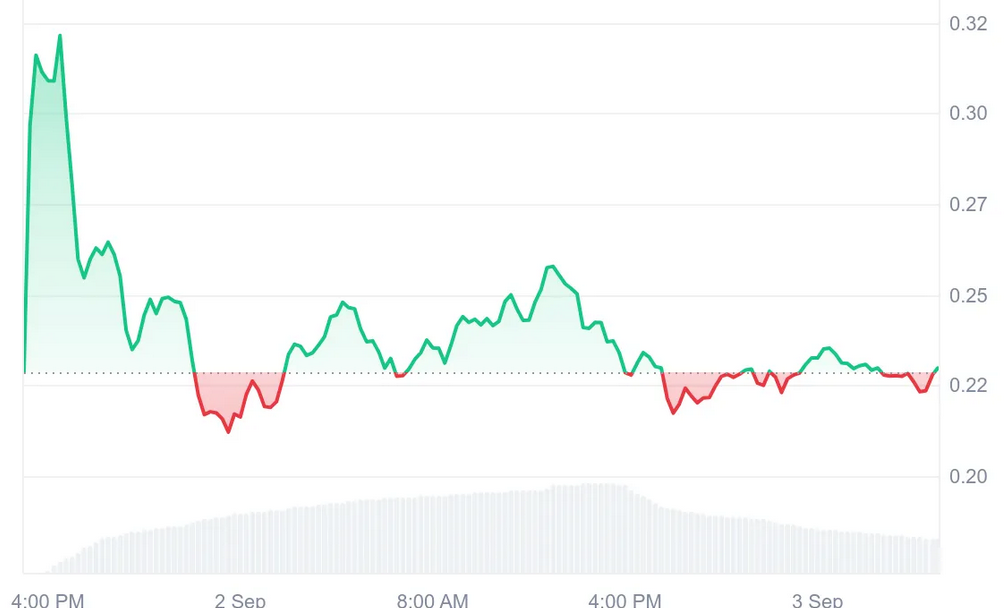
WLFI is a politically associated DeFi governance token reportedly connected to the Trump family. Unlike Bitcoin, whose ownership base is globally diversified, WLFI’s holder base appears more concentrated among politically aligned or event-sensitive participants.
Amberdata’s analysis does not allege insider trading. Instead, it raises a structural question:
Can a politically concentrated, highly leveraged token act as an early stress detector for the broader crypto system?
Part II — The Three Anomalies Before the Crash
Amberdata’s research team identified three key abnormal patterns in WLFI prior to the broader market collapse.
1. Abnormal Volume Surge
Within minutes of tariff-related political news, WLFI’s hourly trading volume surged to approximately $474 million, about 21.7× its normal baseline.
The acceleration began roughly three minutes after the news release—far faster than typical retail reaction cycles.
If this were merely “superior analysis” by sophisticated traders, one would expect similar activity across multiple correlated tokens. Instead, activity was heavily concentrated in WLFI.
This concentration suggests targeted positioning rather than broad macro interpretation.
2. Extreme Funding Rates
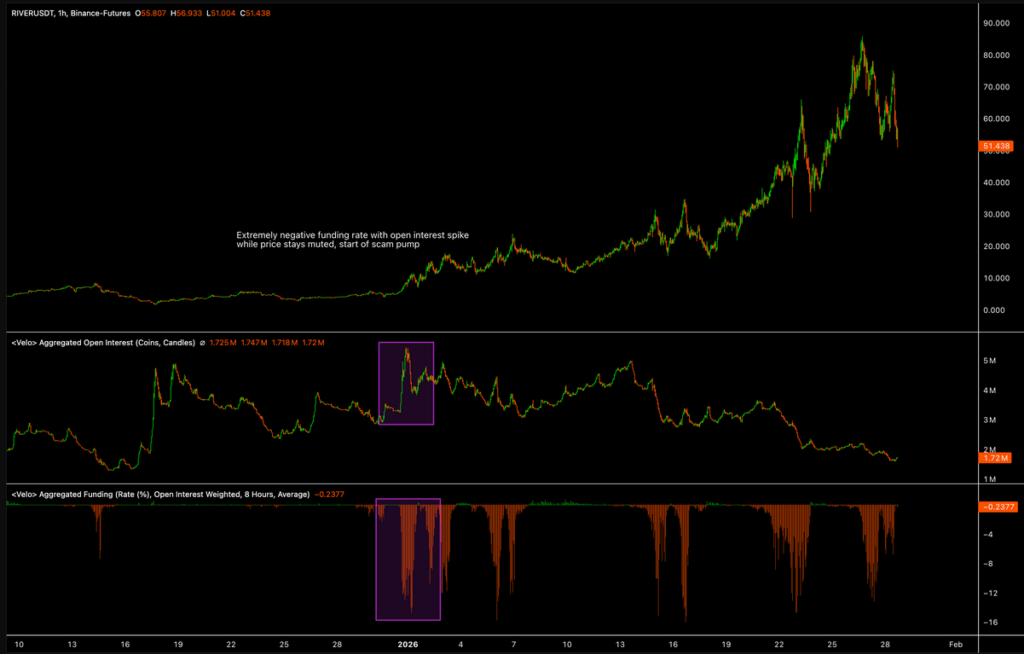
WLFI’s perpetual futures funding rate spiked to 2.87% per 8 hours, equivalent to approximately 131% annualized borrowing cost.
Such funding levels imply extremely one-sided positioning—either aggressive long leverage or panic-driven imbalance.
In crypto derivatives markets, funding rates serve as pressure gauges. When they spike, fragility increases. In WLFI’s case, fragility became instability.
3. Volatility Divergence
Amberdata observed that WLFI’s realized volatility was approximately 8× higher than Bitcoin’s during the stress window.
This is critical.
Assets that are:
- Thinly distributed,
- Politically sensitive,
- And highly leveraged,
are structurally prone to become first movers in deleveraging cycles.
Part III — The Mechanism: Collateral Contagion
To understand why WLFI’s decline mattered, one must understand crypto collateral mechanics.
On many exchanges, traders can post multiple assets as margin for leveraged positions. If WLFI was used as collateral and its price fell sharply, its collateral value dropped.
To maintain margin requirements, traders were forced to sell more liquid assets—primarily Bitcoin and Ethereum.
This triggered:
- Forced BTC/ETH sales
- Price declines
- Additional margin calls
- A liquidation cascade
The result: a $6.93 billion unwind.
This is not about WLFI’s market cap exceeding Bitcoin’s influence. It is about structural leverage interdependence.
Part IV — Is This a Predictive Signal?
Amberdata’s author Mike Marshall cautioned against overinterpretation.
The analysis examines a single event, and statistical robustness requires repetition.
However, from a market-structure perspective, the implications are powerful.
Market signals often have limited half-lives. Once widely recognized, arbitrage erodes alpha.
Marshall noted:
“Signals remain profitable only as long as they are under-monitored. The moment consensus forms, excess return disappears.”
Thus, WLFI may not be a permanent leading indicator—but it may represent a broader class of signals:
High-leverage, politically concentrated tokens as early stress sensors.
Part V — Broader Market Context (Late 2025 Landscape)
Beyond the event itself, the macro backdrop matters.
Recent crypto trends include:
- Persistent institutional ETF accumulation in Bitcoin.
- Elevated derivatives open interest relative to spot volumes.
- Increasing use of cross-collateral margin systems.
- Higher structural leverage compared to previous cycles.
These conditions amplify contagion risk.
Additionally, political news cycles increasingly intersect with financial markets. Politically associated tokens may react faster to regulatory or geopolitical developments than neutral assets like Bitcoin.
This creates asymmetrical reaction speeds in the system.
Part VI — Strategic Implications for Investors
For readers seeking:
- New crypto assets,
- Yield opportunities,
- Practical blockchain applications,
this episode offers several lessons.
1. Monitor Fragile Nodes
Tokens with:
- High funding rates,
- Volume anomalies,
- Concentrated holder bases,
may provide early warnings of broader systemic stress.
2. Understand Collateral Chains
In leveraged systems, the asset that falls first is not necessarily the asset that causes the most damage. Damage propagates through collateral relationships.
3. Alpha Decays
If WLFI becomes widely tracked as a “crash indicator,” its predictive power may fade.
The opportunity lies in identifying structural stress proxies before they become consensus tools.
Part VII — Visualizing the Cascade
[Timeline Chart]
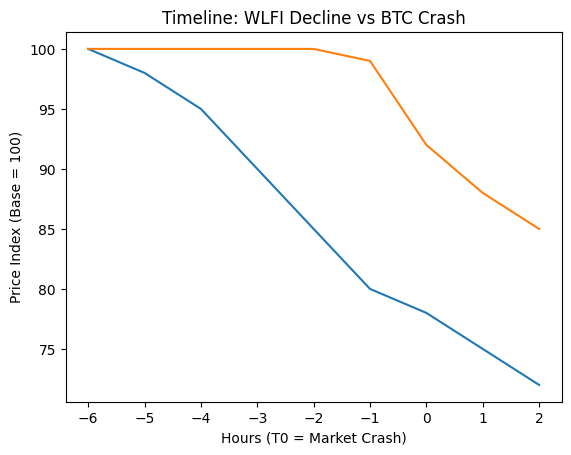
A time-series chart comparing WLFI price decline beginning T–5 hours vs. BTC decline at T0.
[Liquidation Flow Diagram]

A simplified diagram illustrating:
WLFI drop → Collateral loss → BTC/ETH selling → Liquidation cascade → $6.93B forced unwind.
[Funding Rate Spike]
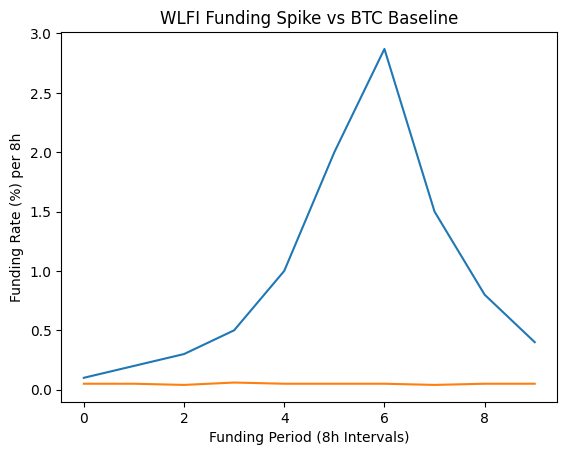
WLFI funding rate spike to 2.87% per 8h vs. BTC funding baseline.
Conclusion — Fragility Speaks First
The October 10, 2025 liquidation event demonstrates how modern crypto markets are no longer driven purely by spot demand or retail flows. They are deeply interconnected leverage systems.
WLFI’s early collapse does not prove foresight. It proves sensitivity.
In complex financial networks, the weakest node often moves first.
Whether WLFI remains a useful early-warning signal is uncertain. But the broader insight remains enduring:
Markets rarely crash without whispers.
The whispers often come from the most fragile corners.
For forward-looking investors and builders, the lesson is not to chase political tokens—but to study structural leverage, volatility asymmetry, and collateral fragility.
In crypto, stress does not appear everywhere at once.
It appears first where leverage is deepest and distribution is narrowest.
And on October 10, 2025, that place was WLFI.


