
Main Points :
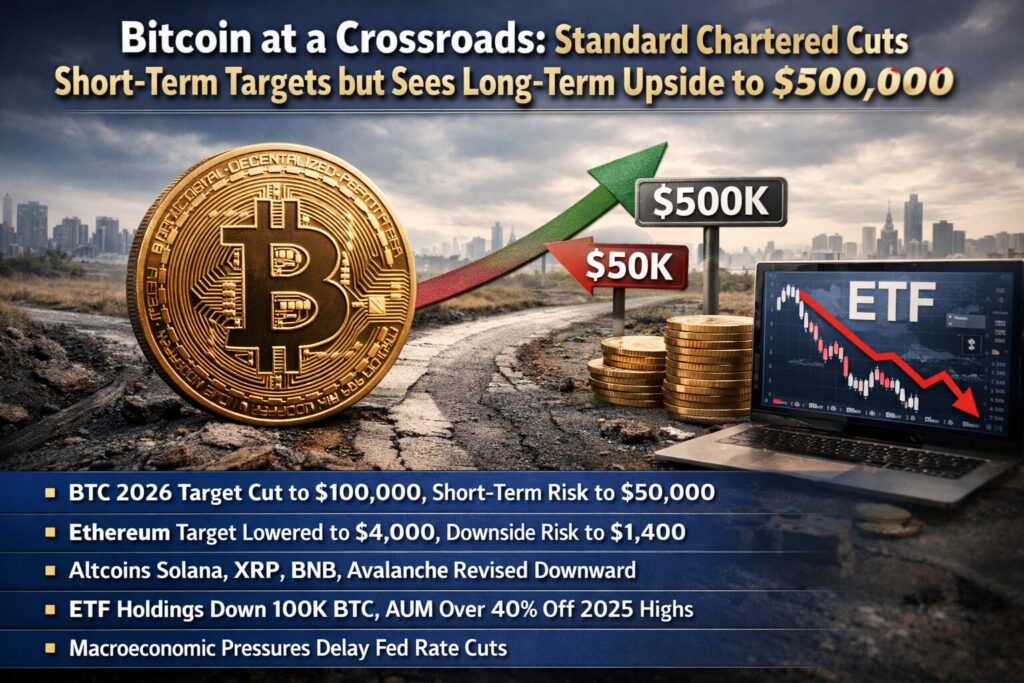
- Standard Chartered lowers its 2026 year-end Bitcoin target to $100,000, with a possible short-term drop to $50,000.
- Ethereum target reduced to $4,000, with downside risk to $1,400.
- Major altcoins such as Solana, XRP, BNB, and Avalanche see significant downward revisions.
- Bitcoin ETF holdings have fallen by roughly 100,000 BTC from peak levels.
- ETF assets under management (AUM) have declined over 40% from 2025 highs.
- Macroeconomic pressures, including delayed Federal Reserve rate cuts, weigh on crypto.
- No systemic collapse like Terra-Luna or FTX; institutional presence supports market structure.
- Long-term targets remain extremely bullish: Bitcoin at $500,000 by 2030.
1. Standard Chartered’s Revised Outlook: Short-Term Pain, Long-Term Conviction
Standard Chartered’s Head of Digital Assets Research, Geoffrey Kendrick, has issued a cautious short-term outlook for cryptocurrency markets, revising price targets downward for several major digital assets. Bitcoin’s 2026 year-end forecast has been reduced to $100,000, while Ethereum’s has been adjusted to $4,000.
More striking, however, is the bank’s near-term downside scenario: Bitcoin could temporarily fall to $50,000, and Ethereum to $1,400, in the coming months. These projections reflect mounting pressures in ETF flows, institutional positioning, and macroeconomic uncertainty.
Yet, despite these reductions, Standard Chartered maintains an extremely bullish long-term outlook. By 2030, the bank continues to forecast Bitcoin at $500,000, Ethereum at $40,000, and Solana at $2,000. This dual narrative—short-term correction, long-term structural growth—defines the current investment landscape.
For readers seeking new crypto assets or income opportunities, this signals a critical transition phase rather than a structural collapse.
2. ETF Outflows: The Structural Pressure Point
One of the main catalysts behind the downgrade is the contraction in Bitcoin ETF holdings. From their peak in October 2025, ETF reserves have declined by approximately 100,000 BTC.
At an average acquisition price near $90,000, many ETF investors are currently holding unrealized losses. This creates psychological and liquidity pressure, particularly among institutional allocators who entered during peak optimism.
Bitcoin ETF AUM fell from roughly $165 billion at peak to approximately $96 billion, a drop of more than 40%.
Ethereum ETFs experienced a similar contraction, declining 43% to around $13 billion.
[“Bitcoin ETF AUM Peak vs Current ($)”]
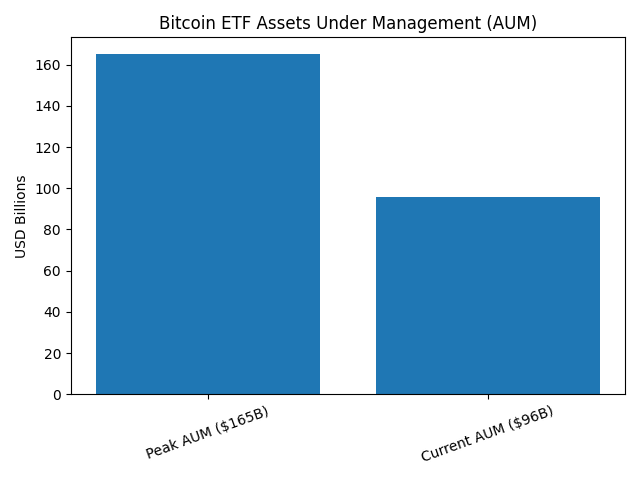
The chart should visually compare:
- Peak Bitcoin ETF AUM: $165B
- Current Bitcoin ETF AUM: $96B
- Peak Ethereum ETF AUM
- Current Ethereum ETF AUM
This decline indicates that crypto’s previous rally was heavily supported by ETF-driven capital flows. The slowdown suggests a temporary exhaustion of marginal buyers.
However, it also confirms something structurally important: institutional vehicles exist and remain functional. Unlike 2022, there is no systemic exchange failure driving panic.
3. Macro Headwinds: The Federal Reserve Factor
Macro conditions remain a central constraint. With the U.S. Federal Reserve chair transition scheduled for June 2026, rate cuts appear unlikely in the near term.
High interest rates suppress speculative capital. Risk assets—particularly growth equities and cryptocurrencies—struggle when liquidity tightens.
Crypto’s recent correction correlates closely with:
- Persistent inflation pressures
- Elevated bond yields
- Strong U.S. dollar strength
- Slower global liquidity expansion
For investors hunting yield or new blockchain-based revenue streams, this environment favors selective positioning rather than aggressive leverage.
Historically, crypto markets recover strongly once rate-cut cycles begin. Therefore, monitoring macro pivot signals becomes more important than short-term volatility itself.
4. Altcoin Revisions: Risk Compression Across the Board
Standard Chartered also cut forecasts for major altcoins:
- Solana revised from $250 to $135
- XRP revised from $8.00 to $2.80
- BNB revised from $1,755 to $1,050
- Avalanche revised from $100 to $18
These reductions reflect a broader de-risking environment.
Altcoins typically exhibit higher beta relative to Bitcoin. When liquidity contracts, speculative narratives lose momentum first.
However, from a practical blockchain usage perspective, this creates opportunity:
- Solana remains dominant in consumer-facing applications and high-throughput DeFi.
- XRP continues expanding cross-border payment integrations.
- BNB benefits from exchange ecosystem resilience.
- Avalanche maintains institutional subnet infrastructure growth.
Price compression does not necessarily equal network deterioration.
5. A Mature Market: No Terra, No FTX
A key distinction from 2022 is the absence of catastrophic platform failures.
During the Terra-Luna collapse and FTX bankruptcy, structural trust evaporated. Liquidity vanished, and contagion cascaded across the ecosystem.
This time, price declines stem from:
- ETF outflows
- Profit-taking
- Macro tightening
- Capital rotation
Institutional custody systems, regulated ETFs, and compliance frameworks have improved market resilience.
This signals crypto’s evolution from a speculative frontier into a semi-integrated asset class within global finance.
6. Strategic Implications for Opportunity Seekers
For readers focused on:
- Identifying new crypto assets
- Building income streams
- Leveraging blockchain for practical applications
This correction phase presents three strategic pathways:
6.1 Accumulation Strategy
If Bitcoin were to approach $50,000, long-term allocation strategies may become attractive, given the 2030 target of $500,000.
6.2 Yield Infrastructure
Bearish or sideways markets often increase demand for:
- Staking services
- Liquidity provisioning
- On-chain lending
- Cross-border payment rails
6.3 Institutional Integration Plays
Watch for:
- Stablecoin expansion
- Tokenized real-world assets (RWA)
- Payment integrations with traditional banks
- ETF derivatives and structured products
7. Long-Term Vision: Why $500,000 Bitcoin Remains on the Table
Standard Chartered’s unchanged 2030 targets suggest a structural thesis:
- Institutional adoption accelerates
- Digital gold narrative strengthens
- Sovereign and corporate treasuries allocate BTC
- On-chain settlement volumes rise
[“Projected Bitcoin Growth Path to $500,000 (Scenario Model)”]
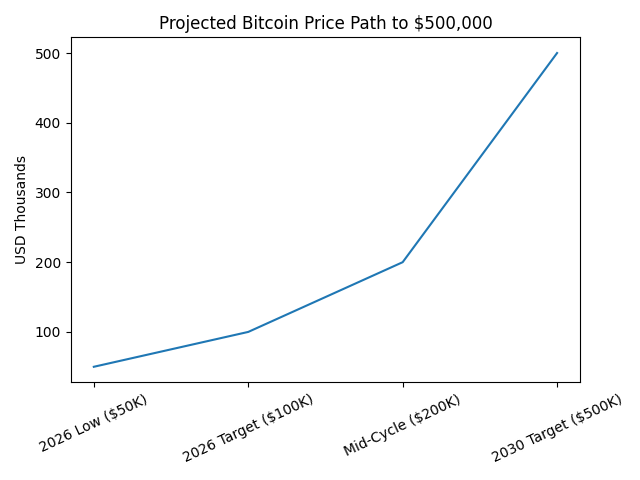
The chart should show:
- Current range ($50,000–$100,000 zone)
- Mid-cycle recovery ($150,000–$200,000)
- Late-decade projection ($500,000)
The long-term argument assumes Bitcoin evolves into a macro hedge and global settlement layer.
Conclusion: A Correction, Not a Collapse
Standard Chartered’s downgrade reflects cyclical cooling rather than structural failure.
ETF flows have weakened. Macro pressures persist. Altcoins have repriced sharply.
Yet, the absence of systemic collapse and the maintenance of long-term targets reinforce a critical message: the foundation remains intact.
For investors and builders, this period may represent:
- A reset in valuation
- A shift from speculative mania to infrastructure growth
- An opportunity to accumulate or build strategically
The crypto market appears to be entering a consolidation phase that may precede the next structural expansion.
Short-term volatility is likely. Long-term conviction remains.


