
Main Points :
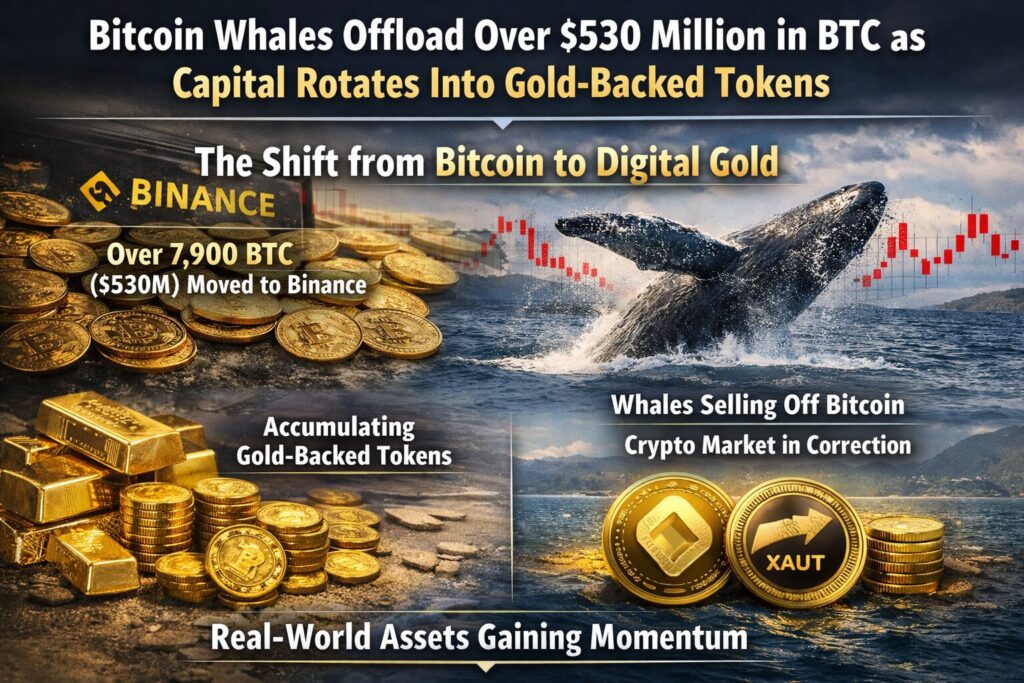
- A major Bitcoin whale transferred more than 7,900 BTC (over $530 million) to Binance within two days, signaling potential sell pressure.
- The broader crypto market is in a corrective phase, increasing the likelihood of profit-taking and defensive positioning by large holders.
- At the same time, multiple large wallets accumulated significant amounts of gold-backed tokens such as PAXG and XAUT.
- The simultaneous BTC distribution and gold-token accumulation suggests a strategic risk-off shift among some whales.
- These flows highlight the growing role of tokenized real-world assets (RWAs), especially digital gold, in crypto portfolio allocation.
Whale Activity: Over 7,900 BTC Moved to Binance in 48 Hours
According to blockchain analytics platform Arkham, a large wallet identified as “3NVeXm” transferred a total of 7,900 BTC to Binance over a two-day period. At recent market prices near $67,000 per BTC, this amounts to approximately $530 million in Bitcoin.
The transfers were executed in three batches:
- 5,000 BTC on the first day
- 1,800 BTC on the second day
- 1,100 BTC later that same day
Large inflows to centralized exchanges are often interpreted by the market as potential sell signals. While not every exchange deposit leads to immediate liquidation, historical on-chain data shows that sizable whale transfers to trading venues frequently precede either partial profit-taking or strategic repositioning.
This development comes during a broader corrective phase in the cryptocurrency market. Bitcoin has been struggling to maintain upward momentum after recent volatility, and analysts at several global banks have revised short-term outlooks more conservatively. In such environments, large holders—often referred to as “whales”—tend to reduce exposure, lock in profits, or rebalance portfolios.
The magnitude of 7,900 BTC is significant not only in nominal terms but also psychologically. Market participants closely monitor whale behavior because concentrated ownership can influence short-term liquidity and price discovery. Even the perception of imminent sell pressure can dampen bullish sentiment.
[Bitcoin Price vs. Exchange Inflows (Last 30 Days)]
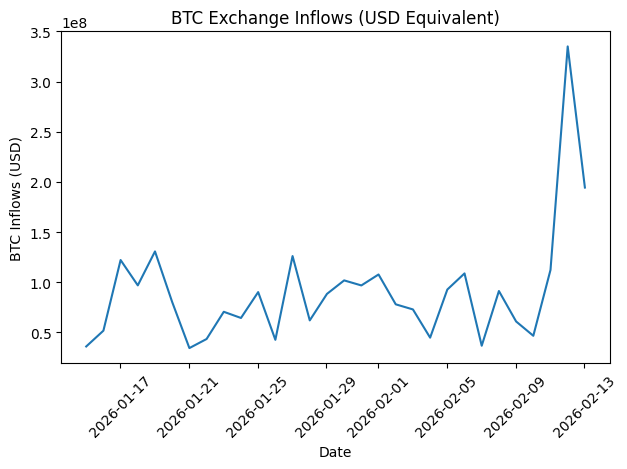
- Line chart showing BTC price (in $)
- Bar chart overlay of daily exchange inflows (BTC)
- Highlight the two days of 5,000 BTC and 1,800 + 1,100 BTC inflows
Market Context: Correction, Liquidity, and Position Unwinding
The crypto market is currently navigating a consolidation phase after strong prior gains. During bull cycles, whales accumulate aggressively, often withdrawing coins from exchanges into cold storage. Conversely, during corrections, exchange inflows tend to increase.
Institutional investors and high-net-worth individuals frequently adjust positions in response to:
- Macro uncertainty (interest rates, inflation expectations)
- ETF-related capital flows
- Risk management triggers
- Portfolio rebalancing mandates
When Bitcoin trades near key psychological or technical levels, whale behavior can amplify volatility. For example, if large BTC deposits coincide with weakening support levels, leveraged long positions may face liquidation cascades.
However, it is critical to note that exchange inflows do not automatically equal market dumping. Some whales use exchanges for collateral management, derivatives hedging, or OTC transactions that do not directly impact spot order books.
Still, in the current risk-sensitive environment, the timing of these deposits has drawn attention.
Simultaneous Rotation Into Gold-Backed Tokens
While one group of whales appeared to be preparing BTC for potential sale, other large wallets were moving decisively into tokenized gold.
On-chain data indicates:
- Two newly created wallets withdrew 986 PAXG (worth approximately $4.9 million at $2,000 per ounce equivalent pricing) from Binance.
- Another wallet purchased 478 XAUT using roughly $2.3 million in USDT.
- An address dormant for eight months allocated over $2 million combined into PAXG and XAUT.
In total, these gold-token purchases exceed $9 million in recent accumulation.
This simultaneous BTC distribution and gold accumulation is noteworthy. It suggests not an exit from crypto entirely, but rather a capital rotation within the digital asset ecosystem.
[Capital Rotation – BTC Outflows vs. Gold Token Inflows]
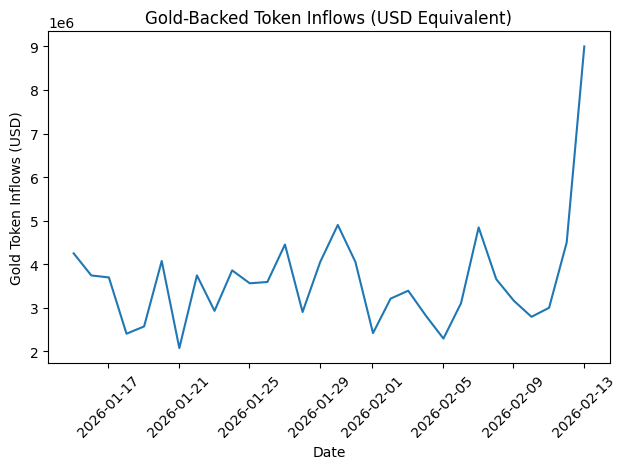
- BTC exchange inflow (in $ terms)
- PAXG and XAUT net inflows (in $ terms)
- Visual comparison showing divergence
Why Gold Tokens? The Rise of Tokenized Safe Havens
Gold-backed tokens such as PAXG and XAUT represent tokenized claims on physical gold reserves. Each token is typically backed 1:1 by allocated gold stored in vaults, with prices tracking the spot gold market.
The appeal of gold tokens during market corrections is multi-layered:
- Volatility Dampening
Gold historically exhibits lower volatility than Bitcoin. When crypto markets turn unstable, rotating into gold tokens can preserve capital while remaining on-chain. - Operational Continuity
Unlike selling BTC for fiat and exiting the crypto ecosystem, moving into PAXG or XAUT keeps funds within blockchain infrastructure. This enables rapid reallocation back into risk assets. - Collateral Utility
Gold tokens can be used as collateral in certain DeFi protocols and centralized platforms. - Regulatory Signaling
Tokenized real-world assets (RWAs) are gaining regulatory clarity in multiple jurisdictions, making them increasingly attractive to institutional players.
The broader RWA narrative has accelerated over the past two years. Tokenized Treasuries, real estate, and commodities are collectively emerging as a major growth segment. Digital gold represents one of the most mature and trusted forms of RWA within crypto.
Strategic Interpretation: Defensive Positioning, Not Capitulation
The concurrent BTC deposits and gold-token accumulation likely reflect risk management rather than panic.
Large investors often operate with multi-layered strategies:
- Hedge BTC exposure through futures
- Reduce spot holdings
- Allocate part of proceeds into lower-volatility assets
- Maintain liquidity for future re-entry
This type of capital rotation mirrors traditional finance behavior, where investors move from equities into bonds or gold during uncertain periods.
In this context, Bitcoin is treated as a high-beta asset, while tokenized gold functions as a digital defensive allocation.
Implications for Investors Seeking the Next Opportunity
For readers interested in new crypto assets and revenue strategies, several insights emerge:
- On-Chain Intelligence Is a Competitive Edge
Whale tracking provides early signals of shifting capital trends. - RWAs Are Becoming Core Portfolio Components
Tokenized gold and Treasuries are not fringe products—they are increasingly mainstream. - Liquidity Cycles Matter
Short-term price formation can be influenced heavily by a handful of large wallets. - Capital Rotation ≠ Market Collapse
Strategic reallocation often precedes the next accumulation phase.
If gold-token inflows accelerate while BTC stabilizes, this could signal a temporary consolidation before a renewed uptrend.
Broader Macro and Structural Trends
Beyond immediate whale activity, several structural factors shape this environment:
- Growing institutional adoption of digital assets
- Expansion of spot Bitcoin ETF participation
- Increased integration of stablecoins and tokenized commodities in cross-border settlement
- Rising interest in diversified on-chain treasury management
Tokenized gold, in particular, may benefit from:
- Geopolitical uncertainty
- Inflation hedging demand
- Regulatory pressure on purely speculative crypto assets
At the same time, Bitcoin continues to mature as a macro asset. Short-term sell pressure does not necessarily undermine its long-term thesis as digital scarcity.
Conclusion: A Signal of Evolution, Not Fear
The transfer of over 7,900 BTC—valued at approximately $530 million—to Binance within two days is undeniably significant. When viewed alongside simultaneous accumulation of gold-backed tokens, it paints a picture of sophisticated capital management rather than indiscriminate selling.
For forward-looking investors, this episode underscores three critical themes:
- Whale behavior can temporarily influence market direction.
- Tokenized real-world assets are gaining structural importance.
- Capital within crypto increasingly rotates rather than exits.
Rather than interpreting these flows as purely bearish, they may represent a transition phase. Defensive positioning often lays the groundwork for the next expansion cycle.
In a market where digital assets are converging with traditional financial instruments, understanding capital rotation dynamics may be just as important as analyzing price charts.


