

Main Takeaways :
- A single input error at Bithumb temporarily credited 620,000 BTC—worth over $43 billion—to customer accounts, exposing deep structural risks in centralized exchange ledger systems.
- Although no on-chain transfer occurred, internal ledger inconsistencies caused a sharp local price crash to $55,000, highlighting systemic market fragility.
- Korean regulators have launched a formal investigation and are signaling stricter IT governance, executive accountability, and disclosure rules.
- The incident reinforces the urgency of real-time ledger–on-chain reconciliation, multi-layer internal controls, and proof-of-reserves frameworks.
- For builders and investors, the crisis opens opportunities in exchange infrastructure, audit tooling, reconciliation layers, and institutional-grade crypto compliance solutions.
A Shockwave from a Single Input Error
On February 6, 2026, South Korea’s cryptocurrency market experienced one of its most startling operational incidents to date. According to multiple media reports, Bithumb, one of the country’s largest cryptocurrency exchanges, mistakenly credited customers with a total of 620,000 BTC as part of a promotional reward event.
The intended reward was modest: approximately $1.60 per user (2,000 KRW converted to USD). Instead, due to an internal input error, 695 users saw balances inflated by up to 2,000 BTC each, equivalent to roughly $140 million per person at prevailing market prices of around $70,000 per BTC.
While the error never propagated to the Bitcoin blockchain itself, the consequences were immediate and severe. Users attempted to sell the credited balances, triggering a flash crash on Bithumb where Bitcoin briefly traded as low as $55,000, significantly below prices on other global exchanges.
This episode has since become a defining case study in the risks inherent in centralized exchange infrastructure—and a catalyst for regulatory and industry-wide reassessment.
Internal Ledgers vs. On-Chain Reality
One of the most critical aspects of the Bithumb incident is that the 620,000 BTC never existed on-chain. The erroneous balances were created solely within Bithumb’s internal accounting ledger, not in its actual wallets.
At the time of the incident, Bithumb reportedly held:
- 175 BTC in company-owned assets
- 42,619 BTC in customer assets
In total, this amounted to 42,794 BTC, a fraction of the mistakenly credited amount.
This discrepancy underscores a fundamental design feature of most centralized exchanges:
trading occurs against an internal ledger, not directly on the blockchain.
Internal Ledger Entry vs. Actual BTC Holdings
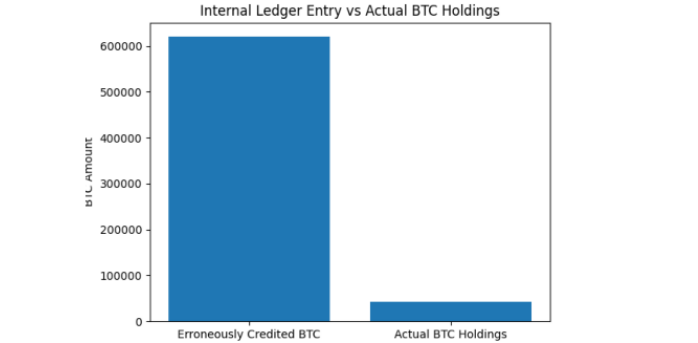
Such systems are efficient and scalable, but they introduce single points of failure. If ledger controls fail—even briefly—markets can behave as if assets exist when they do not.
Market Impact and the Localized Price Crash
Although the blockchain itself remained unaffected, the market impact was real.
As some users attempted to liquidate their phantom balances, selling pressure mounted rapidly on Bithumb’s order books. The exchange’s BTC price diverged sharply from global benchmarks, falling to $55,000 while other major exchanges continued trading near $70,000.
BTC Price Discrepancy During the Bithumb Incident
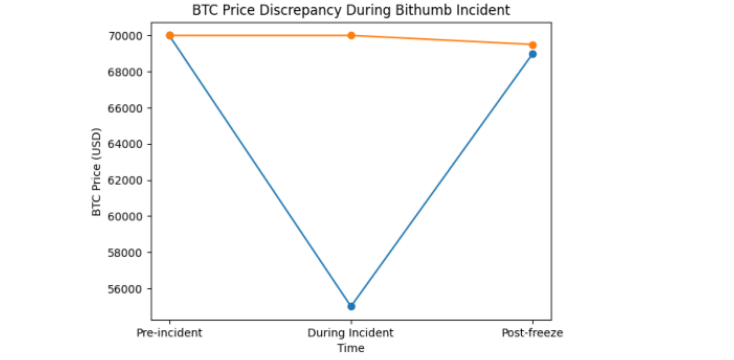
This temporary fragmentation highlights a critical insight for traders and institutions:
price integrity depends not only on blockchain security, but on exchange-level operational correctness.
Rapid Response, Partial Recovery, and Compensation
Bithumb stated that its abnormal transaction detection systems triggered alerts, allowing the exchange to freeze all trading and withdrawals within 35 minutes of the error.
According to the company:
- 99.7% (618,212 BTC) of the erroneous credits were successfully reversed
- The remaining 0.3% was compensated using company funds
- No external hacking or wallet breach occurred
On February 9, Bithumb CEO Lee Jae-won announced a compensation plan:
- $15 per user for all users connected to the app or website at the time of the incident
- For users who sold BTC at the erroneous low price, 100% price compensation plus an additional 10% goodwill payment
While these measures helped contain immediate fallout, they did little to calm broader concerns about systemic risk.
Regulatory Escalation: Korea Takes Notice
The incident prompted swift action from Financial Supervisory Service (FSS), South Korea’s financial watchdog.
At a press briefing, the FSS described the error as evidence of “structural weaknesses in virtual asset exchange ledger systems” and announced a formal investigation into Bithumb’s operations.
Proposed regulatory measures include:
- Monetary penalties for IT-related incidents
- Expanded executive accountability for cybersecurity and system integrity
- Enhanced disclosure requirements around information security
- Mandatory self-management standards for IT system assets
- On-site inspections for firms that fail to address critical vulnerabilities
Notably, South Korea’s ruling Democratic Party echoed these concerns, framing the issue as a national policy matter rather than an isolated corporate mistake.
A Global Context: Not Just a Korean Proble
While the scale of the Bithumb error is extraordinary, the underlying risk is not unique to South Korea.
Recent years have seen multiple incidents globally involving:
- Incorrect ledger balances
- Delayed or opaque reconciliation processes
- Mismatches between reported reserves and actual holdings
These events have fueled demand for proof-of-reserves, real-time auditability, and cryptographic attestation systems—areas now attracting both venture capital and institutional interest.
Opportunities for Builders and Investors
For readers seeking new crypto assets, revenue opportunities, or practical blockchain applications, the implications are clear.
Infrastructure and Middleware
There is growing demand for:
- Real-time ledger–on-chain reconciliation engines
- Independent internal audit layers for exchanges
- Automated anomaly detection tied to execution throttles
Compliance and RegTech
As regulators raise expectations, exchanges and custodians will require:
- Continuous controls monitoring
- Executive accountability dashboards
- Standardized security and disclosure tooling
Investment Thesis
Rather than deterring institutional participation, incidents like Bithumb’s may accelerate capital flows toward firms offering reliability, transparency, and robust operational controls.
Conclusion: A Stress Test for the Industry
The Bithumb 620,000 BTC incident was not a blockchain failure. It was a human and system design failure—one that briefly reshaped prices, triggered political debate, and forced regulators to confront uncomfortable truths about crypto infrastructure.
For the industry, the lesson is not merely to “avoid mistakes,” but to design systems where mistakes cannot scale catastrophically.
For builders, investors, and operators, this moment marks a transition: from speculative growth to institutional-grade reliability. Those who can bridge that gap will define the next phase of the crypto economy.


