

Main Points :
- Net outflows from digital asset investment products slowed sharply to approximately $190 million, suggesting a potential inflection point in investor sentiment.
- Historical patterns indicate that changes in fund flow momentum often precede price stabilization or recovery in underlying crypto assets.
- Total assets under management (AUM) across digital asset investment products declined to around $129.8 billion, reaching the lowest level since March 2025.
- Despite price corrections, ETP trading volumes hit an all-time high, exceeding levels seen during Bitcoin’s October 2025 peak.
- Capital flows show increasing asset-level and regional diversification, with XRP, Ethereum, and Solana leading inflows while Bitcoin products saw continued outflows.
- These dynamics may offer strategic signals for investors seeking new crypto assets, yield opportunities, or practical blockchain use cases.
Market Context: What CoinShares Is Signaling
According to a recent report by CoinShares, digital asset investment products—including ETFs and other exchange-traded products—recorded net outflows of approximately $190 million in the past week. The data was shared by James Butterfill, Head of Research at CoinShares.
While net outflows continued, Butterfill emphasized that the pace of capital leaving the market has slowed markedly. In the two preceding weeks, total net outflows exceeded $1.7 billion per week, making the latest figure a notable deceleration.
From a market-structure perspective, this slowdown is not merely a statistical detail. Historically, shifts in the rate of inflows or outflows—rather than their absolute direction—have often coincided with turning points in investor psychology. In past cycles, similar patterns have preceded periods of price consolidation and eventual recovery in crypto markets.
Why Fund Flows Matter More Than Headlines
Digital asset investment products tend to track the performance of their underlying assets closely. However, the flow of capital into and out of these products often acts as a leading indicator, not a lagging one.
Butterfill noted that changes in net flows have historically provided useful signals about market direction. When panic-driven selling exhausts itself, capital outflows usually slow before prices stabilize. This dynamic is particularly important for institutional and semi-institutional investors, who often enter or exit the market through ETFs and ETPs rather than spot exchanges.
For readers searching for the next revenue opportunity or investable theme, this matters because sentiment shifts often emerge first in allocation behavior, not price charts.
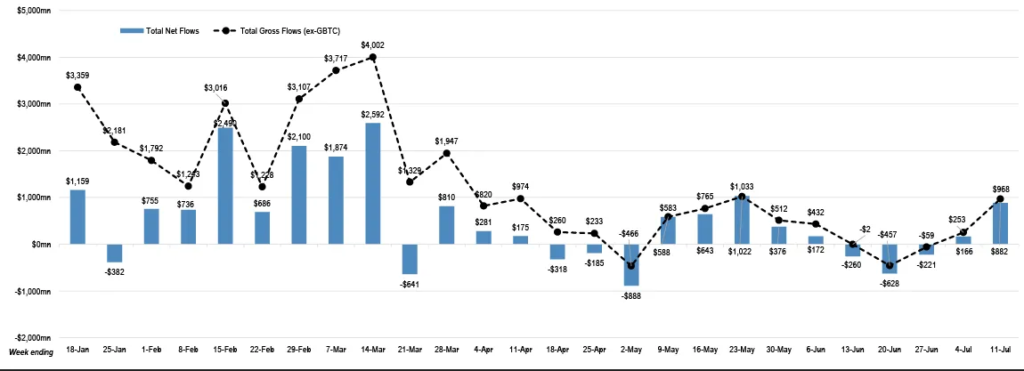
Weekly Net Flows into Digital Asset Investment Products (USD)
This chart should visualize the sharp contrast between the ~$1.7B weekly outflows seen earlier and the most recent ~$190M outflow, highlighting the deceleration trend.
AUM Decline: Reset, Not Collapse
CoinShares also reported that total assets under management across digital asset investment products declined to approximately $129.8 billion. This marks the lowest level since March 2025, when markets were shaken by macroeconomic uncertainty following tariff policy announcements in the United States.
Importantly, this contraction in AUM reflects both price depreciation and net outflows. While this might appear negative at first glance, seasoned market participants often interpret such resets as structural clean-ups rather than systemic breakdowns.
For builders and operators in the blockchain space, lower AUM environments tend to coincide with:
- Reduced speculative noise
- Increased focus on utility-driven protocols
- Greater willingness among investors to evaluate fundamentals
This environment can be fertile ground for projects emphasizing real-world use cases, revenue generation, or infrastructure-level innovation.
Record-Breaking Trading Volumes: A Contradiction That Matters
One of the most striking data points in the report is that digital asset ETP trading volume reached an all-time high during the same week that AUM declined.
Notably, trading volumes exceeded even the levels recorded in October 2025, when Bitcoin reached its previous all-time high.
This apparent contradiction—lower AUM but higher trading volume—suggests intense repositioning rather than market abandonment. Investors are actively reallocating exposure, rotating between assets, strategies, and jurisdictions.
For sophisticated investors, high volume during corrections often signals distribution from weak hands to strong hands, or from passive exposure into more targeted bets.
Understanding ETPs: Why They Matter in This Cycle
ETPs (Exchange Traded Products) include ETFs and other listed investment vehicles that track crypto assets. Their importance has grown significantly because they:
- Provide regulated exposure for institutions
- Serve as the primary gateway for retirement funds and conservative allocators
- Aggregate sentiment across large pools of capital
When ETP volumes surge, it usually reflects institutional-level conviction or hedging activity, not retail speculation.
Asset-Level Flows: Capital Is Rotating, Not Leaving
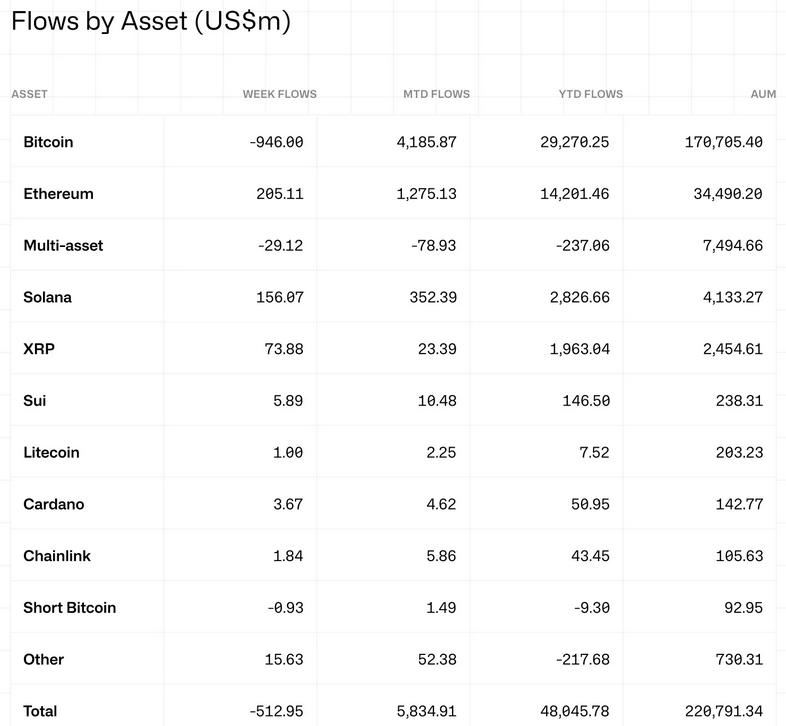
Net Flows by Asset (Year-to-Date)
Butterfill highlighted that while Bitcoin-linked products continued to experience net outflows, capital has clearly rotated into select altcoins.
- XRP has maintained its position as the most successful asset in terms of year-to-date inflows.
- Ethereum attracted steady inflows, reflecting its role as a settlement layer for DeFi, tokenization, and enterprise blockchain use.
- Solana also recorded net inflows, supported by its performance in high-throughput applications and consumer-facing crypto products.
This pattern suggests investors are seeking differentiated exposure, rather than exiting the asset class entirely.
What This Means for Opportunity Seekers
For readers interested in identifying the “next” crypto opportunity, this rotation carries several implications:
- Narrative diversification matters
Assets tied to payments, tokenization, or real-world integration are attracting capital. - Yield and utility are gaining priority
Pure price speculation is giving way to assets with staking, fee generation, or enterprise adoption narratives. - Infrastructure beats hype
Platforms enabling scalable, compliant, or low-cost blockchain usage are increasingly favored.
Geographic Flows: The Globalization of Crypto Capital
Net Flows by Country
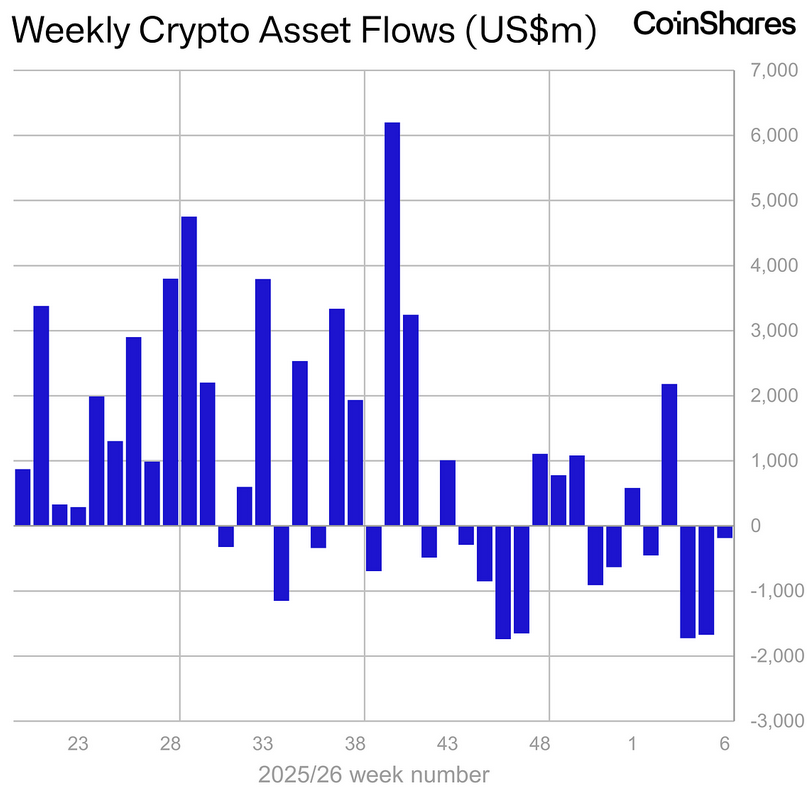
The report also reveals a notable geographic divergence in capital flows.
While the United States saw continued net outflows, several regions recorded net inflows:
- Germany
- Switzerland
- Canada
- Brazil
This trend reflects regulatory arbitrage, currency hedging behavior, and differing macroeconomic outlooks. In particular, jurisdictions with clearer regulatory frameworks or stronger local demand for alternative assets are attracting incremental capital.
For blockchain businesses, this reinforces the importance of jurisdiction-aware product design, including:
- Multi-currency settlement
- Local compliance readiness
- Regional liquidity partnerships
Strategic Interpretation: Is This the Bottom?
Butterfill stopped short of declaring a definitive market bottom. However, he emphasized that historically, similar flow dynamics have aligned with sentiment turning points.
From a strategic standpoint, the current environment suggests:
- Downside momentum may be weakening
- Selective accumulation is underway
- Capital is becoming more discerning, not more fearful
For investors, builders, and operators, this phase may represent a transition from macro-driven volatility to micro-driven opportunity selection.
Conclusion: A Market Reset, Not an Exit
The latest CoinShares data does not paint a picture of capitulation—it paints a picture of reallocation.
Slowing outflows, record trading volumes, asset-level rotation, and regional diversification all point to a market that is searching for its next equilibrium, not abandoning the crypto thesis.
For those seeking new crypto assets, alternative revenue streams, or practical blockchain applications, this period may be less about timing the exact bottom and more about positioning for the next structural wave—one driven by utility, compliance, and real-world integration rather than pure speculation.


