
Key Takeaways :
- The U.S. Commodity Futures Trading Commission (CFTC) has withdrawn its proposal to ban political contracts in decentralized prediction markets.
- The decision signals a regulatory shift toward supporting responsible innovation in derivatives and blockchain-based markets.
- Political and economic prediction markets are increasingly viewed as tools for price discovery and risk hedging rather than pure gambling.
- Sports-related prediction markets remain controversial, facing resistance from state regulators and traditional financial institutions.
- The evolving regulatory stance opens new opportunities for crypto-native platforms, tokenized derivatives, and practical blockchain applications.
1. Introduction: A Regulatory Turning Point for Prediction Markets
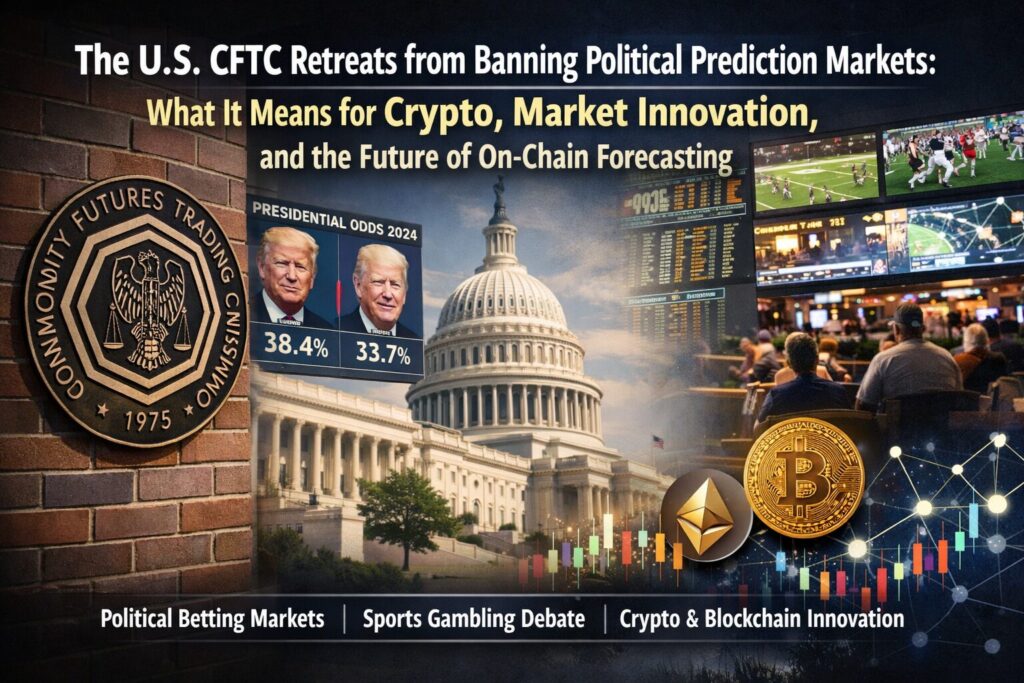
In early February 2026, the U.S. Commodity Futures Trading Commission (Commodity Futures Trading Commission, CFTC) announced a significant policy reversal: it formally withdrew its 2024 proposal to prohibit political event contracts in decentralized prediction markets. At the same time, the agency rescinded a 2025 staff advisory that had warned market participants about the regulatory risks of sports-related event contracts.
This decision represents more than a technical regulatory update. It marks a broader shift in how U.S. regulators view blockchain-based prediction markets—platforms that allow participants to express expectations about future events using crypto assets and smart contracts. For crypto investors, builders, and institutions searching for the next revenue source or practical blockchain use case, this development deserves close attention.
Prediction markets sit at the intersection of finance, data, governance, and decentralized infrastructure. Whether they are ultimately treated as gambling venues or as legitimate financial instruments will shape the future of on-chain derivatives, tokenized risk markets, and information-efficient capital allocation.
2. What Are Decentralized Prediction Markets?
Decentralized prediction markets are blockchain-based platforms that enable users to buy and sell positions tied to the outcome of future events. These events may include political elections, macroeconomic indicators, sports matches, or even regulatory decisions.
Well-known examples include Polymarket and Kalshi, both of which have attracted significant trading volume during election cycles and major economic events.
Unlike traditional betting platforms, decentralized prediction markets rely on:
- Smart contracts to automatically settle outcomes
- Crypto assets or tokenized USD equivalents for collateral
- Oracle systems to determine real-world outcomes
- Transparent, permissionless participation
Supporters argue that these markets generate valuable probability signals, often outperforming polls or expert forecasts. Critics counter that many contracts resemble gambling, especially when tied to elections or sports.
3. The 2024 Proposal: Politics as a “Sensitive Topic”
The now-withdrawn 2024 proposal emerged during the Biden administration, in the lead-up to the U.S. presidential election. It aimed to prohibit political and other “sensitive” event contracts in prediction markets.
The rationale was twofold:
- Political contracts could undermine democratic processes or public trust.
- Prediction markets might be misused for speculative gambling rather than risk management.
This approach effectively sought a blanket ban, regardless of whether a contract served a legitimate hedging or informational purpose. Industry participants criticized the proposal as overly broad and arbitrary, arguing that it conflated speculation with market-based forecasting.
CFTC Chairman Michael Selig later described the proposal as an example of politically motivated regulation that failed to reflect the realities of modern derivatives markets.
4. Why the CFTC Changed Course
By withdrawing the proposal, the CFTC signaled a return to a more principles-based regulatory philosophy. According to official statements, future rules will be grounded in:
- A consistent interpretation of the Commodity Exchange Act
- Congressional intent regarding derivatives markets
- The promotion of responsible innovation
This shift aligns with a growing recognition among regulators that decentralized markets are not going away—and that clarity is more effective than prohibition.
The withdrawal of the 2025 sports advisory was also telling. The advisory had warned registered entities—such as futures commission merchants and exchanges—about legal risks tied to sports contracts. However, the CFTC later acknowledged that the guidance created confusion rather than certainty.
5. Prediction Markets as Financial Infrastructure
Beyond politics, prediction markets increasingly resemble financial instruments used for risk assessment and hedging. For example:
- Inflation-linked prediction markets can help investors hedge macroeconomic risk.
- Election outcome markets may influence currency, bond, or equity positioning.
- Policy-related contracts can offer early signals about regulatory shifts.
From a blockchain perspective, these markets represent a practical use case for:
- On-chain derivatives
- Oracle networks
- Stablecoin settlement
- Compliance-aware smart contracts
This positions prediction markets as potential building blocks for a new class of decentralized financial infrastructure, rather than fringe gambling products.
6. Ongoing Controversy: Sports-Related Prediction Markets
Despite the regulatory softening, sports-related markets remain highly contentious.
Several U.S. state regulators have taken enforcement actions, arguing that sports event contracts violate state-level gambling laws. A notable example involves Coinbase, which was recently sued by Nevada’s gaming regulator over sports-related event contracts.
According to Coinbase’s Chief Legal Officer Paul Grewal, a Nevada district court rejected an attempt to shut down the service without a hearing. The case is expected to move to federal court, highlighting the unresolved tension between state gambling laws and federal derivatives regulation.
This legal fragmentation creates uncertainty for platforms attempting to operate nationwide.
7. Traditional Finance Pushback
Traditional financial institutions remain cautious. On February 5, Rick Wurster, CEO of Charles Schwab, publicly distinguished between economic prediction markets and sports betting.
While acknowledging the value of markets tied to inflation or financial indicators, he stated that sports betting conflicts with Schwab’s mission. His remarks underscore a broader industry view: not all prediction markets are created equal.
This distinction may prove crucial in shaping future regulatory frameworks.
8. Market Trends and Recent Developments
Recent trends suggest growing institutional and retail interest in non-sports prediction markets:
- Increased volume in election and macroeconomic contracts
- Integration of prediction markets with DeFi protocols
- Experiments with DAO governance using prediction signals
- Rising demand for compliance-friendly, KYC-enabled platforms
Regulators are also moving toward coordination. The CFTC and the Securities and Exchange Commission have announced joint efforts—sometimes referred to as “Project Crypto”—to harmonize oversight of digital asset markets.
This suggests that prediction markets may soon benefit from clearer, cross-agency regulatory guidance.
9. Implications for Crypto Investors and Builders
For readers seeking new crypto assets or revenue opportunities, the implications are clear:
- Platforms enabling compliant prediction markets may see renewed growth.
- Tokenized event contracts could evolve into a new asset class.
- Infrastructure providers (oracles, settlement layers, compliance tooling) stand to benefit.
- Jurisdictional arbitrage will remain a factor, but clarity is improving.
From a practical blockchain standpoint, prediction markets demonstrate how decentralized systems can process real-world uncertainty in a transparent, market-driven way.
10. Conclusion: From Prohibition to Pragmatism
The CFTC’s decision to withdraw its ban proposal marks a pivotal moment for prediction markets and the broader crypto ecosystem. Rather than treating these platforms as regulatory anomalies, U.S. authorities are beginning to recognize their potential as legitimate financial tools—provided they are designed and governed responsibly.
While sports-related markets remain a battleground, political and economic prediction markets are increasingly viewed as engines of price discovery and insight. For investors, builders, and institutions exploring the next phase of blockchain adoption, prediction markets may represent one of the most compelling—and practical—frontiers ahead.


