

Main Points :
- Bitcoin spot ETFs recorded nearly $1 billion in net outflows over two days, signaling a sharp shift in short-term market sentiment.
- The outflows coincided with Bitcoin briefly touching $60,000, its lowest level since October 2024.
- Critics argue that ETFs may be transforming Bitcoin into a form of “paper Bitcoin,” weakening its scarcity narrative.
- Despite the sell-off, total assets under management (AUM) of Bitcoin ETFs remain historically large, suggesting structural resilience.
- Altcoin ETFs show mixed behavior, with Ethereum seeing outflows, while XRP and Solana ETFs recorded modest inflows.
- For investors and builders, the episode highlights the growing importance of market structure, liquidity layers, and custody choices.
1. Bitcoin ETF Outflows: What Happened and Why It Matters
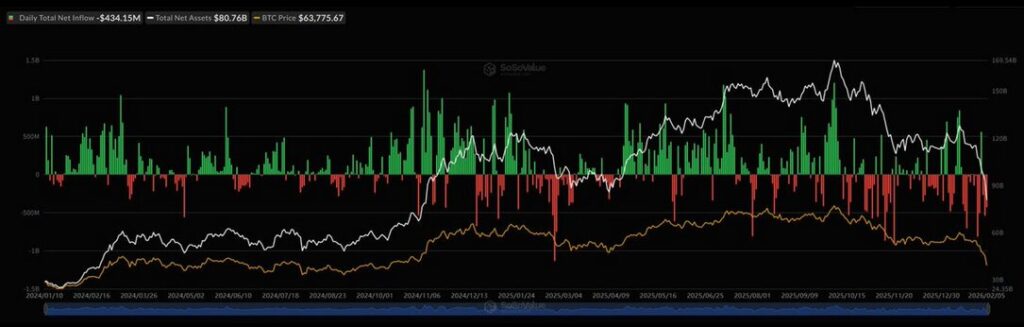
Bitcoin spot exchange-traded funds (ETFs) experienced another day of heavy capital outflows on Thursday, extending a sharp reversal that has now erased nearly $1 billion in assets over just two trading days. According to data from SoSoValue, Bitcoin spot ETFs recorded $434 million in net outflows on Thursday, following $545 million in redemptions the previous day.
Earlier in the week, Monday saw a notable $561 million inflow, but that rebound proved insufficient to offset subsequent losses. As a result, by Friday, weekly net flows had turned decisively negative, reaching approximately $690 million in net outflows.
This abrupt shift matters because Bitcoin ETFs have become one of the most influential demand channels in the market since their approval in January 2024. Unlike earlier bull and bear cycles dominated by retail exchanges, derivatives platforms, or offshore liquidity, ETF flows now act as a visible, institutionally driven signal that both traders and long-term allocators closely monitor.
【Bitcoin ETF Net Flows (Daily)】
2. Price Shock and Timing: Bitcoin Falls to $60,000
The ETF outflows coincided with a sharp decline in Bitcoin’s price, which briefly touched $60,000, marking its first test of that level since October 2024. While the market had already shown signs of weakening momentum, the speed of the decline surprised many participants.
Notably, there has been no single, clearly identifiable macro or crypto-specific trigger. No major regulatory announcement, exchange failure, or protocol-level incident directly preceded the drop. Instead, analysts point to a combination of crowded positioning, profit-taking, and reflexive selling tied to ETF redemptions.
In modern crypto markets, ETFs do not merely reflect price movements—they can actively amplify them. When prices fall, ETF holders redeem shares, forcing authorized participants to sell underlying Bitcoin. That selling pressure, in turn, pushes prices lower, creating a feedback loop that did not exist in earlier cycles.
3. Are Bitcoin ETFs “Paper Bitcoin”?
As the sell-off intensified, criticism of Bitcoin ETFs resurfaced within the crypto community. A recurring argument is that ETFs represent a form of “paper Bitcoin”, similar to how gold ETFs are often accused of diluting the physical gold market.
The concern is structural rather than conspiratorial. Bitcoin’s core value proposition rests on its fixed supply of 21 million coins and the ability of individuals to self-custody their assets. ETFs, by contrast, abstract ownership into shares, custodians, and settlement layers that resemble traditional financial instruments.
Some analysts argue that this financialization allows the same underlying Bitcoin to support multiple layers of claims—ETF shares, futures contracts, perpetual swaps, options exposure, broker loans, and structured products—all simultaneously. In this view, Bitcoin begins to resemble a fractional reserve system, rather than a strictly scarce digital commodity.
This critique echoes earlier warnings from hardware wallet analysts and long-time Bitcoin advocates, who cautioned that institutional products could create synthetic supply and suppress price discovery in stressed conditions.
4. Counterargument: ETFs Are More Resilient Than Critics Claim
Despite these criticisms, other analysts emphasize that Bitcoin ETFs have, so far, demonstrated surprising resilience. Even after the recent outflows, total assets under management remain around $81 billion, with cumulative net inflows of approximately $54.3 billion since launch.
From this perspective, the recent redemptions represent a cyclical correction, not a structural failure. Institutions rebalance portfolios, lock in profits, and respond to risk-off signals just like any other market participant. Importantly, the ETF structure ensures transparency—flows are visible, reported daily, and subject to regulatory oversight.
Moreover, ETFs have significantly expanded Bitcoin’s investor base, enabling pension funds, RIAs, and corporate treasuries to gain exposure without navigating custody, private keys, or on-chain operational risks. For many allocators, ETFs are not a speculative instrument but a compliance-compatible access layer.
5. Altcoin ETFs: Diverging Signals Beneath the Surface
While Bitcoin ETFs experienced heavy outflows, altcoin ETFs presented a more nuanced picture. Ethereum spot ETFs recorded $80.8 million in net outflows, reflecting similar pressure as investors reduced exposure to risk assets more broadly.
However, ETFs linked to XRP and Solana showed modest net inflows of $4.8 million and $2.8 million, respectively. Although small in absolute terms, these inflows are symbolically important. They suggest that some capital is selectively rotating rather than exiting the crypto asset class entirely.
【Crypto ETF Flows by Asset】
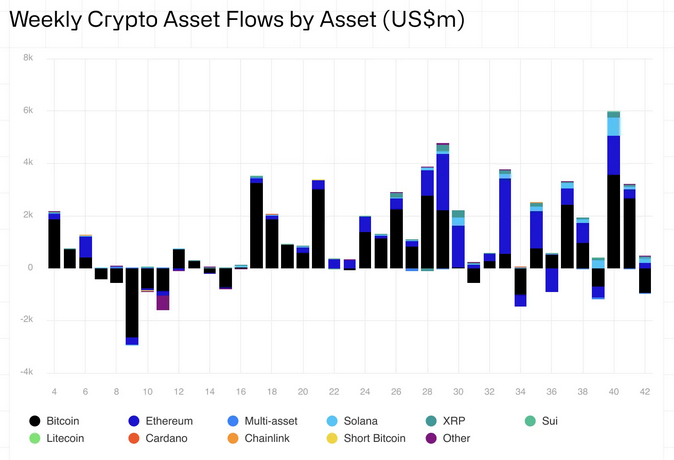
For investors searching for the “next opportunity,” this divergence highlights an important shift: ETF capital is no longer monolithic. Market participants are increasingly differentiating between assets based on regulatory clarity, use cases, and perceived upside asymmetry.
6. Implications for Investors Seeking New Crypto Opportunities
For readers exploring new digital assets or alternative revenue streams, the recent ETF-driven volatility offers several lessons.
First, liquidity structure matters. Assets heavily embedded in institutional plumbing can experience faster, sharper moves during stress. This does not make them weaker—but it does change their behavior.
Second, self-custody remains a strategic choice. ETFs offer convenience, but they also distance investors from the underlying network. Builders and long-term holders should understand how custody decisions affect risk, yield opportunities, and participation in on-chain ecosystems.
Third, the emergence of altcoin ETFs—even in limited form—signals that institutional attention is broadening. Projects with real-world utility, payment integration, or settlement relevance may benefit disproportionately as regulatory frameworks mature.
7. Practical Blockchain Use and the Next Phase of Market Evolution
Beyond price action, this episode underscores a broader transition in crypto markets: from a purely speculative arena to a multi-layered financial system. ETFs, derivatives, on-chain finance, and traditional banking interfaces are increasingly interconnected.
For businesses and developers, this creates both challenges and opportunities. Systems must be designed to operate across custodial and non-custodial environments, to handle volatility driven by off-chain instruments, and to communicate value propositions clearly to users who may never touch a private key.
The next growth phase of blockchain adoption is likely to be shaped less by narrative hype and more by infrastructure robustness, compliance compatibility, and real economic integration.
8. Conclusion: A Stress Test, Not an Endgame
The recent Bitcoin ETF outflows and price decline represent a meaningful stress test for the post-ETF crypto market—but not a verdict on its long-term viability. ETFs have introduced new feedback loops, new risks, and new forms of market psychology. They have also unlocked unprecedented access and capital depth.
For investors, the key is not to ask whether ETFs are “good” or “bad,” but to understand how they reshape market dynamics. For builders, the challenge is to design systems that remain resilient regardless of whether demand arrives via wallets, exchanges, or Wall Street vehicles.
As crypto continues to mature, episodes like this will become more common—and more instructive. Those who understand the structure beneath the headlines will be best positioned to identify the next wave of sustainable opportunities.


