

Main Points :
- Bitcoin whale and shark wallets (10–10,000 BTC) now control the smallest share of supply in nine months, according to Santiment
- Over 81,000 BTC were distributed by large holders within just eight days, coinciding with a sharp price decline
- Market sentiment has collapsed into extreme fear territory, reaching levels not seen since mid-2022
- Retail investors are aggressively accumulating BTC even as large holders reduce exposure
- Historical cycles suggest this pattern often defines late-stage bearish phases—but also seeds the next structural recovery
- For builders and investors, this environment reshapes how risk, opportunity, and real-world blockchain use should be evaluated
1. A Rare Shift in Bitcoin Supply Control
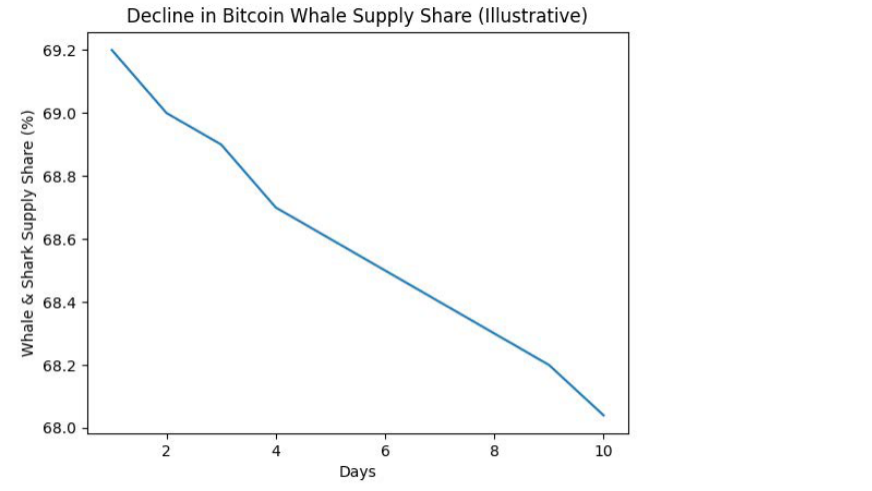
According to crypto analytics firm Santiment, the share of Bitcoin supply controlled by so-called “whale and shark wallets”—addresses holding between 10 and 10,000 BTC—has fallen to its lowest level in approximately nine months. As of the latest data, these large holders collectively control about 68.04% of total Bitcoin supply, a notable decline from earlier in the year.
This level was last seen in late May, a period that coincided with Bitcoin reclaiming the $100,000 level for the first time in roughly three months. At that time, optimism was returning to the market, institutional narratives were strengthening, and liquidity conditions appeared more favorable.
What makes the current decline especially important is the speed of distribution. Santiment reports that 81,068 BTC were released from whale and shark wallets over just eight days. During the same period, Bitcoin’s price fell from approximately $90,000 to $65,000, representing a drawdown of nearly 27%.
This is not merely a passive rebalancing. It reflects a meaningful change in behavior among the largest market participants.
[Decline in Bitcoin Whale Supply Share]
2. Why Whale Behavior Matters More Than Price Alone
In crypto markets, whale behavior is closely watched because large holders often act as liquidity setters, not just price takers. Their actions can signal:
- Perceived market tops
- Risk-off positioning due to macro uncertainty
- Capital rotation into other assets or yield strategies
- Internal risk controls at funds, desks, or treasuries
When whales distribute into strength, it often indicates profit-taking. When they distribute into weakness, it may suggest deeper caution—or forced deleveraging.
Historically, periods of declining whale dominance have tended to increase price volatility. With fewer coins locked in long-term large wallets, circulating supply becomes more sensitive to short-term sentiment, derivatives positioning, and retail flows.
Importantly, this does not automatically mean Bitcoin is “doomed.” Instead, it often signals a transition phase between market regimes.
3. Extreme Fear Returns to the Crypto Market
The behavioral shift among large holders is occurring alongside a dramatic collapse in overall market sentiment.
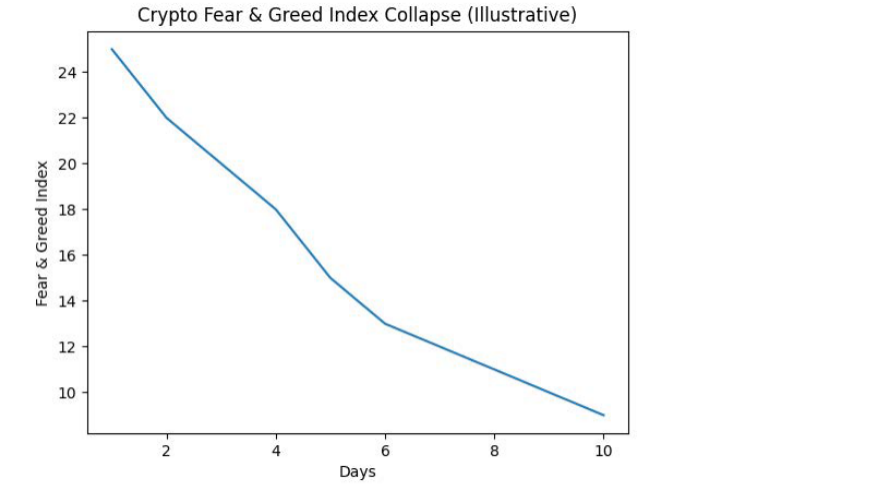
The widely followed Crypto Fear & Greed Index dropped to 9, placing the market deep into “extreme fear” territory. This level has not been seen since mid-2022, during the aftermath of the Terra/Luna blockchain collapse and the cascading failures that followed.
[Crypto Fear & Greed Index Collapse]
At such levels, participants are typically driven less by valuation models and more by loss aversion. Liquidity dries up, leverage is reduced, and narratives shift from growth to survival.
CryptoQuant CEO Ki Young Ju captured this mood succinctly when he posted that “now every Bitcoin analyst has turned bearish.”
From a cyclical perspective, this unanimity itself becomes a signal.
4. Retail Investors Are Moving in the Opposite Direction
While whales are reducing exposure, smaller holders are doing the opposite.
Santiment data shows that addresses holding less than 0.1 BTC, often referred to as “shrimp wallets,” have reached their highest count in roughly 20 months. These wallets now collectively hold approximately 0.249% of total Bitcoin supply, equivalent to around 52,290 BTC.
The last time shrimp wallet growth reached similar levels was June 2024, when Bitcoin traded near $66,000. In the following months, the price fell to around $53,000 by August.
This pattern—large holders selling while retail accumulates—has historically been associated with bear-market extensions rather than immediate recoveries.
However, it is also important to note what followed next. By December 2024, amid renewed political and macro optimism after the U.S. presidential election, Bitcoin surged to $100,000 for the first time in history.
Retail accumulation, while painful in the short term, often lays the foundation for the next cycle.
5. Is This Capitulation—or Preparation?
The key strategic question is whether current whale behavior represents:
- Final capitulation before a structural bottom, or
- Early risk reduction ahead of a longer consolidation phase
There are arguments on both sides.
On the bearish side:
- Whale distribution is fast and broad-based
- Macro uncertainty remains elevated
- Liquidity conditions are tightening globally
- Retail optimism may be premature
On the constructive side:
- Forced selling often clusters near local bottoms
- Extreme fear historically precedes strong medium-term returns
- Bitcoin supply continues to decentralize
- Long-term holders remain largely intact
From a systems perspective, Bitcoin is doing what it has done in every cycle: redistributing coins from concentrated holders to a broader base of participants.
This process is uncomfortable, but structurally healthy.
6. Implications for Investors Seeking the “Next Opportunity”
For readers searching for new crypto assets or yield opportunities, this environment changes how risk should be approached.
Rather than chasing momentum, the focus shifts to:
- Balance sheet resilience
- Cash-flow-generating protocols
- Infrastructure rather than speculation
- Assets with real economic throughput
Historically, periods of extreme fear have been when:
- Layer-2 scaling solutions quietly gained traction
- Stablecoin infrastructure expanded
- Payment rails, custody, and compliance tooling matured
- Builders, not traders, defined the next cycle
This is often when the real work of blockchain adoption happens.
7. Practical Blockchain Use Thrives in Bearish Conditions
While price narratives dominate headlines, actual blockchain usage tends to grow during downturns.
Examples include:
- Cross-border settlement using stablecoins
- Treasury management with on-chain transparency
- Tokenized representations of real-world assets
- Compliance-friendly wallets and reporting systems
Whale distribution can be interpreted as capital moving from speculative positioning into operational deployment—whether on-chain or off-chain.
For companies, fintech operators, and developers, this is often when long-term partnerships are formed and production systems are built.
8. What History Suggests Comes Next
Bitcoin cycles rarely end in euphoria or despair alone. They end in exhaustion.
When:
- Whales have largely de-risked
- Retail conviction has been tested
- Sentiment indicators reach extreme lows
- Volatility compresses after panic
The market quietly resets.
This does not guarantee an immediate price recovery. It does, however, increase the probability that the next major trend begins forming beneath the surface, long before headlines turn optimistic again.
Conclusion: Redistribution Is the Hidden Signal
The decline in Bitcoin whale supply dominance is not just a statistic—it is a structural signal.
It tells us that:
- Power within the network is shifting
- Risk is being repriced, not eliminated
- Short-term fear is masking long-term evolution
For those focused on the next generation of crypto returns and practical blockchain applications, this is not a time to disengage—but a time to observe carefully, build selectively, and position intelligently.
Bitcoin has always moved forward not when confidence was highest, but when conviction quietly survived doubt.


