
Main Takeaways :
- A US congressional investigation into World Liberty Financial (WLF) highlights the growing intersection of political power, sovereign capital, and decentralized finance.
- A $500 million UAE-backed investment tied to political figures raises questions about conflicts of interest, national security, and crypto governance.
- The use of a project-issued stablecoin (USD1) in a $2 billion Binance-related transaction signals a new phase of stablecoins as political-financial infrastructure, not just payment tools.
- For builders and investors, this case offers practical lessons on regulatory risk, governance design, and capital strategy in the coming crypto cycle.
1. Introduction: When DeFi Meets Geopolitics
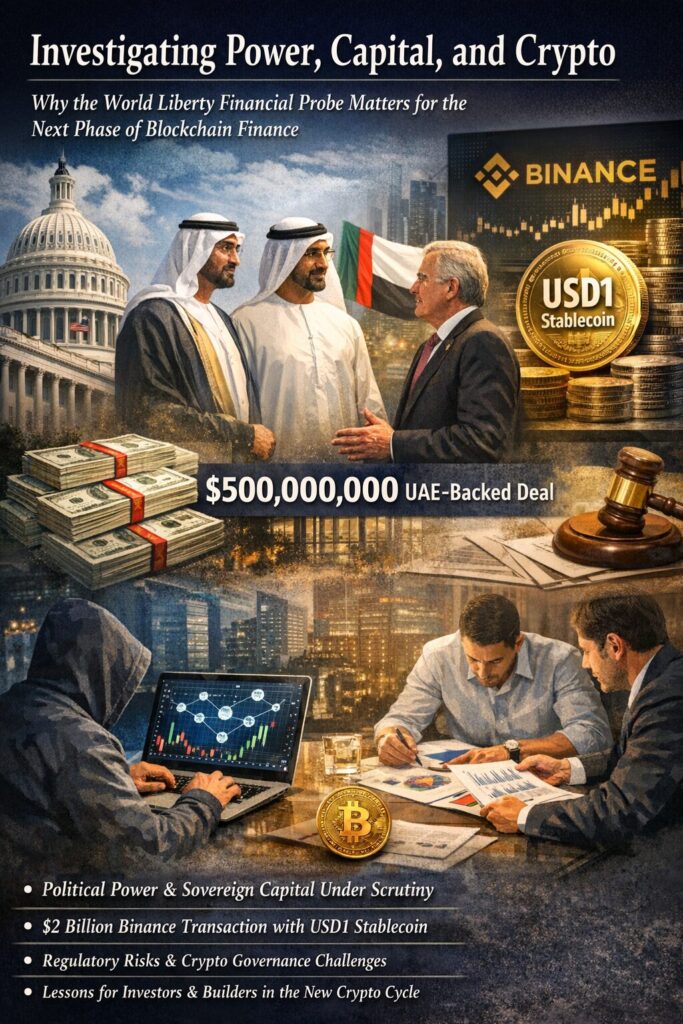
In early February 2026, US Congressman Ro Khanna announced the launch of a formal investigation into World Liberty Financial (WLF), a decentralized finance project reportedly linked to the family of US President Donald Trump.
At the center of the inquiry is a $500 million investment allegedly backed by Sheikh Tahnoun bin Zayed Al Nahyan, a senior member of the UAE royal family, in exchange for 49% equity in WLF. The timing—just days before Trump’s inauguration—has intensified scrutiny.
This is not merely a political scandal. It is a stress test for crypto’s integration into global power structures, involving sovereign wealth, stablecoins, and strategic competition between the United States and China.
For crypto-native founders, institutional investors, and infrastructure builders, the WLF case offers a rare, real-world example of how blockchain projects can become entangled with state-level interests—and what risks and opportunities emerge as a result.
2. What Is World Liberty Financial?
World Liberty Financial positions itself as a next-generation DeFi platform focused on liquidity provision, cross-border capital efficiency, and stablecoin-based settlement. While technical details remain partially undisclosed, WLF is known for issuing its own US dollar–denominated stablecoin, USD1.
Unlike purely community-driven DeFi protocols, WLF appears to follow a hybrid model:
- On-chain liquidity and token mechanics
- Off-chain corporate equity and strategic investors
- Strong branding tied to political and financial elites
This structure is increasingly common among “institutional DeFi” projects seeking rapid scale, but it also introduces governance and compliance complexity.
3. The $500 Million UAE Investment: Structure and Timing
According to reporting by the Wall Street Journal, the transaction under investigation involved:
- $500 million invested into WLF
- 49% ownership stake granted to UAE-backed interests
- Execution four days before Trump’s presidential inauguration
Congressman Khanna argues that such a transaction, involving a foreign royal family and a project linked to a sitting president’s family, creates a material risk of policy influence.
Specifically, he raised concerns that US policy decisions—particularly those restricting advanced AI chip exports to China—could have been implicitly influenced by private financial interests.
Why This Matters Beyond Politics
From a crypto-industry perspective, this highlights a critical issue:
When DeFi projects accept sovereign or politically exposed capital, they may inherit geopolitical risk.
4. National Security, China, and Strategic Competition
Khanna serves as a ranking member of the US House Select Committee on Strategic Competition with the Chinese Communist Party. In his view, any weakening of US technology export controls could:
- Undermine US competitiveness
- Enable China’s access to advanced AI infrastructure
- Increase long-term national security risks
By linking WLF’s financing to potential policy shifts, the investigation reframes crypto not as a fringe financial system, but as a potential lever in global strategic competition.
This represents a broader trend: blockchain infrastructure is increasingly seen as strategic infrastructure, akin to payments networks or cloud computing.
5. The Binance Connection and the Role of USD1
The investigation also examines WLF’s relationship with Binance, the world’s largest crypto exchange by volume.
Khanna points to a separate transaction in which MGX, led by Sheikh Tahnoun, invested $2 billion into Binance. Notably, this transaction allegedly used USD1, WLF’s stablecoin, as the settlement medium.
This raises several unprecedented questions:
- Why was a project-issued stablecoin used instead of USDC or USDT?
- What governance or redemption guarantees backed USD1 at that scale?
- Was USD1 used to bootstrap legitimacy and circulation through political channels?
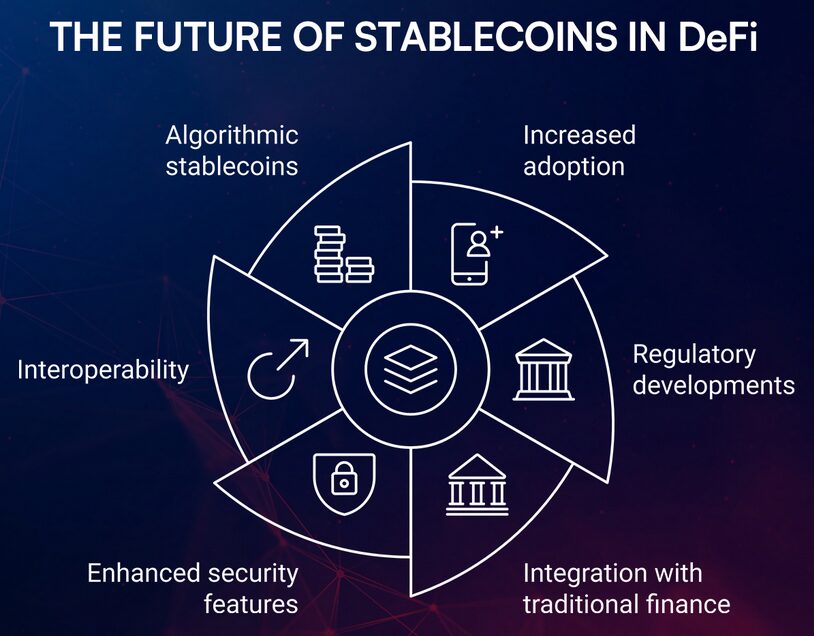
Stablecoin Settlement Flow Diagram
6. Presidential Pardons and Perceived Favoritism
Khanna further referenced the presidential pardon granted to Changpeng Zhao, Binance’s co-founder, after Trump returned to office.
While no direct illegality has been proven, the optics are problematic:
- A stablecoin linked to Trump’s family
- Used in a Binance-related transaction
- Followed by a presidential pardon for Binance’s founder
For regulators, this pattern triggers concerns about regulatory capture.
For crypto entrepreneurs, it demonstrates how perception alone can become a material risk factor.
7. Legal Scope of the Investigation
Khanna has formally requested responses to 16 detailed questions, with a deadline of March 1, 2026. The investigation examines potential violations of:
- US federal ethics laws
- Foreign influence and disclosure requirements
- Constitutional provisions related to emoluments
Even if no laws are ultimately broken, the process itself can impose:
- Reputational damage
- Counterparty risk
- Exchange and banking de-risking
8. Market Reaction and Broader Crypto Trends
Interestingly, the investigation did not trigger a broad crypto sell-off. Instead, market response has been selective:
- Increased scrutiny of politically affiliated projects
- Renewed interest in transparent, overcollateralized stablecoins
- Stronger demand for jurisdictionally neutral DeFi protocols
This aligns with broader 2025–2026 trends:
- Institutional capital entering crypto via structured, compliant vehicles
- Governments treating stablecoins as monetary instruments
- Builders prioritizing governance clarity over narrative hype
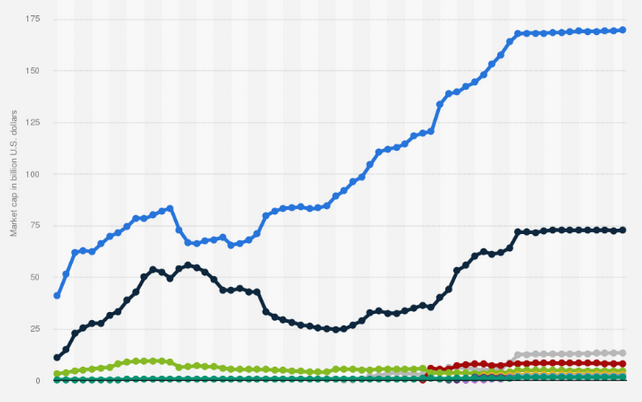
Capital Flow Shift in Crypto (2024–2026)
9. Practical Lessons for Builders and Investors
For readers seeking new crypto assets or revenue opportunities, the WLF case offers concrete takeaways:
- Capital Source Matters
Sovereign or politically exposed investors can accelerate growth—but also amplify regulatory risk. - Stablecoins Are No Longer Neutral
Issuing a stablecoin now implies responsibilities similar to a financial institution, not a startup. - Governance Is a Product Feature
Transparent decision-making and disclosure are becoming competitive advantages. - Regulatory Optics Can Kill Momentum
Even unproven allegations can freeze partnerships and listings.
10. Conclusion: A Preview of Crypto’s Next Reality
The investigation into World Liberty Financial is not just about one project or one political family. It is a preview of crypto’s next reality—where decentralized systems intersect with sovereign capital, national security, and global power politics.
For builders, this means designing protocols that can withstand legal, political, and reputational stress.
For investors, it means evaluating not just tokenomics, but who stands behind the capital.
For the industry as a whole, it signals that crypto has finally grown large enough to matter at the highest levels of government.
The next phase of blockchain finance will not be defined solely by code—but by how that code interacts with the real world.


