
Main Takeaways :
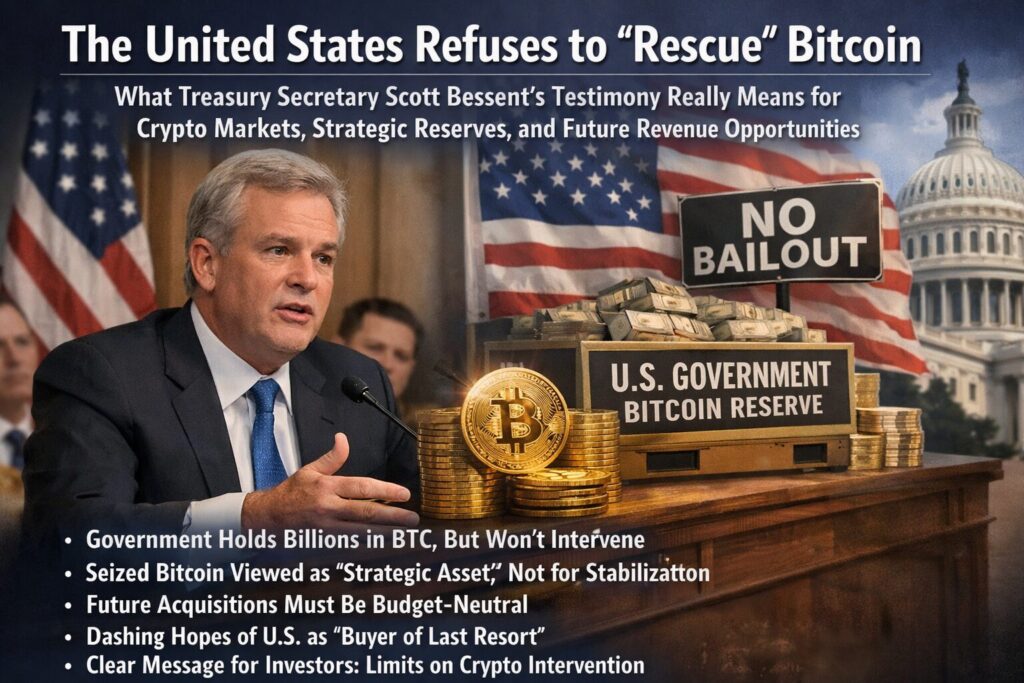
- The U.S. government will not intervene in Bitcoin markets during downturns, even as it holds billions of dollars’ worth of BTC.
- Confiscated Bitcoin is treated as a passive strategic asset, not a tool for market stabilization.
- Any future U.S. Bitcoin acquisition must be budget-neutral, ruling out open-market purchases.
- This stance contrasts sharply with expectations of Bitcoin advocates who envisioned the U.S. as an active BTC buyer of last resort.
- For investors and blockchain operators, this policy clarifies where opportunities and limits lie in the next phase of crypto adoption.
1. Congressional Testimony That Reset Expectations
In a closely watched congressional hearing, U.S. Treasury Secretary Scott Bessent made one point unmistakably clear:
the United States will not “rescue” Bitcoin.
While the U.S. government will continue to hold Bitcoin obtained through asset forfeiture, it will not instruct private banks to buy Bitcoin during market crashes, nor will it alter banking reserve requirements to support crypto prices. This statement directly addressed growing speculation that Washington might quietly backstop Bitcoin in the same way it has supported traditional financial markets in past crises.
The question came from Brad Sherman, a long-time critic of cryptocurrencies. Sherman asked whether the Treasury, or even the Federal Open Market Committee (FOMC), had any authority to stabilize Bitcoin markets or encourage banks to acquire BTC — including politically themed meme assets sometimes referred to as “Trump Coins.”
Bessent’s response was blunt:
“I am the Secretary of the Treasury, and I do not have that authority. Nor do I have it as Chair of the Financial Stability Oversight Council.”
This single sentence effectively dismantled lingering hopes of a U.S.-led Bitcoin bailout.
2. The Reality of the U.S. Government’s Bitcoin Holdings
Despite refusing to intervene in markets, the U.S. government is already one of the world’s largest Bitcoin holders.
According to Bessent’s testimony, Bitcoin seized through criminal and civil forfeiture — initially worth roughly $500 million — has appreciated to over $15 billion while in government custody. This dramatic increase underscores a key paradox:
the U.S. benefits from Bitcoin’s upside while refusing responsibility for its downside.
Growth of U.S. Government Bitcoin Holdings (Value in USD)
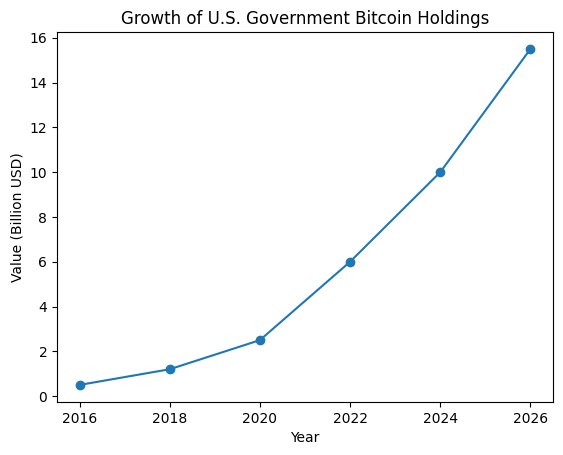
A line chart showing the appreciation from ~$0.5B to $15B+ over time.
Purpose: Visualize why Bitcoin has become strategically relevant even without active policy support.
This passive accumulation model treats Bitcoin more like confiscated gold than a monetary instrument. It is stored, safeguarded, and occasionally liquidated — but not actively managed to influence markets.
3. The Bitcoin Strategic Reserve: Symbolism Over Firepower
The testimony also revived debate around the Bitcoin Strategic Reserve, established by executive order from Donald Trump in March 2025.
At the time, many Bitcoin proponents believed this move signaled a dramatic shift:
the U.S. embracing Bitcoin as a core strategic asset, potentially rivaling gold or oil reserves.
The reality has been far more restrained.
The executive order explicitly limits additional Bitcoin acquisition to two cases:
- Asset forfeiture (criminal or civil seizures), or
- Budget-neutral mechanisms, meaning no new government spending.
This excludes the most bullish scenario imagined by the market — large-scale purchases on public exchanges.
4. What “Budget-Neutral” Actually Means
“Budget-neutral” sounds benign, but in practice it is highly restrictive.
Under this framework, the Treasury could theoretically:
- Convert existing reserve assets (such as gold or other commodities) into Bitcoin.
- Reallocate proceeds from asset sales without increasing total expenditures.
However, such actions would be politically explosive and operationally complex. Selling gold to buy Bitcoin would raise profound questions about monetary stability, risk tolerance, and intergenerational asset management.
As a result, no realistic path exists for aggressive BTC accumulation under current rules.
Allowed vs. Prohibited U.S. Bitcoin Acquisition Methods
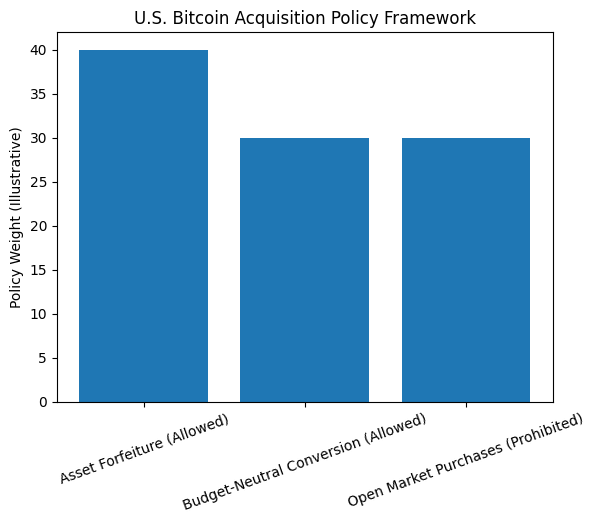
A flow diagram comparing “Asset Forfeiture” and “Budget-Neutral Conversion” (allowed) versus “Open Market Purchases” (prohibited).
5. Why the U.S. Chose Non-Intervention
From a policy perspective, this restraint is deliberate.
Intervening in Bitcoin markets would:
- Implicitly legitimize Bitcoin as systemically important.
- Create moral hazard, encouraging excessive risk-taking.
- Blur lines between decentralized assets and state-backed money.
For regulators, Bitcoin’s value proposition is precisely that it operates outside government guarantees. Supporting it during downturns would contradict years of regulatory messaging.
In short, the U.S. wants Bitcoin’s innovation — not its volatility on the federal balance sheet.
6. Market Impact: What This Means for Bitcoin Prices
Bitcoin advocates such as Samson Mow have argued that active U.S. purchases could:
- Drive sustained demand.
- Push prices materially higher.
- Encourage other nations to establish their own Bitcoin reserves.
Bessent’s testimony closes that door — at least for now.
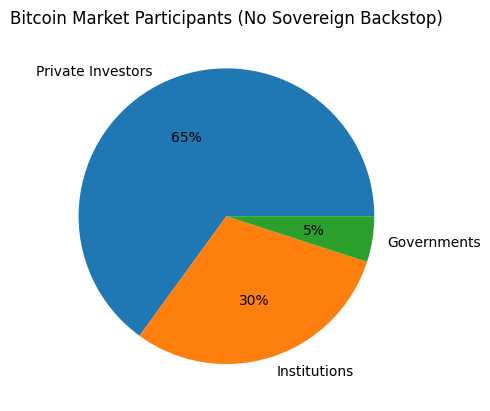
For markets, this means:
- No sovereign buyer of last resort.
- Price discovery remains driven by private capital.
- Volatility remains structurally intact.
Paradoxically, this may strengthen Bitcoin’s narrative as a non-sovereign asset, attractive precisely because it is not state-managed.
7. Implications for Investors Seeking New Revenue Streams
For readers seeking the “next opportunity,” the message is nuanced.
Bitcoin will not become a government-supported yield asset. But clarity reduces uncertainty.
Opportunities shift toward:
- Infrastructure plays (custody, compliance, analytics).
- Layer-2 and settlement solutions that integrate BTC into payments.
- Tokenization and hedging tools that operate independently of sovereign policy.
In other words, the upside lies not in betting on government rescue, but in building around Bitcoin’s neutrality.
8. Strategic Signals to Other Nations
Even without active buying, U.S. policy sends a powerful signal internationally.
By holding Bitcoin — but refusing to manipulate its market — the U.S. positions BTC as:
- A legitimate asset class.
- Not a monetary anchor.
- Not a tool of fiscal stimulus.
Other governments may follow a similar model: hold seized or legacy crypto assets, but avoid open endorsement.
This reinforces a two-track global system:
- States manage fiat and reserves.
- Markets manage crypto valuation.
9. Practical Lessons for Blockchain Operators
For builders and operators, especially those in payments, wallets, or compliance-heavy environments, the lesson is clear:
Do not design systems assuming sovereign backstops.
Instead:
- Design for volatility resilience.
- Build compliance-first architectures that can survive policy ambiguity.
- Focus on real utility, not speculative tailwinds.
Bitcoin’s future remains market-driven — and that favors disciplined operators over hype-driven speculation.
10. Conclusion: Bitcoin Grows Up, Without a Safety Net
Scott Bessent’s testimony was not anti-Bitcoin.
It was anti-illusion.
The United States will hold Bitcoin, benefit from its appreciation, and regulate its interfaces — but it will not save it from itself. For serious investors and builders, this is not bad news. It is maturity.
Bitcoin is being treated not as a rebel experiment, nor as a state currency, but as a neutral strategic asset whose value must be earned, not guaranteed.
That clarity, more than any bailout, may be what allows the next generation of crypto innovation — and revenue — to emerge.


