Main Points :
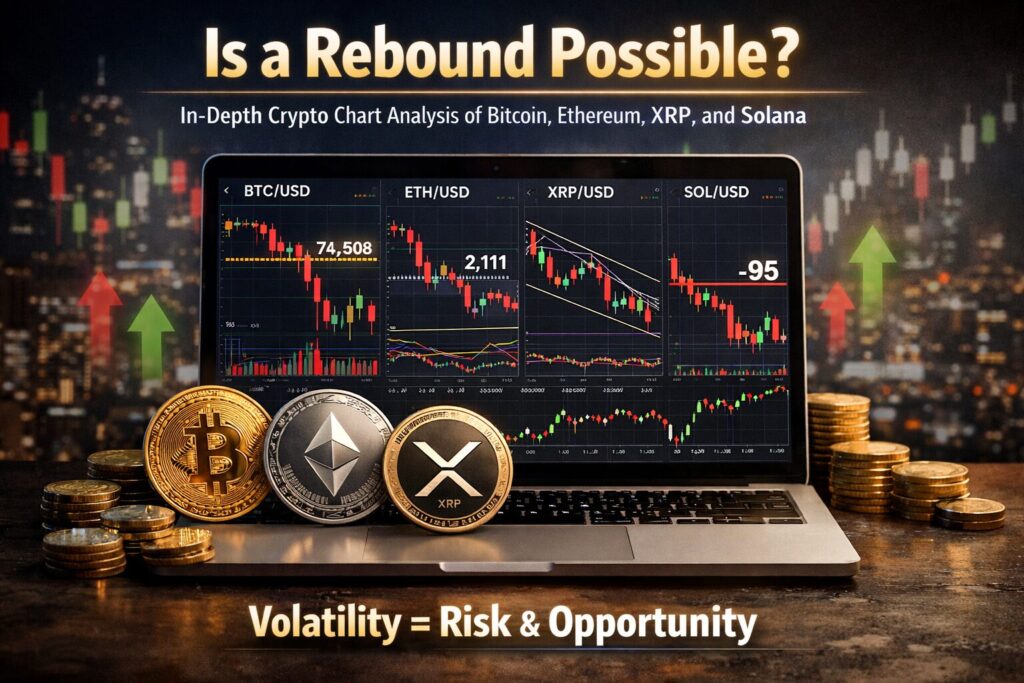
- Bitcoin is struggling to reclaim key support above $74,508, but oversold conditions raise the probability of a short-term rebound.
- Ethereum remains weak below $2,111, yet technical indicators suggest a relief rally is possible if buyers regain momentum.
- XRP is trapped in a descending channel, reflecting structural weakness despite intermittent rebounds.
- Solana faces a critical test below $95, where a breakdown could accelerate downside risk, while a recovery could signal a bear trap.
- For investors seeking new crypto assets, yield opportunities, or practical blockchain use, volatility is not only risk—but also opportunity.
1. Market Context: Why This Correction Matters
The current correction across major cryptocurrencies comes at a critical juncture for the digital asset market. Unlike prior speculative-driven pullbacks, this decline is occurring in an environment shaped by tighter global liquidity, evolving regulatory clarity, and increasing institutional participation.
For investors and operators searching for the next revenue stream—whether through trading, staking, DeFi integration, or payment infrastructure—understanding where prices may stabilize or reverse is essential. Technical analysis, while not predictive in isolation, provides actionable frameworks for managing risk and identifying asymmetric opportunities.
This article expands upon recent chart analyses of Bitcoin (BTC), Ethereum (ETH), XRP, and Solana (SOL), incorporating broader market dynamics and practical implications for crypto-focused businesses and investors.
2. Bitcoin (BTC): Oversold Pressure Meets Structural Support
Current Technical Situation
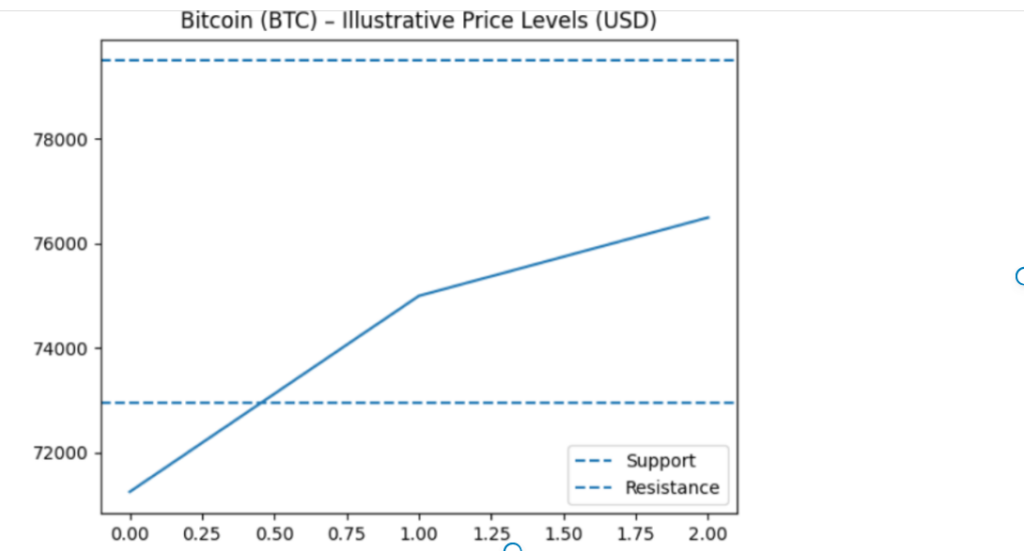
Bitcoin failed to hold above the critical support level of $74,508, signaling persistent selling pressure from bearish participants. This inability to sustain higher levels indicates that buyers remain cautious, even near historically significant zones.
If BTC decisively breaks below $72,945, it would confirm a continuation of the broader downtrend. In such a scenario, the next major support lies near $60,000, a psychologically and structurally important level where long-term buyers may re-enter.
RSI and Rebound Potential
The Relative Strength Index (RSI) has entered oversold territory, suggesting that selling pressure may be temporarily exhausted. Historically, such conditions often precede short-term relief rallies, even within broader bearish trends.
A daily close above $79,500 would strengthen bullish momentum and open the path toward $84,000, the origin point of the recent decline.
Bitcoin Technical Levels Chart
Practical Implications
For market participants:
- Traders may look for short-term mean reversion opportunities.
- Treasury and risk teams should prepare for volatility spikes if $72,945 fails.
- Businesses using BTC as collateral must reassess liquidation thresholds.
3. Ethereum (ETH): Weak Demand, But a Technical Window for Recovery
Price Action Overview
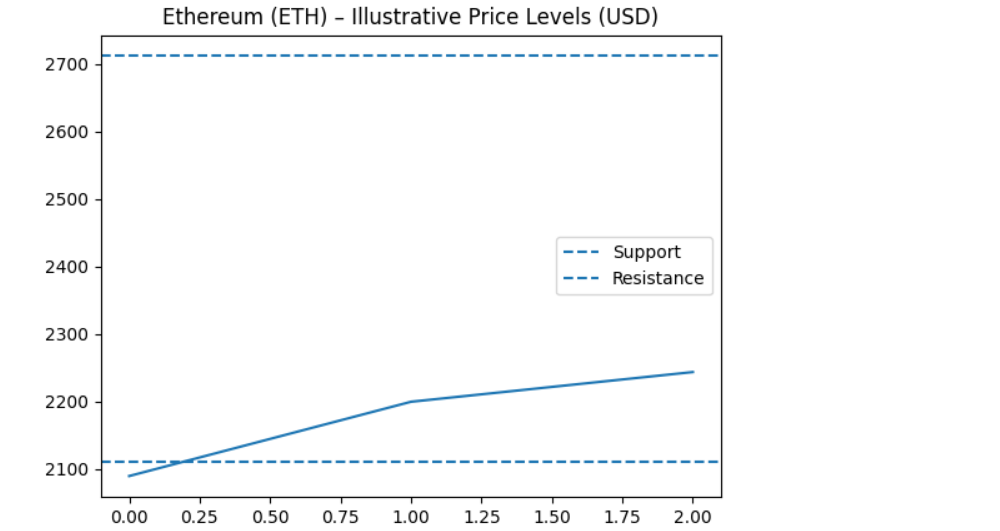
Ethereum found temporary support at $2,111, but the muted rebound indicates a lack of aggressive buying interest. Sellers continue attempting to push ETH below this level to resume the downtrend.
A confirmed breakdown would expose ETH to a sharp decline toward $1,750, a level that could trigger forced deleveraging across DeFi protocols.
Fibonacci and Moving Average Signals
Despite the weakness, ETH’s RSI is also deeply oversold. This opens the door for a rebound toward:
- $2,467 (38.2% Fibonacci retracement)
- $2,712 (20-day Exponential Moving Average)
A daily close above the 20-day EMA would suggest that bulls are regaining tactical control.
Ethereum Technical Levels Chart
Strategic Considerations
- DeFi operators should stress-test liquidity under $1,750 scenarios.
- Builders may find renewed interest if ETH stabilizes, especially in Layer 2 ecosystems.
- ETH volatility remains central to NFT and smart contract revenue models.
4. XRP: Structural Weakness Inside a Descending Channel
Market Structure
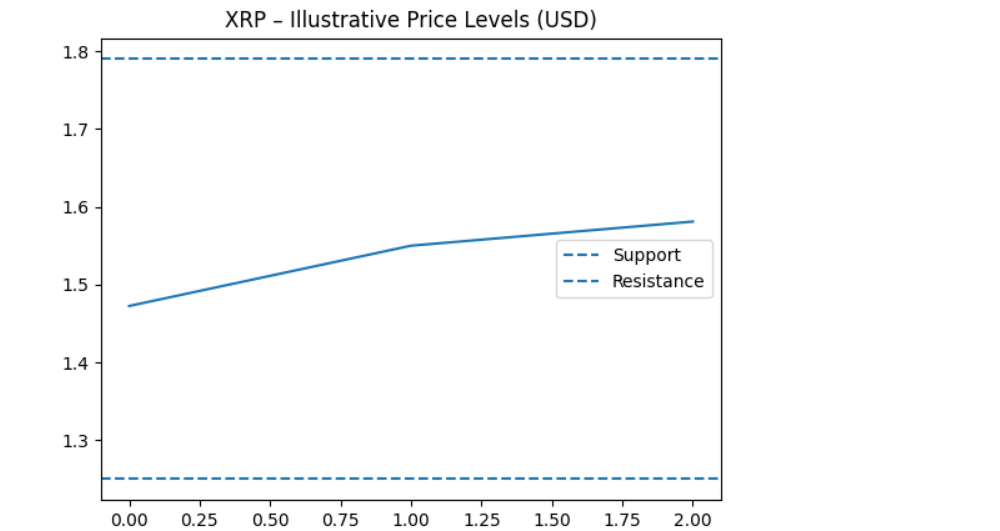
XRP’s failure to hold above $1.61 shows that bears are selling into every minor rally. Price action remains confined within a descending channel, reflecting sustained distribution rather than accumulation.
If sellers succeed in breaking the channel support, XRP may revisit $1.25, the low recorded on October 10, 2025.
Conditions for Stabilization
To reduce downside risk, XRP must reclaim the 20-day EMA at $1.79. A move above this level would likely result in continued consolidation within the channel rather than immediate trend reversal.
A breakout above the descending trendline would be the first meaningful signal of a short-term trend change.
XRP Technical Levels Chart
Use-Case Perspective
Despite price weakness, XRP continues to be relevant for:
- Cross-border settlement infrastructure
- Liquidity provisioning in payment corridors
However, price stability is crucial for enterprise adoption.
5. Solana (SOL): Bear Trap or Trend Breakdown?
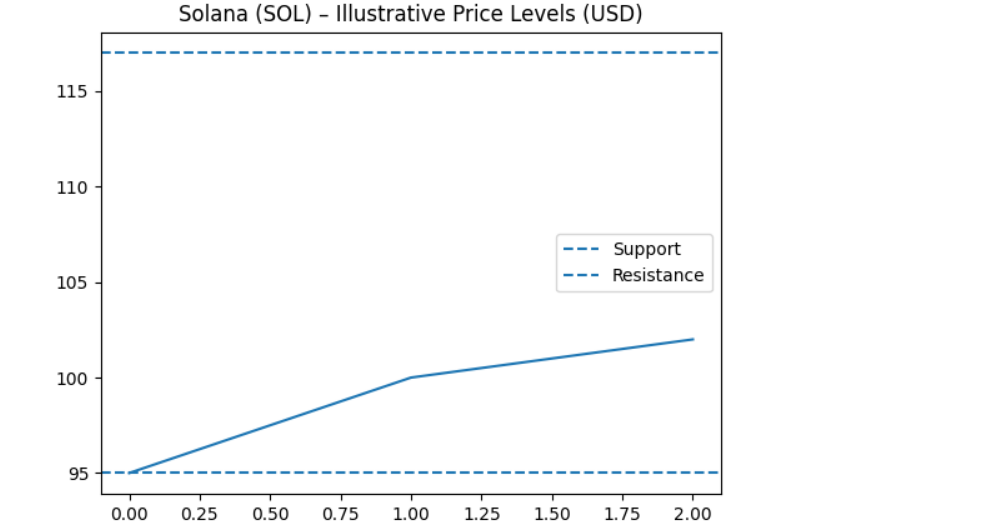
Critical Support at $95
Solana failed to sustain momentum above $107, triggering renewed selling that pushed price below the key $95 support level.
A daily close below $95 would likely confirm the next leg of the downtrend, with $79 as the next downside target.
Bullish Alternative Scenario
If SOL quickly reverses and breaks above $107, the recent dip below $95 could be interpreted as a bear trap. In that case, price may rally toward the 20-day EMA near $117, although selling pressure is expected at that level.
A decisive break above moving averages would indicate that bearish momentum is weakening.
Solana Technical Levels Chart
Ecosystem Implications
- Solana remains attractive for high-throughput applications.
- Infrastructure teams should prepare for network growth if price stabilizes.
- Volatility impacts validator economics and staking yields.
6. Broader Trends and Revenue Opportunities
Beyond short-term price movements, several macro trends are shaping the crypto landscape:
- Institutional risk management is increasingly technical-indicator driven.
- Volatility creates opportunities for market making, structured products, and hedging services.
- Practical blockchain adoption depends heavily on price stability of base assets.
For investors seeking the “next opportunity,” downturns often provide asymmetric entry points—provided risk is managed correctly.
Conclusion: Volatility as a Gateway, Not a Barrier
While Bitcoin, Ethereum, XRP, and Solana all face near-term technical challenges, oversold conditions suggest that short-term rebounds remain possible. Whether these rallies evolve into sustained trend reversals will depend on broader liquidity conditions and investor confidence.
For those exploring new crypto assets, revenue models, or real-world blockchain applications, this period should be viewed not solely as a risk phase—but as a strategic window to prepare, build, and position for the next cycle.