

Main Points :
- Bitcoin remains range-bound below $80,000, while gold and silver attempt a sharp recovery.
- Market participants are divided on whether Bitcoin will reclaim leadership from gold as a “digital store of value.”
- Bitwise CIO Matt Hougan believes the current crypto winter, which began in early 2025, is approaching its final stage.
- Capital rotation, ETFs, and macro uncertainty are reshaping how investors allocate between crypto, precious metals, and equities.
- For investors seeking new digital assets, income opportunities, and practical blockchain use cases, the coming transition phase is critical.
1. Bitcoin Stalls Below $80,000 While Precious Metals Rebound
Bitcoin’s price action in recent weeks has been defined by stagnation rather than collapse. According to data from TradingView, BTC has repeatedly failed to reclaim the psychologically important $80,000 level, which now functions as a clear resistance zone. Instead of trending decisively upward or downward, Bitcoin has been locked in a narrow trading range, reflecting market indecision and a lack of immediate catalysts.
This muted behavior contrasts sharply with the recent movements in precious metals. Gold (XAU/USD) rebounded strongly toward the $5,000 level, recovering more than $500 from its recent local low. Silver, which had sold off aggressively after January’s monthly close, staged an even sharper rebound, rising more than 11% in a single day.
[Illustrative BTC vs Gold Trend]
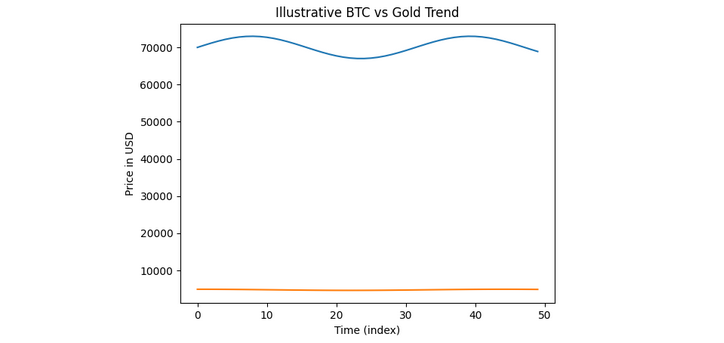
This divergence highlights an important theme: while Bitcoin is often described as “digital gold,” the two assets do not always move in tandem. In the current market environment, capital appears to be rotating back into traditional safe havens, at least temporarily, as investors reassess risk across global markets.
2. The Bitcoin–Gold Relationship: Rotation or Breakdown?
Historically, Bitcoin and gold have shown periods of alternating leadership. When gold dominates investor attention as a hedge against inflation, currency debasement, or geopolitical risk, Bitcoin often lags. Conversely, when risk appetite returns and liquidity expands, Bitcoin tends to outperform.
Trader Jelle summarized this dynamic by noting that gold had been the primary beneficiary for roughly the past 14 months, and that such phases often precede a renewed narrative around Bitcoin as “digital gold.” From this perspective, gold’s recent strength may not be a threat to Bitcoin, but rather a precursor to a broader rotation back into crypto assets.
However, skepticism remains strong. Analyst Northstar has argued that Bitcoin already missed a critical opportunity by failing to make significant new highs when measured against gold. In his view, this cycle may mark the first time Bitcoin structurally underperforms gold, potentially losing up to 80% of its value relative to the metal over time.
This debate matters deeply for long-term allocators. If Bitcoin’s role as a store of value weakens, its investment thesis would shift more decisively toward utility, network effects, and cash-flow-like mechanisms such as staking, fees, and real-world asset tokenization.
3. Gold Near $5,000: Signal of Macro Stress, Not Crypto Failure
Gold’s push toward $5,000 should not be interpreted as a rejection of crypto. Instead, it reflects broader macroeconomic stress. Equity markets have become increasingly sensitive to earnings disappointments, as illustrated by PayPal’s sharp post-earnings drop of nearly 20%. Such moves reinforce demand for assets perceived as defensive.
[Illustrative Gold Recovery Toward $5,000]
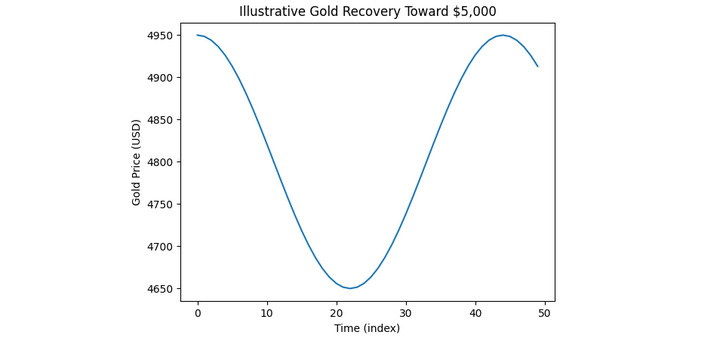
In this context, gold’s strength is a symptom of uncertainty rather than a verdict on Bitcoin’s long-term relevance. Institutional investors, in particular, tend to rebalance portfolios gradually. It is entirely possible for gold, Bitcoin, and even select altcoins to benefit sequentially rather than simultaneously.
For crypto-focused investors, this reinforces the importance of timing and positioning. Periods when Bitcoin underperforms macro hedges often coincide with quieter but strategically important developments in blockchain infrastructure, regulation, and adoption.
4. Bitwise CIO: “Crypto Spring Is Closer Than You Think”
On Tuesday, Matt Hougan, Chief Investment Officer at Bitwise, offered a notably optimistic assessment of the current downturn. According to Hougan, the prevailing mood—characterized by frustration, boredom, and pessimism—is precisely what typically defines the late stages of a crypto winter.
Hougan argues that this downturn effectively began in early 2025, following an exceptionally strong period driven in large part by the approval and launch of U.S. spot Bitcoin ETFs. Those ETFs pulled forward a significant amount of demand, making subsequent consolidation almost inevitable.
Crucially, Hougan sees no evidence that the fundamental pillars of crypto have deteriorated. Network security remains robust, institutional infrastructure continues to improve, and regulatory clarity—while uneven—is far better than in previous cycles.
From this perspective, the absence of excitement is not a warning sign but a prerequisite for the next expansion phase.
5. ETFs, Capital Rotation, and the Next Wave of Opportunity
The introduction of spot Bitcoin ETFs has permanently altered crypto market structure. ETFs make Bitcoin accessible to pension funds, advisors, and conservative allocators who would never self-custody digital assets. However, they also compress volatility and shift speculative energy elsewhere.
As Bitcoin matures into an institutional asset, higher-risk experimentation increasingly migrates to other areas of the ecosystem:
- Emerging layer-1 and layer-2 networks
- Tokenized real-world assets (RWA)
- Yield-bearing protocols tied to actual economic activity
- Enterprise and cross-border payment use cases
For investors seeking “the next Bitcoin,” this means looking beyond price charts and toward usage metrics, regulatory compatibility, and integration with existing financial systems.
6. Silver’s Rebound and What It Tells Us About Liquidity
Silver’s sharp rebound offers another useful signal. Unlike gold, silver has both monetary and industrial demand, making it highly sensitive to changes in liquidity expectations.
[Illustrative Silver Rebound]
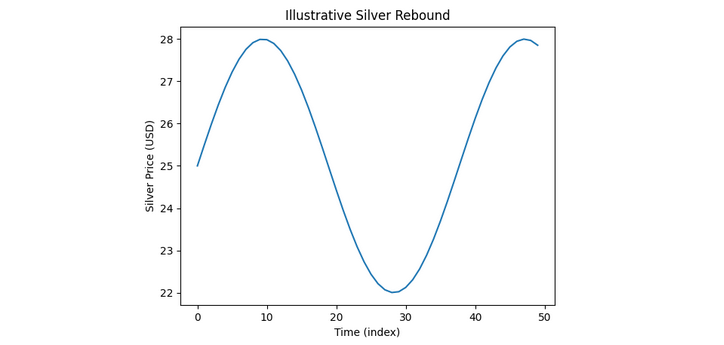
When silver rallies aggressively, it often reflects renewed risk appetite beneath the surface. In previous cycles, such moves have preceded recoveries in smaller-cap assets, including altcoins. While this is not a guarantee, it suggests that market participants should watch for early signs of rotation within crypto rather than waiting for Bitcoin dominance to break decisively.
7. Practical Implications for Crypto and Blockchain Investors
For readers interested in new digital assets, income streams, and practical blockchain applications, the current environment offers three key lessons:
First, patience is a competitive advantage. Late-stage crypto winters are often boring, but they are also when the groundwork for the next cycle is laid.
Second, diversification within crypto matters more than ever. Bitcoin may serve as a core holding, but returns are increasingly driven by infrastructure, services, and real-world integration.
Third, narratives matter less than execution. Projects that generate revenue, solve regulatory problems, or integrate with existing financial systems are more likely to survive and thrive in a post-ETF world.
Conclusion: Winter’s End Is Not a Single Moment, but a Transition
The idea that the crypto winter is “ending soon” should not be interpreted as a call for immediate speculative excess. Rather, it signals a gradual transition from despair to rebuilding, from narrative-driven rallies to structurally sound growth.
Bitcoin’s consolidation below $80,000, gold’s test of $5,000, and silver’s rebound are all expressions of a market searching for equilibrium. In that search lies opportunity—not just in price appreciation, but in the maturation of blockchain as a financial and technological system.
For those willing to look beyond short-term volatility, the coming months may prove to be less about surviving winter and more about preparing for spring.


