
Key Points :
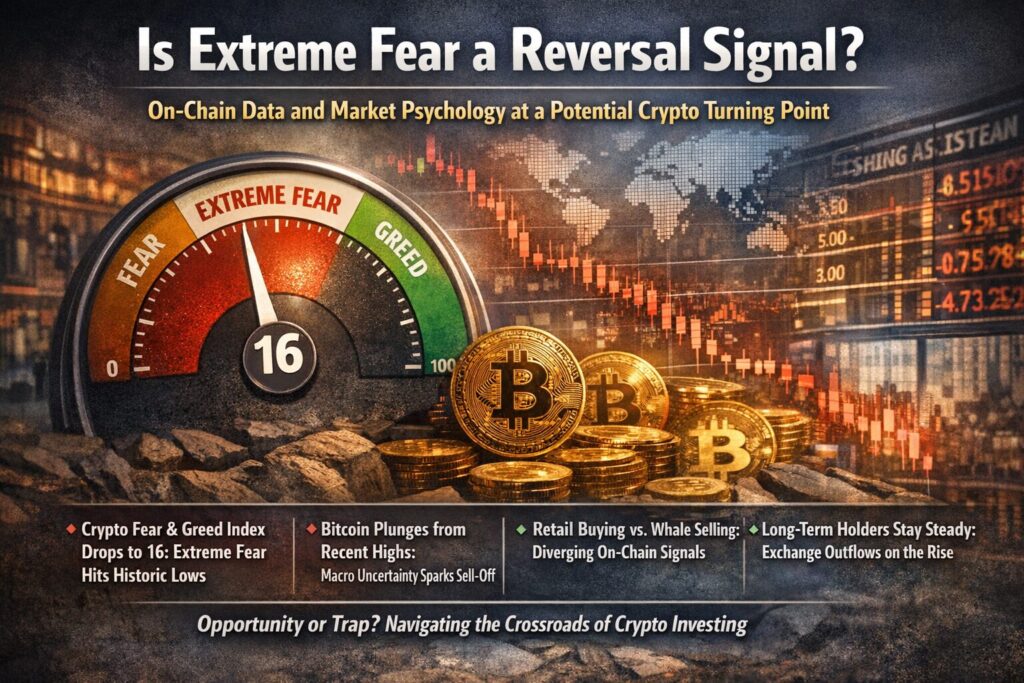
- The Crypto Fear & Greed Index has plunged to 16, one of the lowest readings in history, signaling extreme fear among investors.
- Historically, such extreme pessimism has often preceded major market reversals, though timing remains uncertain.
- Bitcoin has corrected sharply from its recent highs amid macroeconomic uncertainty and global risk-off sentiment.
- On-chain data reveals a growing divergence between retail accumulation and whale distribution, raising questions about sustainability.
- Despite bearish sentiment on social media, long-term holders show limited panic selling, and exchange outflows suggest selective accumulation.
- For investors seeking new crypto assets, yield opportunities, or real-world blockchain applications, the current phase may represent strategic positioning rather than blind contrarian buying.
1. A Historic Low in Market Sentiment: Fear Index Hits 16
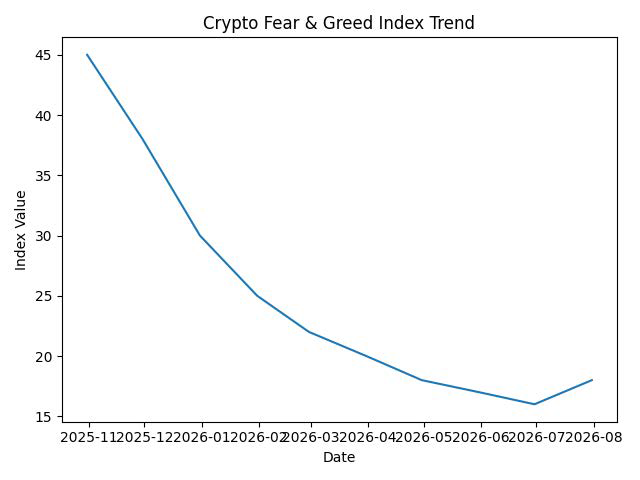
On January 31, 2026, on-chain analytics firm Santiment released its latest weekly report, highlighting a dramatic deterioration in crypto market sentiment. According to the report, the widely followed Crypto Fear & Greed Index fell to 16, marking one of the most extreme fear readings ever recorded.
This index aggregates multiple factors—including volatility, trading volume, social media sentiment, market momentum, and dominance—to quantify investor psychology on a scale from 0 (extreme fear) to 100 (extreme greed). A reading of 16 suggests that pessimism is not only widespread but deeply entrenched.
Historically, such moments have often coincided with late-stage sell-offs rather than the beginning of prolonged bear markets. Santiment notes that when “fear becomes consensus,” markets tend to exhaust sellers, laying the groundwork for potential reversals.
Crypto Fear & Greed Index Trend (Historical Decline to Extreme Fear)
2. Extreme Fear Across the Crypto Market: Panic or Opportunity?
The broader crypto market has entered a phase of heightened anxiety. Online communities, trading forums, and social platforms are saturated with bearish narratives ranging from “cycle top confirmed” to “macro will kill crypto.”
Yet, from a behavioral finance perspective, this environment is precisely when asymmetrical opportunities often emerge. Extreme fear reflects maximum uncertainty, not necessarily maximum downside.
Santiment’s analysis emphasizes that previous cycles—such as March 2020, mid-2021, and late 2022—saw similarly pessimistic sentiment shortly before significant recoveries. However, they also caution that fear alone is not a timing tool, but rather a contextual signal.
3. Bitcoin’s Pullback and the Role of the Macro Environment
Bitcoin began January 2026 trading near $96,000, buoyed by expectations of continued institutional inflows and long-term adoption narratives. However, by late January, BTC had retraced sharply to the $82,000–$84,000 range.
Bitcoin Price Trend (USD, Monthly)
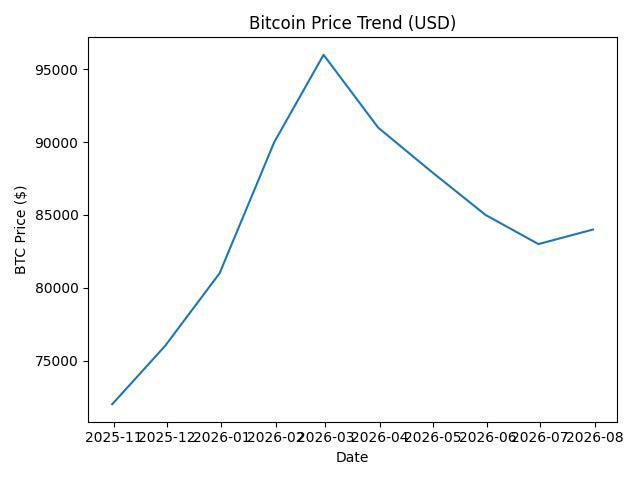
Several macroeconomic factors contributed to this decline:
- A resurgence of risk-off sentiment driven by uncertainty around U.S. fiscal and monetary policy.
- Sharp corrections in gold and silver markets, prompting portfolio rebalancing.
- Strengthening of the U.S. dollar, reducing speculative appetite across risk assets.
These dynamics triggered increased volatility and a spike in trading volume, as short-term traders exited positions while longer-term investors reassessed exposure.
4. Social Media Sentiment: When the Crowd Turns Bearish
Santiment’s social sentiment analysis reveals a striking imbalance: bearish crypto-related comments significantly outnumber bullish ones, with a bullish-to-bearish ratio of approximately 0.8.
This level of negativity is statistically abnormal and often precedes inflection points. Markets, particularly crypto markets, have a long history of moving against prevailing consensus. When most participants expect further downside, marginal selling pressure tends to diminish.
Crucially, despite the sharp price correction, there has been no surge in panic-driven liquidations. Long-term holders appear largely unfazed, suggesting that conviction among core investors remains intact.
5. A Growing Divide: Retail Buyers vs. Whale Sellers
One of the most important—and cautionary—signals highlighted by Santiment is the widening behavioral gap between different investor cohorts.
- Retail addresses holding between roughly $10 and $10,000 worth of BTC have been actively buying the dip.
- In contrast, shark and whale wallets—entities controlling significantly larger balances—have been net sellers.
This inversion of the “smart money” flow pattern raises legitimate concerns. Sustainable bull markets typically begin when large holders accumulate quietly while retail sentiment remains fearful. The current configuration suggests that some large players are reducing risk rather than positioning aggressively for upside.
Additionally, on-chain fundamentals such as active addresses and transaction counts have trended downward, indicating a slowdown in new user inflows and network activity.
Santiment summarizes this risk succinctly: “A true market bottom usually requires a shared moment of fear or capitulation. We may not be there yet.”
6. Exchange Outflows and Selective Accumulation Signals
Despite these cautionary signs, not all data points are bearish.
Prominent analyst Mischa0X noted that approximately 35,000 BTC (around $3.0 billion) recently moved off exchanges into self-custody wallets. Such outflows are often interpreted as a sign of long-term accumulation, as coins removed from exchanges are less likely to be sold immediately.
Mischa0X argues that the coexistence of extreme fear readings and large-scale withdrawals from exchanges suggests a disconnect between emotional indicators and actual capital behavior.
His message to investors is clear: “Track the coins, not the crowd.”
7. What This Means for Investors Seeking New Opportunities
For readers interested in discovering new crypto assets, identifying future revenue streams, or leveraging blockchain for practical use cases, the current environment demands nuance rather than binary thinking.
Key strategic considerations include:
- Staggered entry strategies rather than lump-sum bets.
- Monitoring on-chain accumulation by large entities as confirmation signals.
- Exploring infrastructure, middleware, and real-world asset (RWA) protocols that benefit from long-term adoption regardless of short-term price action.
- Focusing on assets with clear utility, sustainable token economics, and institutional relevance.
Extreme fear does not guarantee immediate upside—but it often marks the transition from distribution to re-accumulation phases.
8. Conclusion: Fear as a Signal, Not a Verdict
The plunge of the Crypto Fear & Greed Index to 16 underscores a market gripped by uncertainty and pessimism. On-chain data paints a complex picture: retail investors are buying, whales are cautious, social sentiment is deeply bearish, yet panic selling remains limited.
History suggests that such conditions frequently precede major turning points—but patience and confirmation are essential. For sophisticated participants, this is not a moment for emotional reactions, but for structured analysis and strategic positioning.
Whether this extreme fear becomes a definitive reversal signal or merely a waypoint toward deeper capitulation will depend on macro developments, liquidity conditions, and the behavior of long-term capital. What is clear, however, is that markets rarely reward the crowd—and moments like these deserve close, unemotional attention.


