
Main Points :
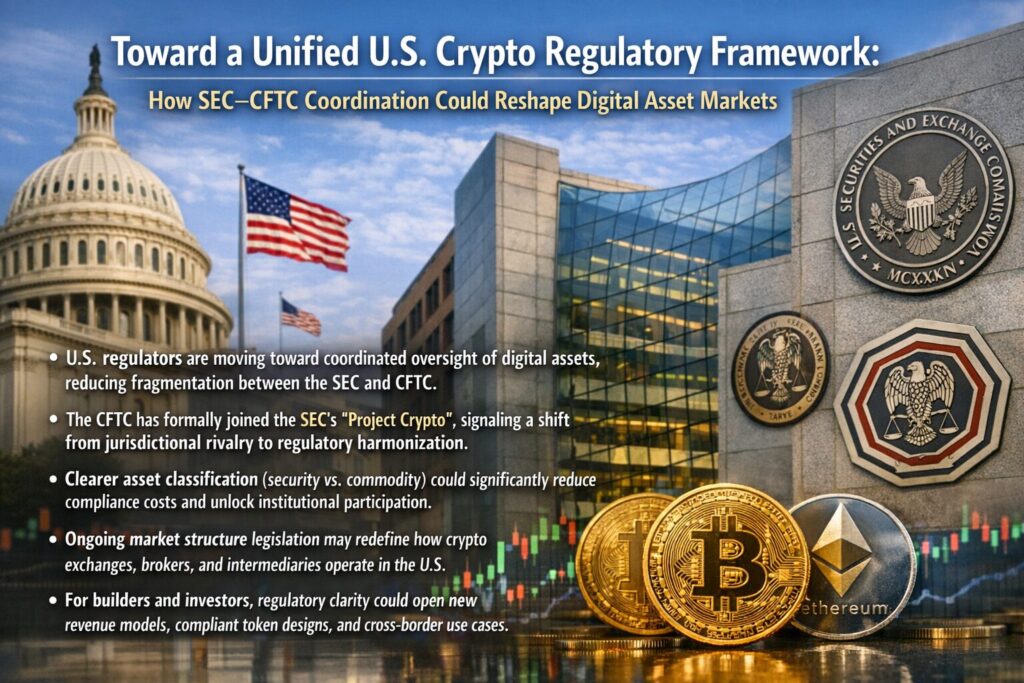
- U.S. regulators are moving toward coordinated oversight of digital assets, reducing fragmentation between the SEC and CFTC.
- The CFTC has formally joined the SEC’s “Project Crypto”, signaling a shift from jurisdictional rivalry to regulatory harmonization.
- Clearer asset classification (security vs. commodity) could significantly reduce compliance costs and unlock institutional participation.
- Ongoing market structure legislation may redefine how crypto exchanges, brokers, and intermediaries operate in the U.S.
- For builders and investors, regulatory clarity could open new revenue models, compliant token designs, and cross-border use cases.
1. Introduction: Why Regulatory Coordination Matters Now
For over a decade, the U.S. cryptocurrency market has operated under a fragmented regulatory environment. The U.S. Securities and Exchange Commission (SEC) and the Commodity Futures Trading Commission (CFTC) have often taken divergent—and at times conflicting—approaches to digital asset oversight. This regulatory ambiguity has increased compliance costs, discouraged innovation, and pushed some crypto businesses offshore.
That landscape may now be changing.
In a significant policy signal, CFTC Chair Michael Selig announced that the CFTC will formally participate in the SEC’s Project Crypto, an initiative launched in July to clarify digital asset regulation. The move reflects a broader shift in Washington: from regulatory turf wars toward coordinated supervision designed to future-proof U.S. financial markets.
This article examines what that coordination really means, how it intersects with pending legislation, and why it matters not only for Bitcoin and Ethereum—but for the next generation of crypto assets, yield models, and blockchain-based financial infrastructure.
2. Project Crypto: A Turning Point in U.S. Digital Asset Policy
Project Crypto was introduced by the SEC as a framework initiative aimed at clarifying how existing securities laws apply to digital assets. While initially perceived as an SEC-led effort, its scope has widened with the CFTC’s participation.
According to Chair Selig, the objective is not to blur statutory boundaries, but to:
- Establish a clear classification framework for crypto assets
- Define jurisdictional boundaries between regulators
- Eliminate duplicative compliance requirements
- Reduce regulatory fragmentation that distorts capital allocation
From an economic perspective, Selig emphasized that fragmented oversight imposes real costs: higher barriers to entry, reduced competition, increased legal uncertainty, and incentives for regulatory arbitrage rather than productive investment.
This acknowledgment is crucial. For years, crypto entrepreneurs have faced the paradox of being regulated everywhere and nowhere at the same time. Harmonization could finally resolve that contradiction.
3. SEC vs. CFTC: From Turf Wars to Functional Alignment
Historically, the SEC has viewed many tokens as securities under the Howey Test, while the CFTC has treated Bitcoin and certain other assets as commodities. This duality created uncertainty for exchanges, custodians, and issuers.
Recent remarks by SEC Chair Paul Atkins suggest a philosophical shift. “Years of jurisdictional conflict must give way to a new era of cooperation,” he stated, underscoring the need for a unified regulatory posture that supports innovation while protecting market integrity.
Figure 1: Traditional Fragmented Oversight vs. Coordinated SEC–CFTC Model
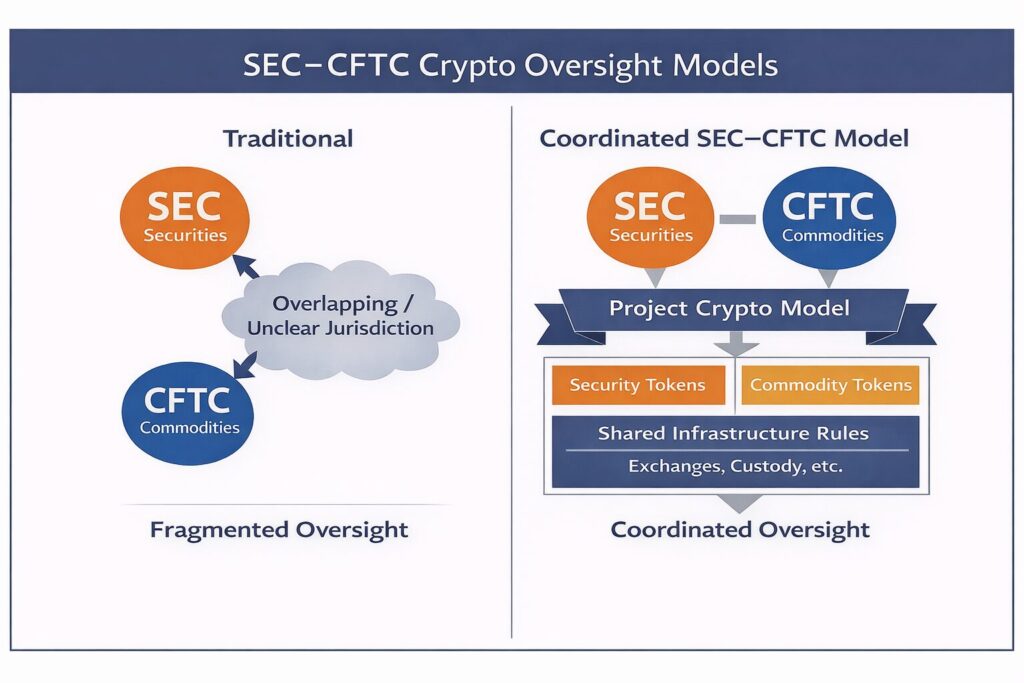
(Conceptual diagram showing overlap vs. aligned supervision)
This alignment could result in:
- Predictable pathways for token issuance
- Clearer licensing regimes for exchanges and brokers
- Reduced legal exposure for compliant DeFi and infrastructure projects
For market participants, clarity is not about deregulation—it is about knowability.
4. Market Structure Legislation: Redefining Crypto Intermediation
The regulatory coordination effort coincides with progress on digital asset market structure legislation in Congress. Recently, the Senate Agriculture Committee advanced a bill aimed at establishing a comprehensive framework for digital commodity intermediaries.
The legislation seeks to:
- Clearly assign oversight responsibilities between the SEC and CFTC
- Define registration requirements for crypto brokers, dealers, and platforms
- Standardize disclosure and custody rules
However, the bill has also exposed political tensions—particularly regarding the CFTC’s current leadership capacity. Senator Amy Klobuchar raised concerns that granting expanded authority to an understaffed commission could undermine effective enforcement.
Despite these concerns, the broader direction is clear: Congress is moving toward codifying what regulators are already attempting through coordination.
5. Event Contracts, Prediction Markets, and Regulatory Flexibility
Beyond crypto spot and derivatives markets, Chair Selig also addressed the CFTC’s approach to event contracts and prediction markets—a space increasingly intersecting with blockchain platforms.
He announced the withdrawal of prior rules and guidance that restricted political and sports-related event contracts, arguing that existing frameworks had failed to provide market certainty. Instead, the CFTC aims to establish clear, objective standards that align with market realities.
This is particularly relevant for blockchain-based prediction markets, which have emerged as alternative financial instruments with applications in:
- Risk hedging
- Information aggregation
- Decentralized governance
Figure 2: Expansion of Blockchain Use Cases Under Regulatory Clarity
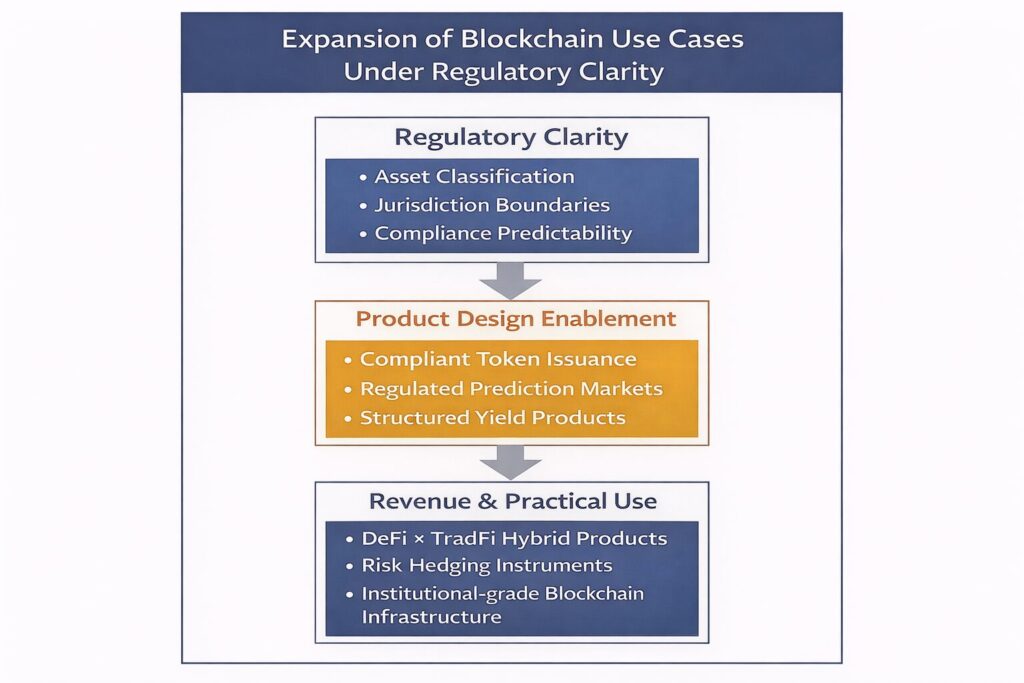
(Flowchart linking regulation → compliant products → new revenue models)
Regulatory clarity in this area could unlock compliant prediction markets integrated with DeFi, insurance, and analytics platforms.
6. Implications for Investors, Builders, and Institutions
For investors, regulatory coordination reduces tail risk. Clear asset classification lowers the probability of sudden enforcement actions that can erase billions in market value overnight.
For builders, it enables:
- Designing tokens with explicit regulatory positioning
- Structuring yield products that comply with U.S. law
- Integrating fiat and crypto rails with confidence
For institutions, alignment between the SEC and CFTC removes one of the largest obstacles to large-scale participation. Banks, asset managers, and payment companies require predictable compliance frameworks before deploying capital at scale.
7. Global Context: Why the U.S. Move Matters Worldwide
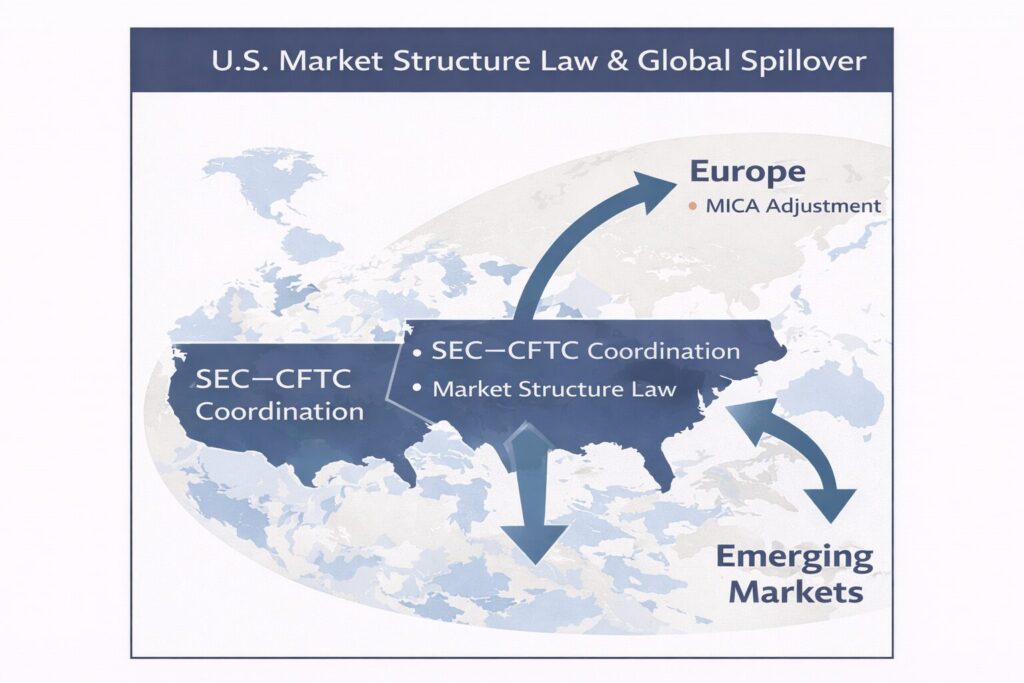
U.S. regulatory policy has global spillover effects. When U.S. agencies clarify their stance, other jurisdictions—from Asia to Europe—often recalibrate their own frameworks.
A coordinated U.S. model could:
- Reinforce global standards for token classification
- Reduce regulatory arbitrage across borders
- Encourage interoperable compliance regimes
For cross-border blockchain projects, this convergence is essential.
8. Conclusion: From Fragmentation to Foundation
The decision by the CFTC to join the SEC’s Project Crypto marks more than bureaucratic cooperation—it signals a strategic recalibration of how the U.S. approaches digital assets.
While challenges remain, particularly in staffing and legislative alignment, the trajectory is clear: the era of fragmented crypto oversight is giving way to a more coherent, innovation-aware regulatory foundation.
For those seeking the next generation of crypto assets, revenue opportunities, and practical blockchain applications, this shift may prove to be one of the most important developments of the decade.


