Main Takeaways :
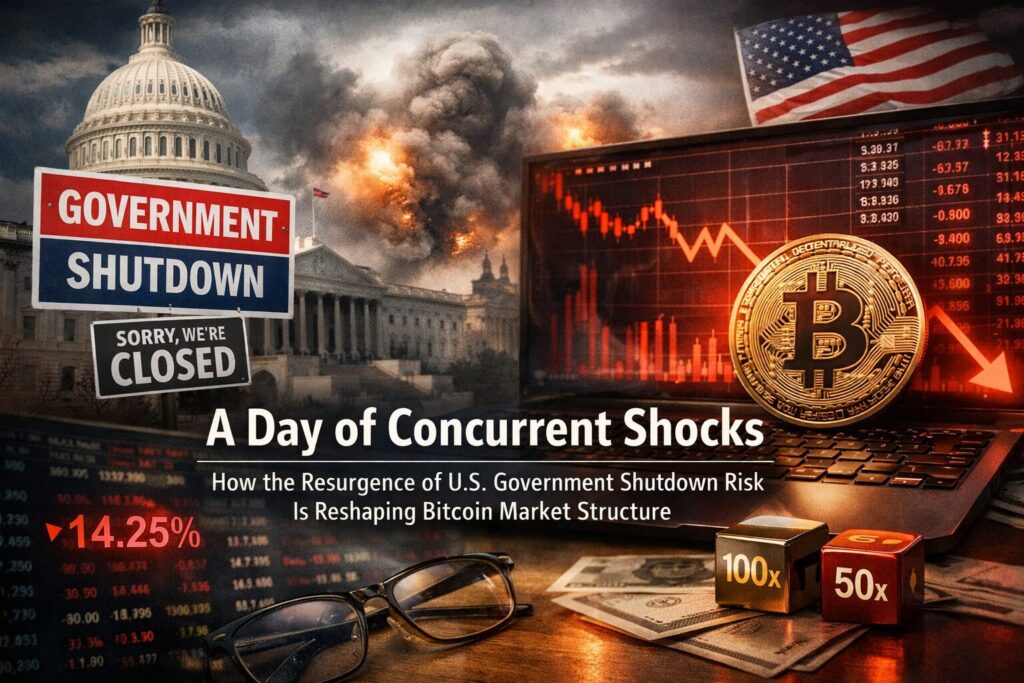
- Bitcoin entered a correction phase not due to a single trigger, but from a convergence of macroeconomic, geopolitical, and market-structural shocks.
- The renewed risk of a U.S. government shutdown played a central psychological and flow-driven role, especially for U.S.-based investors.
- On-chain and derivative indicators suggest U.S.-led deleveraging rather than a synchronized global capitulation.
- While the current phase is corrective, stabilization of U.S. flows could quickly change the market narrative.
1. Bitcoin at a Transitional Point: From Late-Stage Rally to Stress-Driven Correction
The current Bitcoin market should be understood as being in a transitional phase rather than in the early stages of a structural breakdown. Following a sustained upward trend, the market has entered a corrective zone where short-term price action is increasingly dictated by flows, leverage, and macro sentiment rather than by long-term adoption narratives alone.
This distinction is critical for investors and operators looking for the next opportunity in digital assets. A correction phase does not imply the collapse of long-term value, but it does imply that price discovery becomes fragile. Liquidity thins, volatility rises, and small shocks can have outsized effects.
In this context, the sharp decline observed on January 30, 2026, cannot be attributed to a single headline. Instead, it reflects a rare moment when multiple external shocks aligned simultaneously, effectively subjecting Bitcoin to a real-time stress test.
2. The Anatomy of a “Composite Shock” Day
The market sell-off unfolded as a compound event driven by overlapping risk vectors:
- A broad macro risk-off move across equities and commodities
- Growing anxiety over AI-related capital expenditure following disappointing earnings from major U.S. technology firms
- Escalating geopolitical tensions involving the United States and Iran
- A renewed focus on the possibility of a U.S. government shutdown
- Structural illiquidity in crypto markets
- Forced deleveraging from an overextended derivatives market
Each of these factors alone might have caused a mild pullback. Together, they created a feedback loop that amplified downside pressure.
Bitcoin, by virtue of being highly liquid, globally accessible, and traded 24/7, often becomes the first asset investors adjust when reducing overall risk exposure. In stress environments, this liquidity advantage paradoxically turns into a vulnerability.
3. Why U.S. Government Shutdown Risk Matters More Than It Appears
Historically, the threat of a U.S. government shutdown has not always had a consistent or immediate impact on Bitcoin prices. However, market memory matters.
In October 2025, an actual government shutdown occurred and persisted longer than initially expected. During that period, risk-off sentiment intensified, U.S. institutional participation weakened, and Bitcoin experienced sustained downside pressure alongside traditional risk assets.
That episode left a lasting psychological imprint on market participants. As a result, even the re-emergence of shutdown risk—before any actual closure—now acts as a catalyst for preemptive risk reduction.
This time, the market response suggests that investors are no longer waiting for confirmation. They are reacting to probability.
4. U.S.-Led Selling Pressure and the Coinbase Premium Signal
On-chain data provides strong evidence that the latest downturn was driven primarily by U.S. investors rather than by a global, synchronized sell-off.
The Coinbase Premium Index, which measures the price difference between Bitcoin on Coinbase (primarily U.S. users) and offshore exchanges, dropped sharply during the sell-off. This indicates that selling pressure was disproportionately concentrated in the U.S. market.
[Illustrative Coinbase Premium Index Decline]
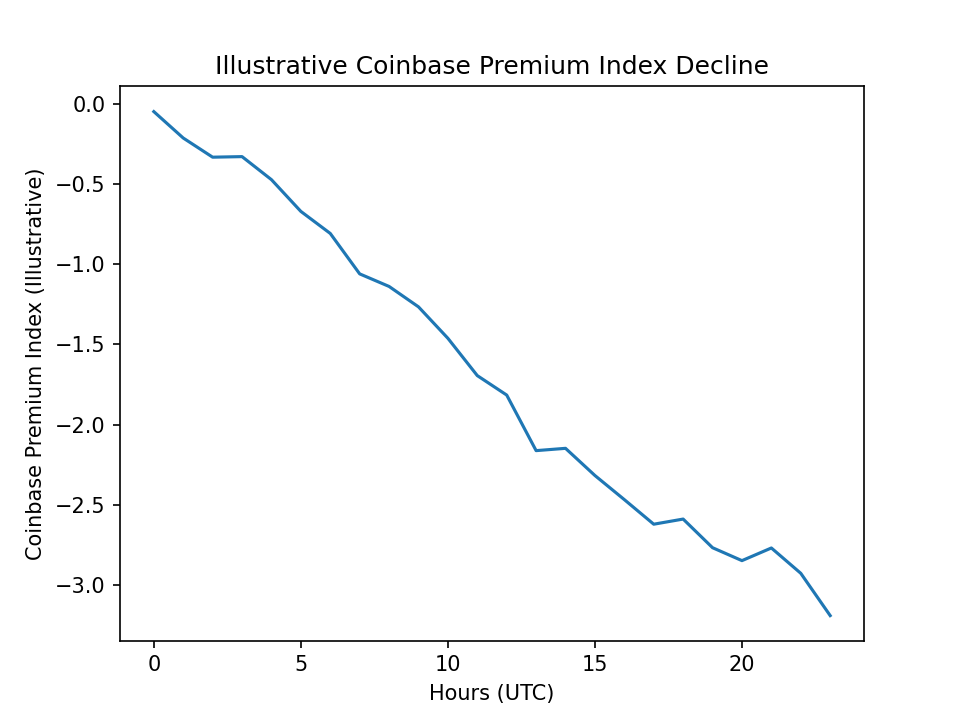
A declining or negative Coinbase Premium typically signals weakening U.S. demand or outright selling by American investors. In contrast, global markets did not exhibit the same degree of panic, suggesting that the shock was geographically asymmetric.
For market participants, this distinction matters. U.S.-led selling often reverses faster once domestic uncertainty clears.
5. Liquidity, Leverage, and the Derivatives Feedback Loop
Another critical amplifier of the decline was the structure of the derivatives market.
Leading into the sell-off, short-term leverage had accumulated across perpetual futures markets. Funding rates indicated crowded positioning, leaving the market vulnerable to forced liquidations.
Once prices began to fall, initial losses triggered margin calls, which led to liquidations. These liquidations pushed prices lower still, creating a cascading effect.
[Illustrative BTC Price Reaction During a Multi-Shock Day]
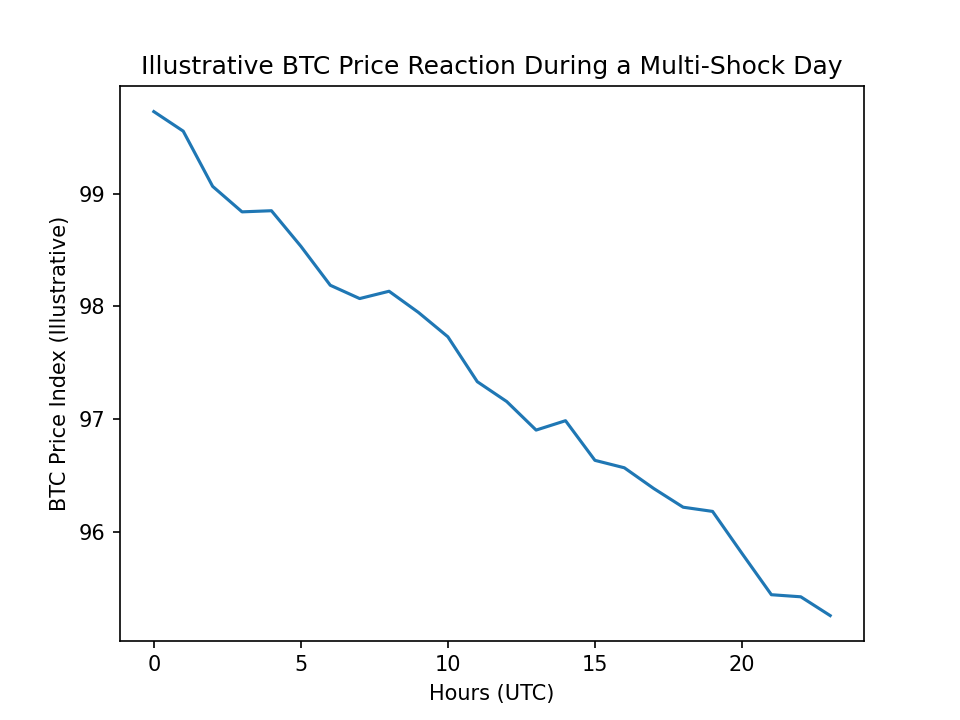
This dynamic is not unique to crypto, but it is particularly pronounced due to the market’s relatively shallow liquidity compared to traditional asset classes.
6. Bitcoin as a Macro Hedge—or a Macro Release Valve?
A recurring debate in digital asset circles is whether Bitcoin functions as a hedge against macro instability or as a high-beta risk asset.
This episode suggests that, in the short term, Bitcoin still behaves as a macro “release valve.” When uncertainty spikes, investors reduce exposure even to assets they believe in long term.
However, this does not negate Bitcoin’s structural role. Instead, it highlights a time-horizon mismatch. Short-term flows respond to fear; long-term allocation responds to monetary credibility and scarcity.
7. Alternative Scenarios: When the Narrative Could Flip
While the base case remains a corrective phase driven by compounded external risks, alternative scenarios deserve attention.
If:
- U.S. government shutdown risk recedes,
- macro conditions stabilize,
- the Coinbase Premium Index recovers, and
- spot-led buying resumes,
then the current drawdown may be reclassified as a temporary stress reaction rather than the start of a deeper downturn.
For builders and investors searching for the next revenue stream or practical blockchain application, these inflection points matter more than headline prices.
8. Practical Implications for Investors and Builders
For investors:
- Monitor flow-based indicators rather than price alone.
- Distinguish between U.S.-specific stress and global demand trends.
- Avoid excessive leverage during macro-sensitive phases.
For builders and operators:
- Volatility reinforces the value of real-world blockchain utility.
- Payment rails, settlement layers, and on-chain infrastructure that function regardless of market sentiment gain strategic importance.
- Corrections often create acquisition and partnership opportunities that are invisible during bull phases.
9. Understanding the Coinbase Premium Index (Technical Note)
The Coinbase Premium Index measures the price difference of Bitcoin between Coinbase and offshore exchanges.
- A positive premium indicates strong U.S. buying demand.
- A declining or negative premium indicates weakening demand or selling pressure from U.S. investors.
Sharp declines in this index often precede or accompany U.S.-driven market corrections.
Conclusion: A Stress Test, Not a Verdict
January 30, 2026, should be remembered not as a verdict on Bitcoin’s future, but as a stress test of its current market structure.
The convergence of macro risk, geopolitical uncertainty, policy paralysis fears, and leverage imbalances exposed vulnerabilities—but also clarified where real pressure originates.
For those seeking the next generation of crypto assets, yield opportunities, or practical blockchain deployments, the lesson is clear: understanding flows, incentives, and structure matters more than reacting to price alone.