Main Points :
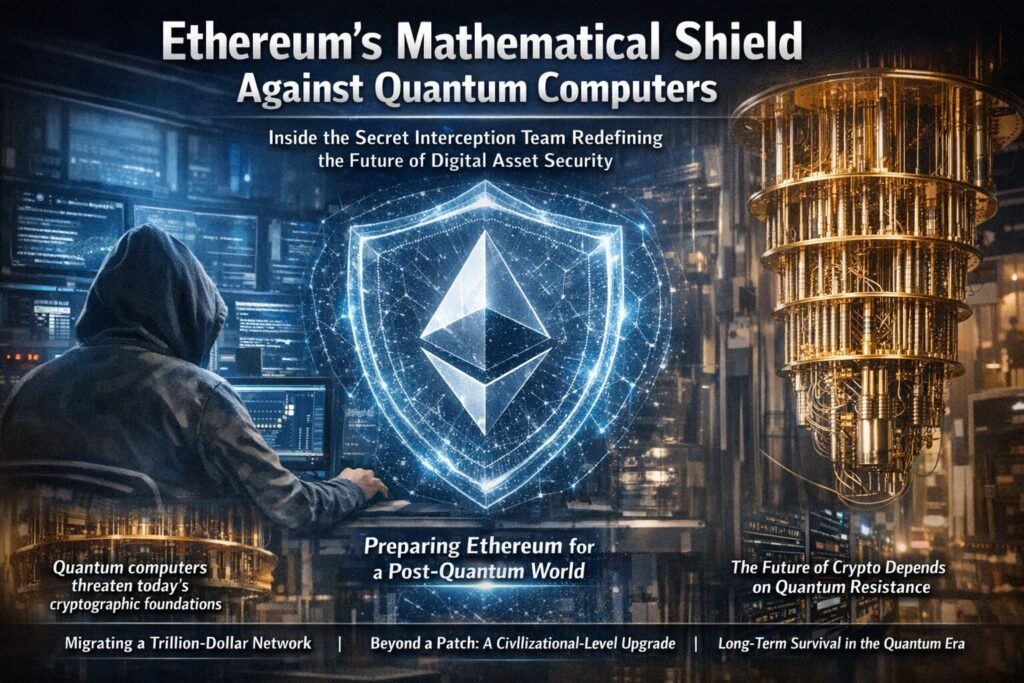
- Quantum computers pose a real and existential threat to today’s cryptographic foundations.
- The Ethereum ecosystem has quietly begun preparing for a post-quantum world.
- Migrating a live, trillion-dollar-scale network to post-quantum cryptography is one of the hardest challenges in computer science.
- Long-term value in crypto will belong to networks that survive the quantum transition.
- Ethereum’s response is not a patch, but a civilizational-level mathematical upgrade.
1. The Quantum Threat That Can Break Today’s Cryptography — and Ethereum’s Counteroffensive
Quantum computers are no longer a science fiction concept. With steady advances in qubit stability, error correction, and quantum algorithms, the moment they cross from laboratory curiosity into practical machines is approaching faster than many investors realize.
The danger is not abstract. Modern cryptography — including the elliptic curve signatures that secure Ethereum wallets — relies on mathematical problems that are hard for classical computers. Quantum computers change that assumption entirely. Shor’s algorithm, once run on sufficiently powerful quantum hardware, can dismantle today’s public-key cryptography in minutes.
If that happens, private keys cease to be private. Wallets become transparent. Ownership itself collapses.
Behind the daily noise of price charts and market sentiment, Ethereum developers are confronting a far more fundamental question: how does a decentralized financial system survive a future where its core mathematics no longer holds?
In response, the Ethereum ecosystem — with coordination from the Ethereum Foundation — has initiated quiet but serious work on post-quantum security. This is not marketing, and it is not a short-term roadmap item. It is long-horizon survival engineering.
What makes this moment unique is that the threat is predictable. Unlike unknown vulnerabilities, quantum computing advances are visible years in advance. That means inaction would be a conscious decision to accept eventual failure.
Ethereum’s response signals something critical: the network is no longer optimizing only for growth, but for multi-decade durability.
2. Redefining the Mathematical Foundation: The Brutal Challenge of Post-Quantum Migration
Transitioning to post-quantum cryptography is not comparable to past upgrades like fee market changes or consensus improvements. It is closer to replacing the laws of physics while an economy is running on top of them.
Post-quantum cryptography relies on mathematical structures believed to resist quantum attacks, such as lattice-based cryptography, hash-based signatures, and multivariate polynomial systems. These are not theoretical novelties — many are being standardized globally — but integrating them into a live blockchain introduces enormous complexity.
Ethereum must solve several problems at once:
- Preserve backward compatibility without freezing funds.
- Avoid breaking user experience at the wallet level.
- Maintain decentralization despite heavier cryptographic computation.
- Coordinate global consensus for changes that touch the deepest protocol layers.
This is often compared to replacing every engine component of an aircraft while it is in flight.
Unlike centralized systems, Ethereum cannot simply “force update” users. Any post-quantum transition requires careful, opt-in pathways, long transition periods, and cryptographic agility — the ability to support multiple schemes simultaneously.
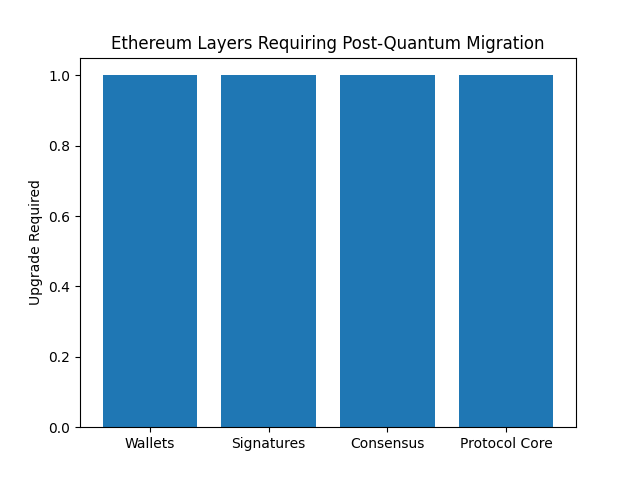
The work underway is therefore not a single solution, but a layered strategy. Wallets, signature schemes, consensus rules, and protocol primitives all need quantum-resilient counterparts.
【Ethereum Layers Requiring Post-Quantum Migration】
This migration is not about claiming invincibility. It is about acknowledging that cryptographic immortality is a myth, and that resilience comes from continuous evolution.
3. Beyond the Myth of Invincibility: Building a Fortress That Evolves
By 2026, one truth has become unavoidable: no technology is permanently secure. The only viable strategy is adaptability.
Quantum computing represents the ultimate stress test for blockchains. Networks that refuse to evolve will not fail gradually — they will fail catastrophically. In contrast, protocols that treat cryptography as an upgradeable layer can emerge stronger after the transition.
Ethereum’s approach reflects a mature understanding of this reality. The goal is not to defeat quantum computers forever, but to stay ahead of them long enough that the network remains a reliable store of value and settlement layer.
For investors, this reframes what “fundamentals” truly mean. Long-term value is not just about throughput, fees, or adoption metrics. It is about whether a network can survive future computational revolutions.
【Quantum Computing Impact vs Post-Quantum Preparedness】
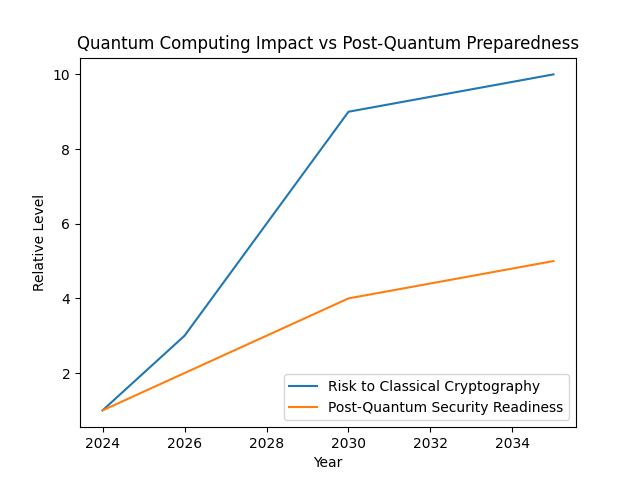
When viewed through this lens, post-quantum readiness becomes one of the most important, yet least priced-in, aspects of digital assets.
Ethereum’s quiet preparation sends a powerful signal: this is not a speculative system hoping to outrun time, but an evolving financial infrastructure designed to coexist with it.
Conclusion: Mathematics as the Final Contract of Trust
The rise of quantum computing will not merely disrupt cryptography — it will redefine trust in the digital age.
In that future, value will concentrate in systems that anticipated the threat early and responded with mathematical rigor rather than marketing slogans. Ethereum’s post-quantum efforts represent a shift from optimism to responsibility.
The invisible work of cryptographers and protocol engineers is building a fortress not of walls, but of equations — a structure meant to endure not years, but generations.
For those seeking the next source of sustainable returns, or the next truly durable blockchain platform, the question is no longer “what is growing fastest,” but what can survive the longest.
Ethereum’s mathematical shield may well become the blueprint for digital asset security in the quantum era.