Key Takeaways :
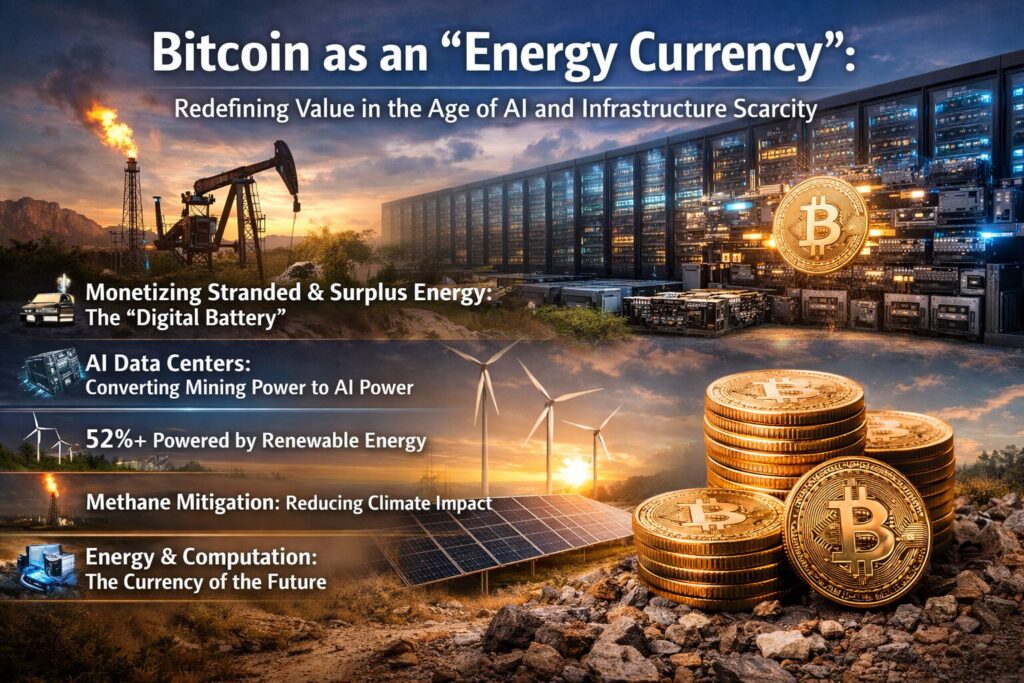
- Bitcoin is increasingly being re-evaluated not as a speculative asset, but as an energy-backed monetary and infrastructure system.
- Bitcoin mining has historically monetized stranded and surplus energy, effectively functioning as a “digital battery.”
- In the AI era, Bitcoin mining infrastructure can be rapidly converted into AI data centers, offering a critical speed advantage.
- More than 52% of Bitcoin mining is powered by renewable energy, with methane mitigation offering measurable climate benefits.
- Industry leaders increasingly view Bitcoin as a currency rooted in physical energy and computation, aligning naturally with AI-driven economies.
1. Why Bitcoin’s Value Is Being Reconsidered Now
For over a decade, Bitcoin has been criticized primarily through a single lens: energy consumption. Headlines have repeatedly framed Bitcoin mining as wasteful, environmentally harmful, and socially inefficient. However, this framing is increasingly being challenged—not by Bitcoin maximalists alone, but by infrastructure investors, AI engineers, and even leaders of the traditional energy sector.
The catalyst for this shift is the rapid emergence of artificial intelligence as a dominant consumer of energy and computation. As AI models scale, their demand for electricity, data centers, and stable power infrastructure has grown exponentially. In this context, Bitcoin’s proof-of-work (PoW) system is no longer being examined merely as a cost, but as a mechanism for monetizing energy, stabilizing grids, and reallocating capital toward compute infrastructure.
In January 2026, Simon Kim, CEO of crypto investment firm Hashed, articulated this shift in a widely discussed essay titled “Monetizing Energy: Redefining Bitcoin’s Role in the AI Era.” His argument reflects a broader reassessment underway across the industry.
2. Bitcoin Mining as a Digital Battery for Surplus Energy
Bitcoin mining did not emerge in energy-rich but demand-constrained regions by accident. Historically, mining operations clustered around locations where electricity was abundant, cheap, and often underutilized.
Examples include:
- Hydroelectric power in Sichuan, China
- Geothermal energy in Iceland
- Wind and solar overproduction in parts of North America
- Flared natural gas fields in oil-producing regions
These energy sources shared a common trait: they could not easily be transmitted or stored economically. Bitcoin mining solved this problem by converting otherwise wasted energy into a globally liquid digital asset.
Simon Kim describes Bitcoin as a “digital battery”—not in the chemical sense, but economically. Energy that would otherwise be curtailed, flared, or spilled can be converted into Bitcoin, stored indefinitely, and transported across borders at near-zero marginal cost.
This reframing fundamentally alters how energy efficiency should be measured. The relevant question is no longer “How much electricity does Bitcoin use?” but rather “How much unusable energy does Bitcoin make economically useful?”
3. Renewable Energy and Methane Mitigation
Estimated Energy Mix of Bitcoin Mining
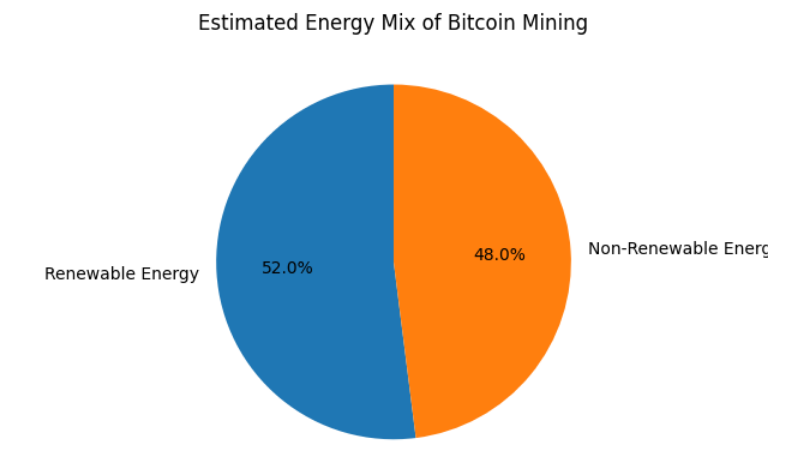
Environmental criticism has long focused on Bitcoin’s carbon footprint. However, recent data suggests a more nuanced reality. According to multiple industry surveys and mining disclosures, over 52% of Bitcoin mining is now powered by renewable energy.
More importantly, Bitcoin mining has become one of the few economically viable use cases for methane mitigation. In oil and gas operations, methane is often flared due to the lack of infrastructure to transport it. By deploying mobile mining units on-site, companies can convert methane into electricity and mine Bitcoin—reducing greenhouse gas emissions by over 60% compared to flaring.
This positions Bitcoin mining not as a competitor to clean energy, but as:
- A buyer of last resort for renewable overproduction
- A grid stabilizer during periods of demand imbalance
- A carbon mitigation tool for heavy industries
4. The AI Infrastructure Bottleneck—and Bitcoin’s Hidden Advantage
The AI boom has exposed a severe infrastructure constraint. Building a new AI data center typically requires:
- Land acquisition
- Grid connection approvals
- Environmental assessments
- Construction and cooling systems
- Hardware procurement
This process often takes 3 to 6 years.
By contrast, Bitcoin mining facilities already possess:
- High-capacity power connections
- Cooling and ventilation systems
- Modular compute layouts
- Remote locations with excess power
Simon Kim highlights multiple cases where mining operators have converted facilities into AI data centers in as little as 6 months.
Time to Deploy AI Compute Infrastructure
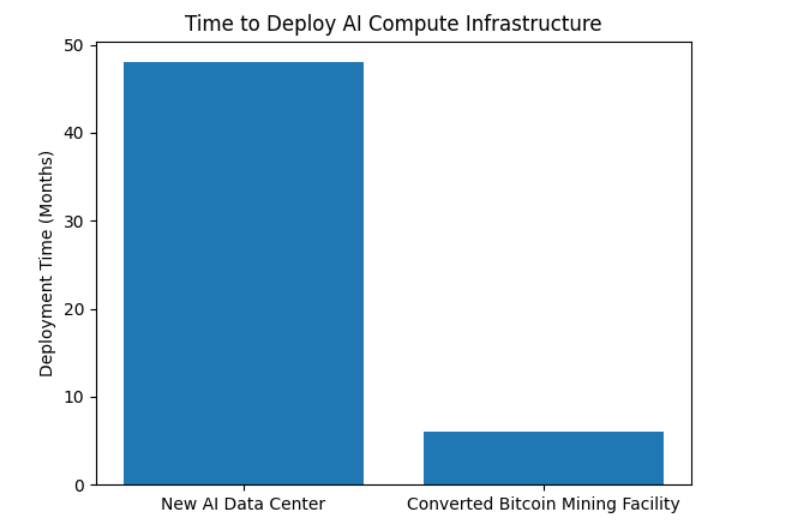
This speed advantage is not trivial. In AI development, time-to-compute can determine competitive survival. Bitcoin mining infrastructure effectively functions as a strategic reserve of deployable compute capacity.
5. Industry Leaders Converge on the “Energy Currency” Thesis
This re-evaluation is not isolated to crypto-native voices.
In January 2026, Jensen Huang, CEO of NVIDIA, stated that Bitcoin “stores surplus energy in the form of money and makes it transportable across the world.” For a company whose GPUs power both AI and mining, this observation carries particular weight.
Similarly, in November 2025, Elon Musk remarked:
“Energy is the true currency. Governments can print money by law, but they cannot create energy by law.”
Musk emphasized that Bitcoin’s PoW mechanism translates physical scarcity into digital scarcity, a property increasingly relevant in a compute-constrained world.
Earlier, in July 2023, Arthur Hayes described Bitcoin as “a pure expression of energy”, arguing that for AI systems—whose operational costs are fundamentally electricity-based—Bitcoin represents a logically consistent monetary unit.
6. Implications for Investors and Builders
For readers seeking new crypto assets or revenue opportunities, this shift carries important implications:
- Bitcoin’s long-term value proposition may increasingly correlate with energy markets and AI growth, not just macro liquidity.
- Mining companies may evolve into hybrid energy–compute infrastructure providers.
- Regions with surplus or stranded energy may gain new economic relevance through Bitcoin-backed monetization.
- Bitcoin’s role as settlement collateral for AI-driven economies may expand.
Rather than competing with AI, Bitcoin may become one of its foundational economic layers.
7. Conclusion: Asking the Right Question
Simon Kim concludes with a powerful reframing:
“The right question is not how much electricity Bitcoin consumes, but how efficiently and cleanly it can improve the global energy grid.”
As AI accelerates the demand for computation and electricity, systems that can absorb surplus energy, stabilize infrastructure, and translate physical resources into digital value will become increasingly important.
Bitcoin, once dismissed as wasteful, is now being reconsidered as energy money for a computational civilization.