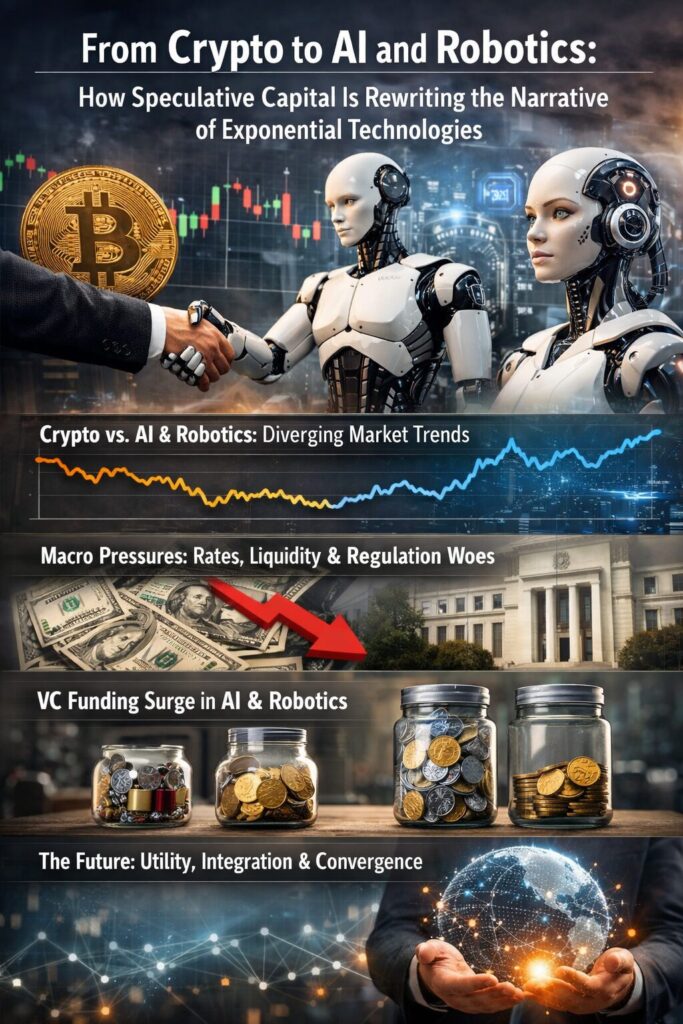
Main Points :
- Speculative capital is no longer flowing automatically into crypto; it is now actively competing with AI and robotics narratives.
- Market performance shows a clear divergence between Bitcoin, altcoins, and AI/robotics-linked assets.
- Macro factors—interest rate expectations, liquidity tightening, and regulatory uncertainty—are amplifying crypto’s underperformance.
- Venture capital data reveals accelerating funding into robotics and AI, while crypto VC investment shows signs of late-cycle deceleration.
- For investors and builders, crypto’s future growth increasingly depends on practical utility, integration with real-world systems, and convergence with AI.
Introduction: The End of Crypto as the Default Speculative Trade
For much of the past decade, the cryptocurrency market functioned as the default destination for speculative capital seeking asymmetric risk and exponential returns. When global liquidity was abundant and technological narratives were scarce, crypto absorbed excess risk appetite almost automatically.
That era is ending.
According to recent analysis by Delphi Digital, speculative capital is increasingly rotating out of crypto markets and into other emerging technology sectors—most notably artificial intelligence and robotics. This shift does not imply the collapse of crypto, but rather a structural change in how speculative capital allocates itself across competing exponential narratives.
Crypto is no longer competing only with other crypto assets. It is now competing with every frontier technology that promises scale, disruption, and monetization.
Crypto vs. AI and Robotics: Competing for the Same Capital
Delphi Digital’s core insight is deceptively simple: speculative money is finite. When multiple exponential narratives coexist, capital migrates toward whichever story offers the clearest combination of momentum, visibility, and near-term payoff.
In a recent post, Delphi noted that the poor performance of many altcoins over the past year signals that crypto has lost its status as the default high-risk playground. Instead, speculative capital is being redistributed toward AI applications, robotics, and automation platforms—sectors that currently offer clearer enterprise adoption paths and revenue visibility.
This reframing is critical. Crypto is no longer evaluated in isolation. It is evaluated relative to other exponential technologies.
Market Performance Confirms the Rotation
Market data strongly supports this thesis.
[Comparative performance chart of BTC, altcoins, and BOTZ ETF]
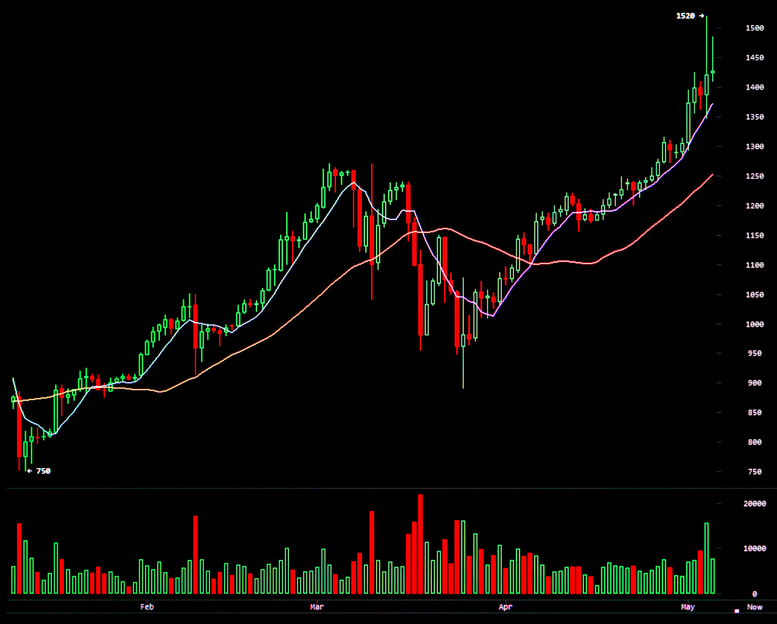
According to data aggregated from TradingView:
- Bitcoin (BTC) declined by approximately 12% over the past year.
- The Global X Robotics & Artificial Intelligence ETF rose by roughly 13% during the same period.
- Altcoins outside the top 10 suffered losses exceeding 30%.
This divergence matters. Speculative capital is performance-sensitive. When one narrative delivers positive momentum while another stagnates, capital reallocates quickly.
Macro Headwinds: Interest Rates and Liquidity Matter Again
Beyond narrative competition, macroeconomic conditions are intensifying crypto’s challenges.
Nansen Chief Research Analyst Aurélie Barthere emphasizes that crypto’s recent weakness cannot be separated from broader monetary dynamics. Markets have revised expectations around future interest rate cuts, with terminal rates now priced near 3.8% over the next five years.
Higher-for-longer rates tighten liquidity. Tight liquidity disproportionately harms speculative assets with uncertain cash flows—particularly altcoins.
AI and robotics companies, by contrast, increasingly demonstrate clearer revenue models, enterprise contracts, and government-backed industrial policy support. In a tightening liquidity environment, this distinction becomes decisive.
Regulatory Uncertainty Adds a Crypto-Specific Discount
Unlike AI and robotics, crypto faces an additional, sector-specific burden: regulatory ambiguity.
In the United States, delays surrounding the CLARITY Act have weighed heavily on sentiment. The postponement of committee discussions—triggered most recently by extreme winter weather—reinforces uncertainty around compliance obligations, custody rules, and market structure.
For institutional investors, uncertainty equals risk. When regulatory clarity stalls, capital waits—or leaves.
Venture Capital Tells a Similar Story
Venture capital flows provide another lens through which to observe this rotation.
[VC funding comparison chart for robotics, AI, and crypto]
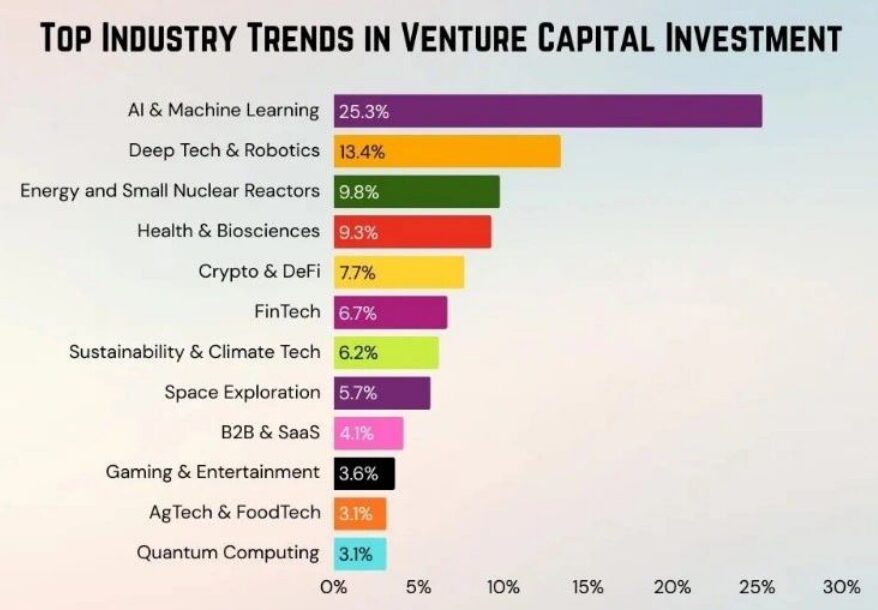
Data from Crunchbase shows that robotics startups raised approximately $13.8 billion in 2025, sharply up from $7.8 billion in 2024 and surpassing the previous record set in 2021.
Crypto venture investment also rebounded in 2025. According to Rootdata, investors deployed $18.2 billion across 902 deals—an 80% increase year-over-year.
However, momentum faded late in the year. Monthly investment plunged from $3.1 billion in November to $700 million in December, a 77% decline.
Market Shocks and Forced Deleveraging
This late-year slowdown coincided with a sharp crypto market correction following renewed geopolitical and trade tensions.
After former U.S. President Trump signaled higher tariffs on Chinese goods, crypto markets experienced a rapid drawdown. According to CoinGlass, liquidations reached $19 billion, exceeding the previous all-time record set in April 2021.
Such events leave lasting scars. Forced deleveraging reduces speculative appetite and pushes capital toward assets perceived as more structurally resilient.
Why AI and Robotics Are Winning the Narrative Battle
AI and robotics currently offer three advantages over crypto:
- Enterprise Adoption
AI tools are already embedded in corporate workflows, from customer service to software development. - Policy Alignment
Governments actively support automation, semiconductors, and AI infrastructure as strategic priorities. - Clear Monetization
Subscription models, licensing, and hardware sales provide predictable revenue streams.
Crypto, by contrast, still struggles to articulate its value beyond trading, speculation, and niche financial use cases—despite significant progress in payments, tokenization, and infrastructure.
What This Means for Crypto Builders and Investors
The implication is not that crypto is obsolete. Rather, it must evolve.
Crypto’s next growth phase is unlikely to be driven by meme-driven speculation alone. Instead, capital will increasingly favor:
- Tokenization of real-world assets
- Blockchain-based settlement and clearing
- Stablecoin-powered payment rails
- Integration with AI agents and autonomous systems
In other words, crypto must become infrastructure—not just an asset class.
Convergence, Not Competition, Is the Endgame
The most compelling opportunities may emerge at the intersection of crypto, AI, and robotics. Autonomous agents require trustless settlement. Robots operating in open environments need programmable money. Decentralized infrastructure can provide neutrality where centralized platforms cannot.
Speculative capital has not abandoned crypto entirely—it is demanding more from it.
Conclusion: A More Competitive, More Mature Future
The rotation of speculative capital from crypto into AI and robotics marks a turning point. Crypto is no longer the only exponential story in town. It must now compete on substance, utility, and integration.
For investors, this shift demands a more selective approach. For builders, it demands real-world relevance. For the industry as a whole, it signals maturation.
Crypto’s future belongs not to those chasing narratives—but to those building systems that matter.