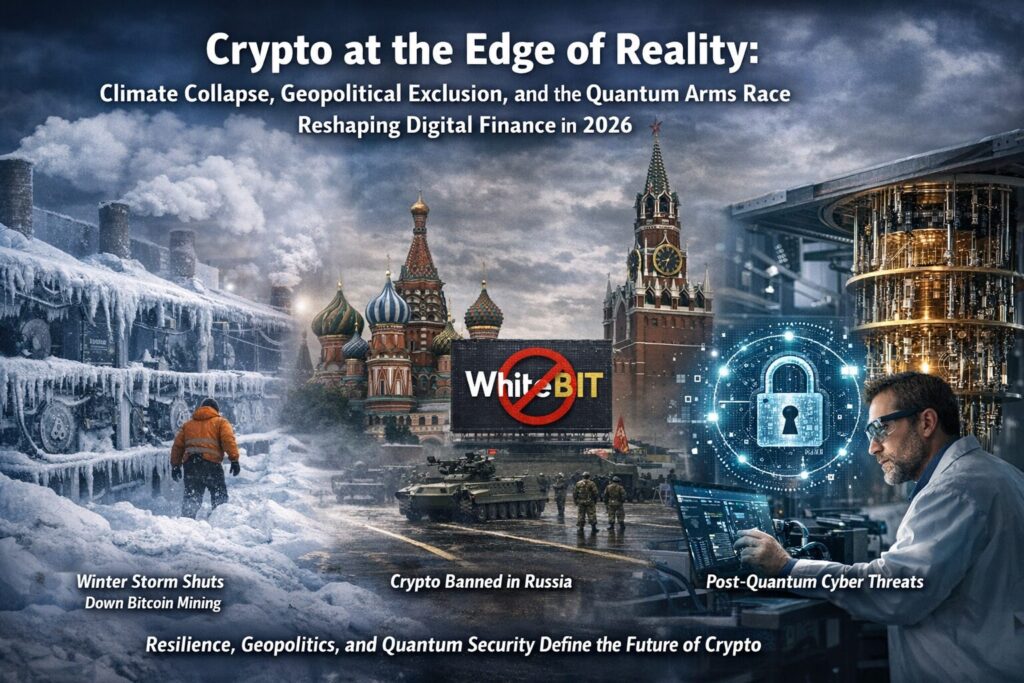
Key Takeaways :
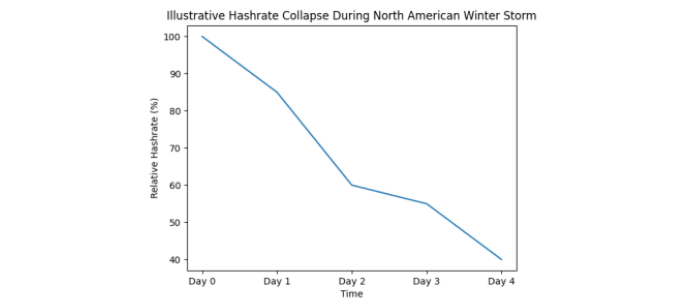
- A record-breaking winter storm in North America exposed the physical fragility of Bitcoin mining, wiping out nearly 60% of Foundry USA’s hashrate in days.
- Russia’s ban on the exchange WhiteBIT signals a new era where crypto platforms are treated as geopolitical weapons rather than neutral infrastructure.
- The Ethereum Foundation has quietly mobilized a post-quantum defense initiative, acknowledging that future computing power could invalidate today’s cryptography.
- Together, these events reveal that crypto’s next battlefield is not price volatility, but physical resilience, political alignment, and long-term cryptographic survival.
1. The North American Deep Freeze and the Shock of a Collapsing Hashrate
In early 2026, an unprecedented winter storm swept across large parts of North America, with Texas at its epicenter. Temperatures plunged far below historical averages, power grids strained under surging residential heating demand, and authorities issued emergency requests for industrial consumers to shut down electricity usage. For the cryptocurrency mining industry, whose lifeblood is uninterrupted power, this was a moment of brutal reckoning.
Mining facilities across Texas and neighboring states powered down en masse. Entire warehouses filled with ASIC machines fell silent, not because of software failure or market conditions, but because physical survival took precedence over digital economics. What followed was one of the most dramatic hashrate shocks in Bitcoin’s history.
The most alarming data point came from Foundry USA, one of the world’s largest mining pools. Within a very short period, its share of global hashrate dropped by roughly 60%. This was not a marginal fluctuation; it was a systemic rupture that sent shockwaves through the entire network. Bitcoin continued to function, but the event stripped away the comforting illusion that decentralization alone guarantees resilience.
This episode highlighted a structural vulnerability that had been building quietly for years: geographic concentration. In the relentless pursuit of efficiency, miners clustered where electricity was cheapest and regulatory conditions were favorable. North America, and Texas in particular, became a gravitational center for hashpower. Climate change, however, does not respect optimization models.
What the storm revealed is that a decentralized protocol can still rest on highly centralized physical foundations. When too much computational power is tied to one climate zone or one energy grid, a single natural disaster can create a global shock. The hashrate collapse was not merely an operational inconvenience; it was a warning about network security itself.
This was not just a temporary outage. It was a signal that mining infrastructure must once again become globally distributed, not as an ideological preference, but as a matter of systemic defense. As climate volatility increases, the old assumption of stable power availability becomes untenable.
The machines that went dark in subzero temperatures are a stark reminder that digital assets are ultimately grounded in the physical world. In 2026, asset security can no longer be discussed without reference to energy grids, weather patterns, and physical redundancy.
The price paid for years of efficiency-driven centralization was steep. The lesson is clear: resilience requires diversity. Only by spreading computational resources across continents, climates, and energy systems can the network withstand the increasingly violent swings of nature.
[“Illustrative Hashrate Collapse During North American Winter Storm”]
2. WhiteBIT and the Weaponization of Crypto Exchanges
While nature exposed one fault line, geopolitics tore open another. In a move that reverberated far beyond Eastern Europe, Russian authorities designated the cryptocurrency exchange WhiteBIT as an “undesirable organization,” effectively banning its activities within Russia. The justification was WhiteBIT’s continued financial support for Ukraine.
This decision marked a turning point. Cryptocurrency exchanges, long promoted as neutral marketplaces, were now explicitly framed as instruments of political alignment. For Russian users, the consequences were immediate and severe: restricted access, frozen assets, and the sudden realization that “borderless finance” has very real borders.
The WhiteBIT ban demonstrates that crypto assets are no longer judged solely by compliance or risk controls, but by perceived ideological loyalty. Supporting one side in a geopolitical conflict can result in total exclusion from another jurisdiction. Asset mobility, once seen as crypto’s defining advantage, has become a liability.
This is financial warfare by other means. Exchanges are pressured to choose sides, and neutrality is increasingly treated as complicity. The chilling effect extends far beyond WhiteBIT itself. Other platforms now face an unspoken but powerful question: which camp are you in?
For investors, this represents a profound shift in risk assessment. Political exposure has joined market volatility and technical risk as a primary concern. Holding assets on a platform subject to hostile jurisdictional action can mean instant loss of access, regardless of personal intent or legal standing.
The broader implication is grim. As states become more comfortable weaponizing financial infrastructure, ideological screening of users and platforms is likely to accelerate. Crypto, once envisioned as a refuge from state power, is being dragged directly into the arena of international conflict.
Internet censorship, network blocking, and legal coercion are no longer hypothetical threats. They are active tools. The WhiteBIT case is likely only the first of many such incidents, each reinforcing the reality that sovereignty still trumps code.
In this environment, self-custody, jurisdictional diversification, and a deep understanding of political risk are no longer optional. They are survival skills. True financial freedom remains elusive as long as assets remain tethered to state-controlled choke points.
In 2026, protecting wealth requires not just technical literacy, but geopolitical awareness.
3. Ethereum’s Quiet Mobilization Against the Quantum Threat
Beyond climate and politics lies a more abstract, but potentially existential danger: quantum computing. While still in development, sufficiently powerful quantum machines could render today’s cryptographic systems obsolete almost overnight.
Recognizing this, the Ethereum Foundation has quietly assembled a specialized team focused on post-quantum cryptography. The move itself is an admission that the threat is real, and that waiting for quantum computers to arrive before acting would be catastrophic.
Current signature schemes underpinning blockchain security rely on mathematical problems that are effectively unsolvable for classical computers. Quantum algorithms, however, threaten to collapse these assumptions. If private keys can be derived efficiently, every wallet becomes vulnerable.
The challenge is immense. Transitioning a live, multi-trillion-dollar network to quantum-resistant cryptography is not a simple upgrade. It requires rethinking the mathematical foundations of the protocol while maintaining backward compatibility and user trust.
This is not just a technical exercise; it is a race against time. The value of today’s digital assets depends entirely on whether these defenses can be deployed before quantum capability reaches a critical threshold.
What inspires confidence is not certainty, but preparedness. By confronting the threat early, Ethereum’s leadership signals a commitment to long-term survivability rather than short-term complacency.
Technological progress always casts a shadow. Quantum computing magnifies that shadow, but proactive defense can turn existential risk into a manageable transition.
In 2026, the myth of invulnerability is gone. Continuous adaptation is the only viable strategy.
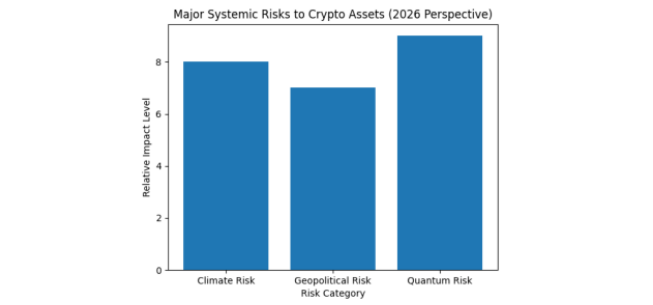
[“Major Systemic Risks to Crypto Assets (2026 Perspective)”]
Conclusion: Toward a New Financial Survival Strategy
The events of early 2026 make one thing painfully clear: the future of crypto will be shaped less by speculative cycles and more by resilience under pressure. Climate instability, geopolitical fragmentation, and technological disruption are converging into a single stress test.
For those seeking new digital assets, new revenue models, or practical blockchain applications, the opportunity remains vast—but only for those who adapt. Mining must decentralize physically. Asset custody must decentralize politically. Cryptography must evolve continuously.
Crypto is no longer just an innovation story. It is a survival story. And in that story, preparedness is the ultimate yield.