Main Takeaways :
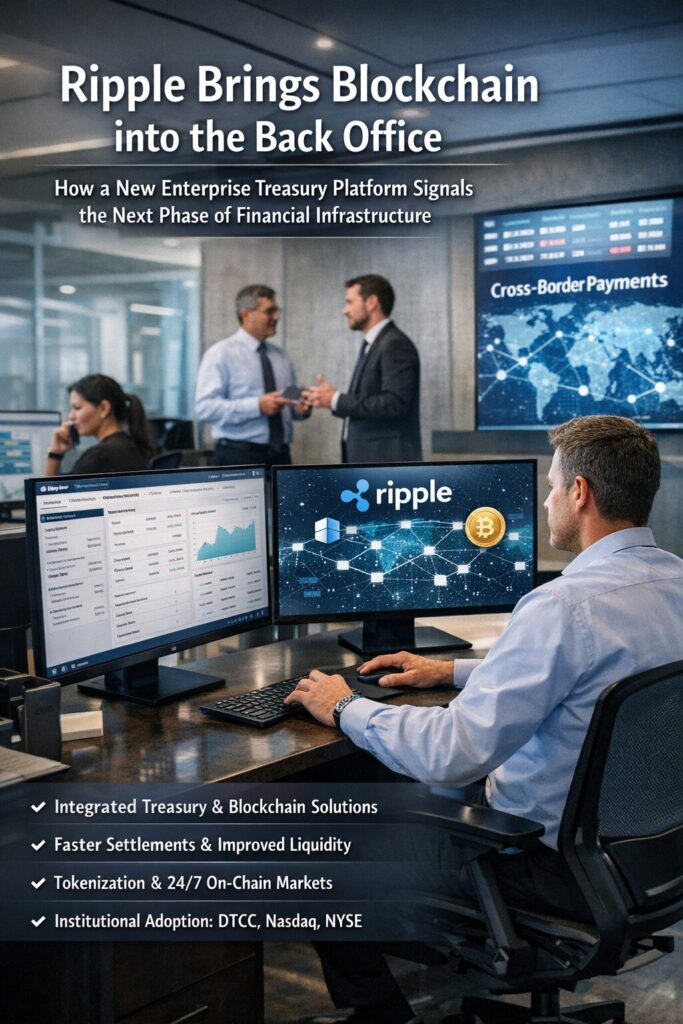
- Ripple has launched a new enterprise treasury platform that integrates blockchain and stablecoins directly into corporate back-office operations.
- By combining Gtreasury’s treasury management software with Ripple’s digital asset infrastructure, companies can manage cash, payments, and liquidity on a single system.
- The platform aims to shorten settlement cycles, improve cross-border liquidity efficiency, and unlock yield from idle corporate cash.
- This move aligns with a broader industry shift toward tokenization, 24/7 markets, and on-chain settlement led by institutions such as DTCC, Nasdaq, and the NYSE.
- For enterprises and investors, the development highlights practical, revenue-oriented blockchain use cases beyond speculation.
1. From Front Office to Back Office: Ripple’s Strategic Shift
For much of the past decade, blockchain adoption has been driven by front-facing use cases: cryptocurrencies for retail investors, decentralized finance (DeFi) for yield seekers, and NFTs for digital ownership experiments. Ripple’s newly announced enterprise treasury platform marks a decisive shift in focus—from the front office to the back office, where some of the largest inefficiencies in global finance still persist.
According to Ripple’s announcement, the platform integrates traditional treasury management tools with blockchain-based payment and settlement infrastructure. Built in partnership with Gtreasury, a well-established provider of treasury management software, the solution allows corporate users to manage cash positions, execute payments, and oversee liquidity using a single, unified system—without dismantling existing internal controls or workflows.
This is a critical point. Unlike many blockchain initiatives that require enterprises to rebuild processes from scratch, Ripple’s approach emphasizes continuity. Existing governance frameworks, approval hierarchies, and risk policies remain intact, while blockchain quietly enhances speed, visibility, and capital efficiency underneath.
2. Solving Long-Standing Treasury Pain Points
Corporate treasury teams face a familiar set of challenges: multi-day settlement cycles, fragmented bank accounts across jurisdictions, and limited real-time visibility into cash positions. These issues are especially pronounced for multinational corporations operating across time zones and currencies.
Ripple positions its new platform as a direct response to these structural inefficiencies. By leveraging blockchain rails and stablecoin settlement, transaction finality can be reduced from days to minutes. This not only accelerates payments but also improves liquidity forecasting and working capital management.
Cross-border payments are a particularly strong use case. Traditional correspondent banking introduces delays, fees, and foreign exchange uncertainty. Using stablecoins for settlement, the platform enables near-instant cross-border value transfer while reducing exposure to FX volatility. Importantly, all balances—fiat and digital—are visible within a single treasury dashboard, addressing one of the most persistent blind spots in corporate finance.
3. Unlocking Yield from Idle Corporate Cash
One of the most compelling aspects of the new platform is its potential impact on corporate cash utilization. During a product introduction session, Gtreasury CEO Renato Figueiredo highlighted a common but underappreciated reality: enormous sums of corporate cash sit idle overnight and over weekends due to banking hour constraints.
If settlement times shrink to minutes, treasurers can deploy surplus funds more dynamically, even outside traditional banking hours. This does not necessarily mean taking on speculative risk. Instead, companies can implement yield strategies that remain consistent with existing investment and risk management policies, but with far greater temporal flexibility.
In an environment of higher interest rates and tighter margins, the ability to generate incremental yield from previously inactive capital represents a meaningful competitive advantage. Blockchain, in this context, becomes not a speculative asset class but a capital efficiency tool.
4. Stablecoins as the Glue Between Fiat and Digital Assets
At the heart of Ripple’s treasury platform is stablecoin-based settlement, particularly Ripple USD (RLUSD), the company’s U.S. dollar–denominated stablecoin. As of the time of writing, RLUSD has a market capitalization of approximately $1.42 billion, according to DefiLlama data.
Stablecoins play a crucial role in bridging traditional finance and blockchain systems. They provide price stability, regulatory clarity, and operational familiarity—qualities essential for enterprise adoption. By using stablecoins for settlement and liquidity management, Ripple’s platform minimizes the volatility risks typically associated with cryptocurrencies while preserving the speed and programmability of blockchain.
From a treasury perspective, this creates a unified financial layer where fiat balances, stablecoins, and tokenized assets can coexist and be managed cohesively. As Figueiredo noted, removing friction depends on achieving full visibility across both digital assets and traditional currencies on a single platform.
Architecture of Ripple–Gtreasury Enterprise Treasury Platform
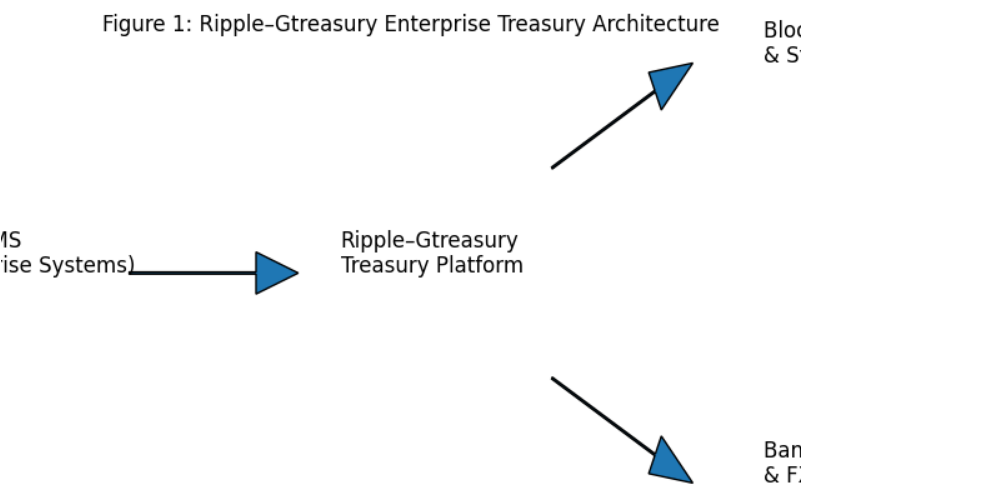
(Shows integration of ERP/TMS, blockchain settlement layer, stablecoins, and banking partners)
5. The Strategic Significance of Ripple’s Gtreasury Acquisition
Ripple’s acquisition of Gtreasury for $1 billion in October was more than a software purchase—it was a strategic bet on enterprise infrastructure. Gtreasury brings deep relationships with corporate finance teams, along with a mature treasury management product already embedded in enterprise operations.
By integrating blockchain capabilities into an existing, trusted treasury system, Ripple dramatically lowers adoption barriers. This contrasts with standalone blockchain solutions that struggle to gain traction due to compliance concerns, system incompatibility, or organizational inertia.
The acquisition also signals Ripple’s long-term vision: positioning blockchain not as an alternative to traditional finance, but as its invisible upgrade layer.
6. Tokenization and the March Toward 24/7 Markets
Ripple’s announcement arrives amid accelerating institutional momentum toward tokenization and around-the-clock markets. Traditional financial infrastructure, designed for limited trading hours and batch settlement, is increasingly misaligned with a global, digital economy.
In December, the U.S. Securities and Exchange Commission (SEC) issued a no-action letter allowing a subsidiary of the Depository Trust & Clearing Corporation (DTCC) to launch tokenized securities services. Initially focused on tokenized U.S. Treasuries issued on the Canton Network, the initiative is expected to expand to a broader range of securities.
DTCC processed approximately $370 quadrillion in securities transactions in 2024, underscoring the scale of infrastructure now experimenting with on-chain settlement.
7. Regulatory Winds Are Shifting
Regulatory posture is evolving alongside technology. SEC Chair Paul Atkins recently stated that U.S. financial markets are entering an “on-chain transition phase,” emphasizing the Commission’s willingness to prioritize innovation and adopt new technologies.
This shift is not merely rhetorical. Nasdaq has identified regulatory approval for tokenized equities as a top strategic priority, while the New York Stock Exchange is developing a blockchain-based trading platform designed for 24-hour trading of tokenized stocks and ETFs.
For enterprise users, these developments matter because they reduce regulatory uncertainty—a key obstacle to blockchain adoption in corporate finance.
Institutional Momentum Toward Tokenization and 24/7 Markets
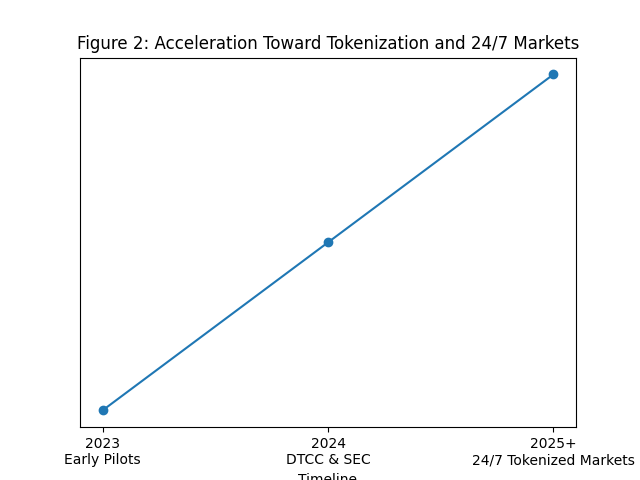
(Timeline showing DTCC, SEC, Nasdaq, NYSE initiatives)
8. Practical Implications for Investors and Builders
For readers seeking new crypto assets, revenue opportunities, or practical blockchain applications, Ripple’s treasury platform offers several insights.
First, value creation is increasingly moving toward infrastructure rather than speculative tokens. Platforms that integrate seamlessly with enterprise workflows are likely to capture durable, fee-based revenue streams.
Second, stablecoins are emerging as core financial primitives, not just trading instruments. Their role in settlement, liquidity management, and tokenized markets positions them as foundational assets in the next financial stack.
Finally, blockchain’s most transformative impact may occur behind the scenes. By improving settlement speed, transparency, and capital efficiency, blockchain enables incremental but compounding gains—exactly the kind that large enterprises value.
9. Risks and Open Questions
Despite the promise, challenges remain. Enterprise adoption depends on regulatory harmonization across jurisdictions, robust cybersecurity, and clear accounting treatment for digital assets. Integration complexity, while reduced by Gtreasury’s involvement, still requires careful change management.
Moreover, competition is intensifying. Banks, fintech firms, and other blockchain providers are racing to offer similar treasury and settlement solutions. Ripple’s success will depend on execution, ecosystem partnerships, and continued regulatory engagement.
Conclusion: Blockchain as Financial Plumbing
Ripple’s new enterprise treasury platform represents a quiet but profound evolution in blockchain adoption. Rather than chasing headlines, it targets the financial plumbing that underpins global commerce. By embedding blockchain into treasury operations, Ripple is reframing digital assets as tools for efficiency, yield, and resilience.
As tokenization accelerates and markets move toward 24/7 operation, the distinction between “traditional finance” and “crypto” continues to blur. For enterprises and investors alike, the message is clear: the next wave of blockchain value will be built not on hype, but on infrastructure.