Main Points :
- The simultaneous depreciation of the Japanese yen and rising Japanese Government Bond (JGB) yields signal deep structural stress in Japan’s monetary system.
- Arthur Hayes argues that this stress may force coordinated intervention by the Bank of Japan (BoJ) and the U.S. Federal Reserve, amounting to a de facto form of quantitative easing (QE).
- Such intervention would likely expand the Federal Reserve’s balance sheet, weaken the U.S. dollar, and inject global liquidity.
- Historically, expansions in global liquidity have strongly favored Bitcoin and select high-quality altcoins.
- For investors seeking new crypto assets, yield opportunities, and real-world blockchain use cases, this macro shift could define the next cycle.
1. The Warning Signal from Japan’s Bond Market
Arthur Hayes, co-founder of BitMEX, published an essay titled “Woomph” on January 27, warning that Japan’s bond market is flashing signals rarely seen in modern monetary history.
Under normal circumstances, when a country’s currency weakens, domestic government bonds are supported by local buyers, pushing yields lower. Japan is currently experiencing the opposite: the yen is depreciating while JGB yields are rising simultaneously.
This dual movement suggests that investors are not merely adjusting for inflation or interest-rate expectations—they are questioning Japan’s long-term fiscal sustainability.
Japan is heavily dependent on imported energy and raw materials. A weaker yen directly translates into higher domestic inflation. At the same time, rising bond yields increase the government’s debt-servicing costs. With public debt exceeding 250% of GDP, even modest yield increases significantly strain fiscal stability.
The largest holder of JGBs is the Bank of Japan itself. As yields rise, the BoJ incurs massive unrealized losses on its balance sheet, reducing its policy flexibility and credibility.
2. Why This Matters Beyond Japan
Japan’s financial stress does not remain domestic. Japanese institutional investors—banks, insurers, pension funds—hold approximately $2.4 trillion in foreign bonds, the majority of which are U.S. Treasuries.
If JGB yields continue rising, these investors face a rational incentive: sell foreign assets and repatriate capital to capture higher domestic yields. Such a move would trigger large-scale selling of U.S. government debt.
This scenario poses a direct threat to U.S. financial stability. A sudden surge in U.S. Treasury yields would tighten financial conditions globally, destabilize equity markets, and sharply increase borrowing costs for the U.S. government.
From this perspective, Japan’s bond market stress becomes a systemic global risk.
3. The Federal Reserve’s Likely Response: A Hidden QE
According to Hayes, the U.S. Federal Reserve would not remain passive in such a scenario. Instead, it could intervene indirectly through the New York Fed using global dollar liquidity mechanisms.
The proposed sequence is as follows:
- The New York Fed creates additional dollar liquidity via bank reserves, working with institutions such as JPMorgan.
- These dollars are sold in the foreign exchange market to purchase yen, supporting the Japanese currency.
- The acquired yen is then used to buy JGBs, suppressing bond yields.
On the Federal Reserve’s balance sheet, this would appear as an increase in “foreign currency assets.” Functionally, however, it mirrors quantitative easing: the expansion of base money to stabilize financial markets.
While politically sensitive, such coordination would align with U.S. interests. Preventing disorderly selling of U.S. Treasury securities is a strategic priority regardless of administration.
4. Dollar Weakness as a Feature, Not a Bug
A side effect—perhaps even a desired outcome—of this intervention would be a weaker U.S. dollar.
As the Federal Reserve expands liquidity, the dollar would depreciate against other major currencies. The euro and Chinese yuan would strengthen, reducing the export competitiveness of European manufacturers, particularly in Germany and France.
From a U.S. perspective, a weaker dollar improves export competitiveness and eases debt burdens. From a global perspective, it marks another step toward currency debasement as a policy tool.
5. Where Bitcoin Enters the Equation
Hayes’ core thesis is simple: Bitcoin thrives when central banks expand balance sheets.
Bitcoin is priced globally in fiat currencies. When the supply of those currencies increases, scarce digital assets reprice upward mechanically. This is not speculative theory—it has played out repeatedly since 2009.
During every major liquidity expansion—post-Global Financial Crisis QE, pandemic-era stimulus, and regional banking stress responses—Bitcoin outperformed most traditional assets.
Unlike equities, Bitcoin carries no earnings risk. Unlike bonds, it has no duration risk. Unlike real estate, it has no geographic constraints. It is pure monetary optionality.
6. Illustrative Macro Relationships (Graphs)
[Illustrative Co-movement: USD/JPY and JGB Yield]
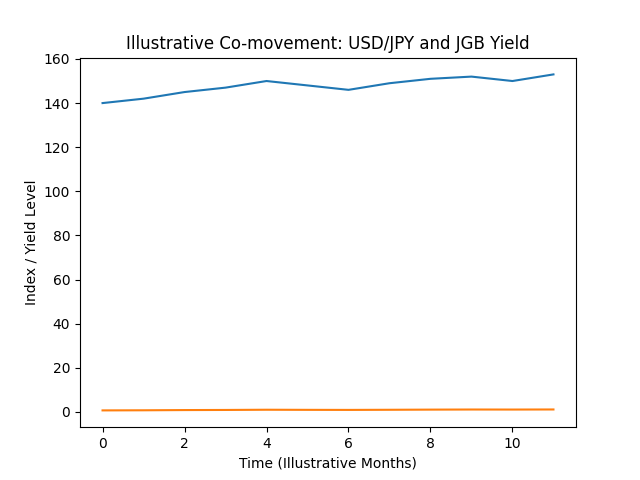
This conceptual chart shows the unusual scenario Hayes highlights: a weakening yen alongside rising bond yields, signaling a breakdown in conventional monetary expectations.
[Illustrative Relationship: Liquidity Expansion and Bitcoin]
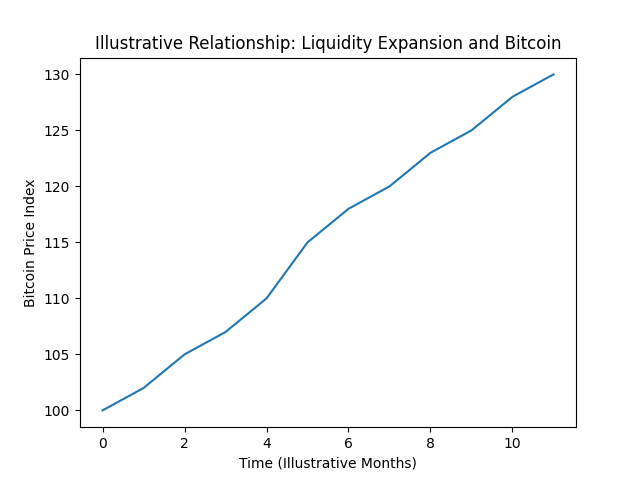
This chart illustrates how expansions in global liquidity have historically coincided with upward repricing in Bitcoin.
7. Implications for Crypto Investors and Builders
For readers seeking new crypto assets, revenue models, and practical blockchain use cases, this macro backdrop is critical.
Liquidity-driven cycles tend to favor:
- Bitcoin as the primary monetary hedge
- High-quality altcoins with real cash flow or infrastructure utility
- Blockchain protocols tied to payments, settlement, and cross-border value transfer
At the same time, speculative, low-liquidity tokens often underperform once volatility rises. Discipline in asset selection becomes more important, not less.
For builders, periods of monetary easing accelerate institutional interest in blockchain rails for treasury management, settlement efficiency, and alternative yield generation.
8. The Bigger Picture: Monetary Fragility as Opportunity
Japan’s bond market stress is not an isolated anomaly—it is a preview. Aging populations, high debt loads, and political constraints limit central banks’ ability to normalize policy.
As a result, balance sheet expansion remains the path of least resistance.
Bitcoin, by design, sits outside this system. It does not require trust in fiscal discipline, demographic stability, or political coordination. It simply responds to monetary reality.
Conclusion
Arthur Hayes’ analysis reframes Japan’s bond market turmoil as more than a regional issue—it is a trigger point for global monetary intervention.
If the Federal Reserve expands its balance sheet to stabilize Japan and protect U.S. Treasuries, the result will be increased liquidity, a weaker dollar, and renewed tailwinds for Bitcoin.
For investors and operators focused on the next generation of crypto assets and blockchain-driven revenue, this environment may define the coming years.
The “woomph” Hayes warns about is not just danger—it is momentum.