
Key Takeaways :
- Bitcoin is entering a high-volatility phase where a short-term bottom may form before the end of the month.
- Wyckoff analysis suggests a possible “Spring” event, potentially pushing BTC briefly below $80,000.
- On-chain momentum indicators show stabilization rather than strong bullish continuation.
- Macro events, including the FOMC decision, may act as catalysts for a decisive move.
- For investors and builders, this phase represents a strategic accumulation and positioning window rather than a breakout chase.
1. Market Overview: Bitcoin in a Transitional Phase
Bitcoin (BTC) has shown limited price movement during the early U.S. trading session, hovering around the mid-$80,000 range. While the lack of strong directional movement may appear unremarkable on the surface, deeper technical and on-chain analyses suggest that the market is approaching a critical inflection point.
Rather than signaling weakness, the current price behavior reflects a market digesting prior volatility. Analysts increasingly believe that Bitcoin is transitioning from a distribution or markdown phase into a preparatory stage for a longer-term structural move.
Importantly, this phase does not favor impulsive trading. Instead, it rewards investors and operators who understand market structure, liquidity behavior, and accumulation dynamics.
2. Short-Term Price Action and Technical Context
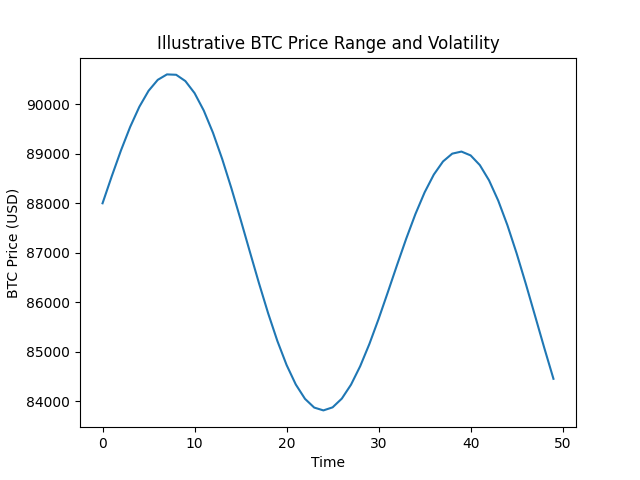
According to TradingView data, BTC/USD briefly climbed to approximately $88,315 before retracing lower. The price action remains range-bound, offering little directional clarity to short-term traders.
However, Keith Alan, co-founder of Material Indicators, highlighted a newly emerging daily trend signal. While this signal does not guarantee an immediate test of resistance, it significantly reduces the probability of Bitcoin revisiting the previous day’s lows.
A key technical level remains the daily close above approximately $87,500, which aligns closely with the yearly open. Failure to maintain this level—particularly through a long lower wick—could indicate renewed downside pressure and a possible breakdown scenario.
[Illustrative BTC Price Range and Volatility]
3. Macro Asset Environment: Calm Before the Storm
Bitcoin’s muted movement coincides with subdued volatility across traditional macro assets. U.S. equities such as the S&P 500 and Nasdaq opened slightly higher, while gold tested support near $5,000 per ounce.
This synchronized calm suggests that markets are collectively waiting for a macro catalyst. The most immediate is the Federal Open Market Committee (FOMC) interest rate decision, alongside guidance from Federal Reserve Chair Jerome Powell.
Despite political pressure for rate cuts, the CME FedWatch Tool indicates less than a 3% probability of a rate cut at this meeting. This disconnect between political narrative and market expectations increases the risk of volatility across risk assets, including Bitcoin.
4. On-Chain Momentum: Stabilization, Not Euphoria
Data from CryptoQuant offers a nuanced but constructive outlook. According to contributor Arab Chain, Binance data shows daily price momentum of approximately $1,676, with a positive momentum rate of 1.93%.
This indicates that Bitcoin is closing slightly higher than its opening price, reflecting an attempt by the market to regain equilibrium following prior selling pressure. Crucially, this is not indicative of strong bullish momentum. Instead, it reflects a quiet consolidation phase.
Order book data further supports this interpretation. Bitcoin is neither in a clear breakout phase nor a distribution phase. Instead, it occupies what Wyckoff theory describes as a “phase of growing anticipation.”
For builders and long-term capital allocators, such phases historically offer asymmetric risk-reward opportunities.
5. Wyckoff Theory Explained: Why the “Spring” Matters
Wyckoff theory focuses on the relationship between price, volume, and time to identify institutional accumulation and distribution patterns. One of its most important concepts is the “Spring.”
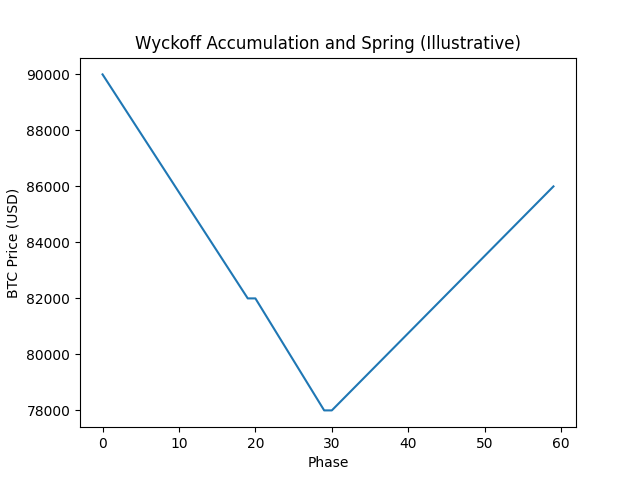
A Spring occurs when price temporarily breaks below a well-defined support level, triggering stop-losses and shaking out weak hands—only to quickly reclaim the range. This move often marks the final stage of accumulation before a sustained uptrend.
Market commentator MartyParty applied this framework to BTC/USDT and identified a potential Spring event aligning with this week’s macro events. His analysis suggests a brief dip below $80,000 is possible before a strong recovery.
This scenario does not imply a bearish trend reversal. On the contrary, within Wyckoff logic, it often precedes a powerful markup phase.
[Wyckoff Accumulation and Spring (Illustrative)]
6. Strategic Implications for Investors and Builders
For readers seeking new crypto assets, yield opportunities, or practical blockchain applications, the current environment carries several implications:
First, volatility-driven fear may create discounted entry points not only in Bitcoin but also in high-quality altcoins that are structurally tied to BTC liquidity cycles.
Second, infrastructure builders—such as exchanges, wallet providers, and payment platforms—should prepare for renewed user activity following this consolidation phase. Historically, accumulation phases precede increases in on-chain activity and transaction volumes.
Third, risk management is paramount. A Wyckoff Spring is, by definition, psychologically uncomfortable. Capital deployed during this phase should be structured with sufficient liquidity buffers and long-term conviction.
7. Beyond Price: Structural Signals to Watch
Price alone does not define opportunity. Several secondary indicators deserve attention:
- Exchange reserves: Continued decline suggests long-term holding behavior.
- Funding rates: Neutral or slightly negative rates often precede upward expansions.
- Stablecoin flows: Increases signal latent buying power.
- Volatility compression: Often resolves explosively.
When these align with Wyckoff-based accumulation structures, the probability of favorable outcomes increases substantially.
8. Conclusion: A Quiet Turning Point with Outsized Implications
Bitcoin’s current price action may appear uneventful, but beneath the surface, market structure is evolving rapidly. Wyckoff analysis, on-chain metrics, and macro positioning all point toward a critical turning point.
Whether or not Bitcoin briefly dips below $80,000, the broader narrative remains intact: this is not a distribution top, but a late-stage accumulation environment.
For those focused on discovering new crypto assets, identifying future revenue streams, or building real-world blockchain applications, this period should be viewed not with fear, but with disciplined curiosity and strategic intent.