Main points :
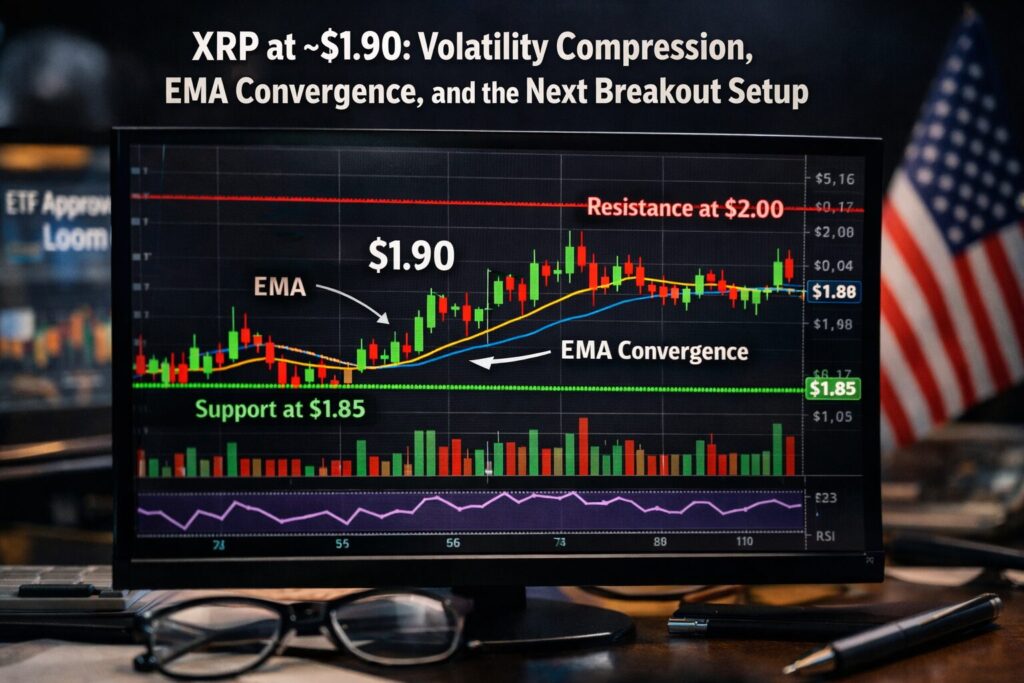
- XRP is trading around $1.90, with price action tightening into a classic volatility compression zone.
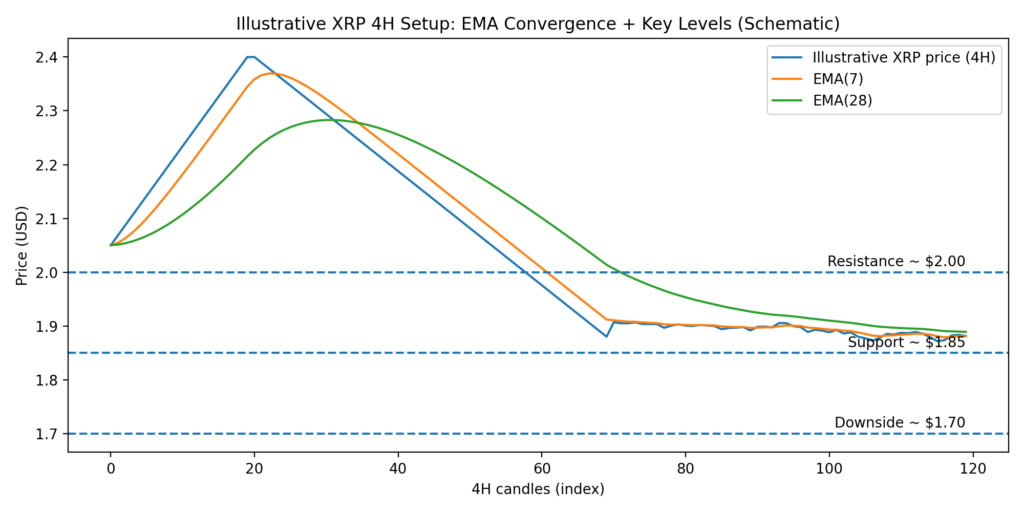
- The EMA(7) and EMA(28) are converging, a frequent “decision point” pattern where the next directional move tends to arrive suddenly once the market chooses a side.
- The tactical battleground is whether XRP can break and hold above the 28 EMA (turning it from resistance into support).
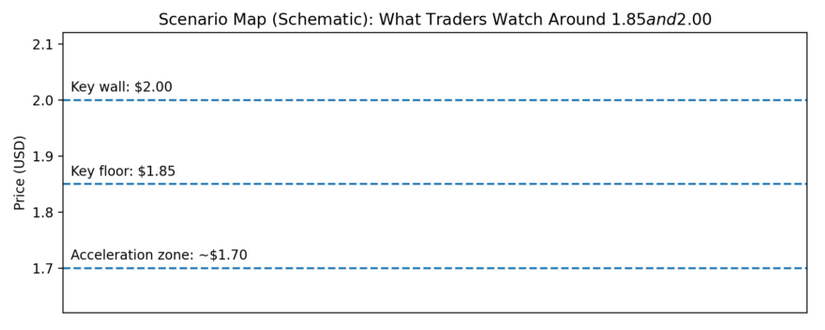
- Key levels to watch are $1.85 (support / floor) and $2.00 (psychological resistance and supply zone).
- Beyond the chart, XRP’s narrative is being shaped by institutional wrappers and ETF-related flow headlines, and by a broader shift toward regulatory/process clarity in U.S. crypto markets.
1) Where the market is right now: “Quiet before the move”
XRP is hovering near $1.90, and—more importantly—its short-term swings have narrowed.
In technical terms, this is the kind of setup traders often describe as “coiling”: a period where the market seems undecided, liquidity thickens around a tight band, and both buyers and sellers become increasingly sensitive to a break in either direction.
This is not just a chart cliché. Compression phases can matter because they frequently reflect a real shift in behavior:
- Short-term traders reduce position sizes after a large move and wait for confirmation.
- Market makers tighten spreads as realized volatility falls.
- Late entrants from the prior trend get trapped and become forced buyers/sellers once a key level breaks.
In the Japanese article you referenced, the narrative fits this archetype perfectly: XRP ran up toward ~$2.40 earlier in January, then faced sustained sell pressure and started printing lower highs—yet it also showed meaningful demand around the $1.80–$1.85 region.
That combination often produces a “spring-loaded” zone. The market is not moving much now precisely because participants are debating whether the prior rally was just a spike—or the first leg of a larger re-pricing.
2) The core technical tension: EMA(7) and EMA(28) are colliding
The most actionable element in the original analysis is the convergence between the 7-period EMA and the 28-period EMA on the 4-hour timeframe. In practice:
- EMA(7) is often used as a “fast” trend proxy—if price consistently holds above it, momentum is typically bullish in the short run.
- EMA(28) frequently behaves like a mid-term “gate.” In downtrends, price struggles below it; in uptrends, it becomes support.
When these EMAs converge, it tends to imply that (a) the prior trend has weakened, (b) the market is undecided, and (c) a breakout attempt is likely because traders are clustering their decisions around the same band.
The next question becomes simple and binary:
Can XRP break above the EMA(28) and then stay above it long enough for that line to flip from resistance into support?
That “support flip” is the difference between a one-candle fakeout and a real regime change. If XRP pushes above EMA(28) but immediately gets shoved back below, it often indicates that larger sellers are using the bounce as an exit.
Illustrative XRP 4H Setup: EMA Convergence + Key Levels
3) Level-based playbook: $1.85 floor vs. the $2.00 wall
In tight markets, levels are often more useful than predictions. The referenced analysis identifies two levels that matter because they are both technical and behavioral.
The floor: $1.85 (and the $1.80–$1.85 demand zone)
The repeated bounces near $1.80–$1.85 suggest that buyers have been willing to defend that region.
This zone also acts as a “truth test”: if XRP breaks it cleanly, it signals that the market’s willingness to absorb supply is fading.
Bear-case mechanics
If the current rebound fails (a “dead cat bounce” or bull trap) and price drops below the EMA(28) again, traders typically shift their focus immediately to the nearest defended level. In this case, that is $1.85.
- If $1.85 holds, the market may continue ranging.
- If $1.85 breaks, the move often accelerates as stop-losses trigger and sidelined shorts gain confidence.
The referenced scenario calls out a potential push toward the $1.70s if the breakdown is decisive. That’s a reasonable map, not because $1.70 is “guaranteed,” but because once a floor breaks in a compressed market, the next liquidity pocket can be surprisingly far away.
The ceiling: $1.95–$2.00 (and why $2.00 is a different beast)
Even if XRP stabilizes above the EMA cluster, bulls still face the zone near $1.95–$2.00.
The number $2.00 is psychologically important. Round numbers attract:
- profit-taking from traders who bought the dip,
- “sell walls” from participants who want to exit at an obvious level,
- and new speculative entries that can be easily reversed if the break fails.
That’s why many breakouts above a round number succeed only when supported by volume expansion (real participation) rather than thin-liquidity spikes.
Scenario Map (Schematic): What Traders Watch Around $1.85 and $2.00
4) Adding context: the institutional wrapper narrative (ETFs and tradable products)
A chart setup gets stronger when it aligns with a plausible flow story. In early 2026, XRP headlines have repeatedly focused on ETF-related developments and institutional access vehicles—even when the market disagrees on their direct impact.
- The Block maintains an XRP ETF tracker that aggregates applications and status updates across issuers.
- Grayscale’s XRP-related product page for “GXRP” emphasizes exposure to XRP through an ETF wrapper (and periodic updates tied to trading platform constituents have been reported via TradingView news feeds).
- Financial news aggregation has also circulated claims around “XRP ETF inflows” and institutional behavior. While such articles can be noisy and require careful verification, they reflect the broader reality that tradable wrappers—when real—can alter liquidity and positioning behavior.
Why does this matter for a trader or a builder looking for practical blockchain use?
Because flows change market structure. If more of the market accesses XRP through wrappers, it can affect:
- where large hedges happen,
- how arbitrage transmits volatility,
- and how quickly spot price reacts to demand shocks.
Even if you are not trading, these developments can influence strategic decisions like treasury exposure, payment corridor timing, and liquidity provisioning.
5) Regulatory backdrop: why “clarity” headlines still move XRP
XRP is unusually sensitive to regulatory tone because its multi-year identity was defined by the Ripple–SEC litigation era. Reuters reported that the SEC ended its lawsuit against Ripple, with Ripple paying $125 million and both sides dropping appeals (reported August 2025).
Even after a case conclusion, the market tends to “reprice the narrative” in waves:
- First wave: relief rally (uncertainty premium falls).
- Second wave: re-evaluation (what does it mean for listings, banks, payments, and product issuance?).
- Third wave: policy and market structure (how do new rules affect XRP’s role relative to other assets?).
In early 2026, U.S. policy debate has also included letters and commentary around SEC priorities and crypto enforcement posture—signals that the regulatory environment remains a live variable rather than a settled constant.
Separately, SEC-facing public documents and correspondence about crypto market structure have continued to circulate (including a document framed as a response to a Ripple-related letter), showing that Ripple remains engaged in the broader policy conversation.
The practical implication: XRP is often not “just a chart.” It trades as a hybrid of:
- a liquid large-cap crypto asset,
- a regulatory narrative token,
- and a payments/cross-border thesis proxy.
That blend can amplify breakout moves once a technical trigger aligns with a sentiment trigger.
6) What this means for “next revenue” and practical blockchain users
Your audience is looking for new assets, yield or revenue opportunities, and practical blockchain usage—not only speculative price talk. Here are the actionable takeaways framed that way:
For traders (short-term)
- The cleanest decision framework is EMA(28) hold vs. reject, anchored by $1.85 and $2.00.
- Compression phases can reward patience: the edge often comes from waiting for confirmation (close above resistance + follow-through), not guessing the breakout.
For builders and operators (mid-term)
- If ETF or wrapper products become more meaningful, they can change liquidity conditions—useful for market-making, treasury execution, and corridor sizing.
- Regulatory tone shifts can still affect counterpart behavior (exchanges, banks, payment partners), even after major court cases are “done.”
For “practical usage” investors
- Treat XRP’s technical setup as a timing lens: it can help decide when to scale into exposure, when to hedge, and when to avoid providing liquidity if volatility is likely to expand.
- Separate “headline flow” from “settlement reality.” Institutional access vehicles can matter, but only when they are confirmed, liquid, and large enough to influence spot markets.
Conclusion: a compressed spring with clear levels
XRP around $1.90 looks like a market that is saving its energy.
The convergence of short- and mid-term EMAs on the 4-hour chart is a classic signal that the current equilibrium may not last. The immediate question is whether XRP can break and hold above the 28 EMA and then build enough strength to challenge $1.95–$2.00.
If it fails and slips back below the EMA gate, the market’s attention shifts quickly to $1.85—and a clean break there can accelerate downside toward the $1.70s. If it succeeds, the prize is not just a bounce, but a potential regime shift where the EMA(28) becomes support and the market can attempt a higher-high structure again.
The important part is that this is not an ambiguous setup. It is a clear, level-driven map—exactly the type of environment where disciplined traders and pragmatic operators can align risk controls with observable triggers rather than opinions.