Main Points :
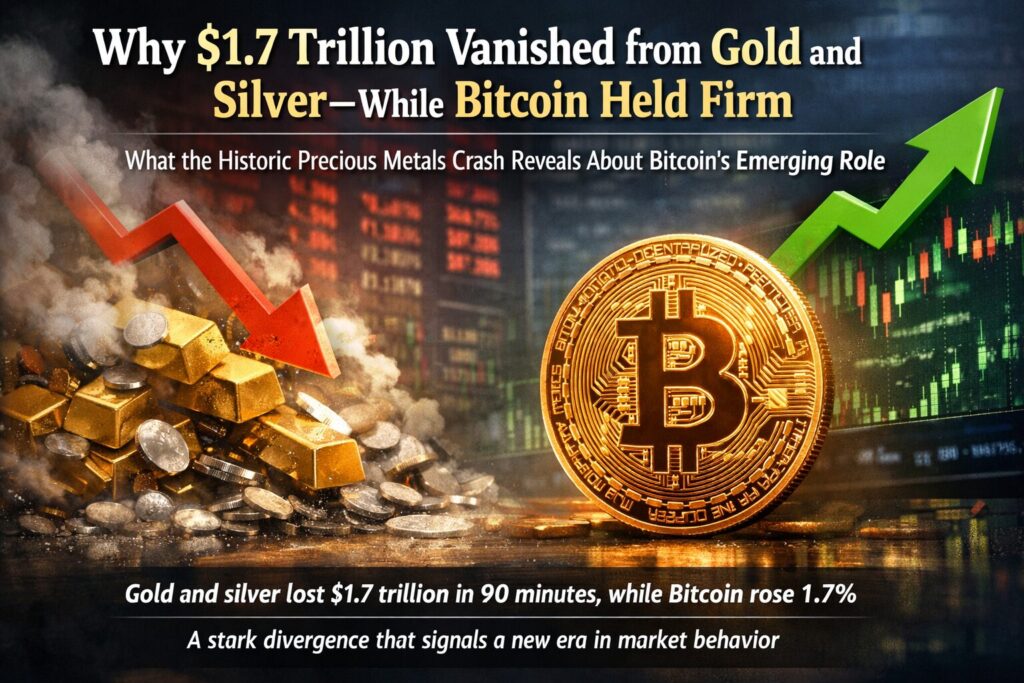
- Gold and silver lost a combined $1.7 trillion in market capitalization in just 90 minutes, one of the largest reversals in modern market history.
- The collapse appears driven primarily by overheated positioning and rapid deleveraging, rather than a structural loss of confidence in precious metals.
- In sharp contrast, Bitcoin (BTC) rose approximately 1.7% over the same period, reinforcing its narrative as an alternative, non-sovereign asset.
- The divergence does not automatically imply a direct capital flight from gold to Bitcoin, but it does highlight how differently these markets now behave.
- For investors seeking new crypto assets, yield opportunities, or practical blockchain use cases, this event marks an important inflection point in portfolio construction.
The Shock: A $1.7 Trillion Evaporation in 90 Minutes
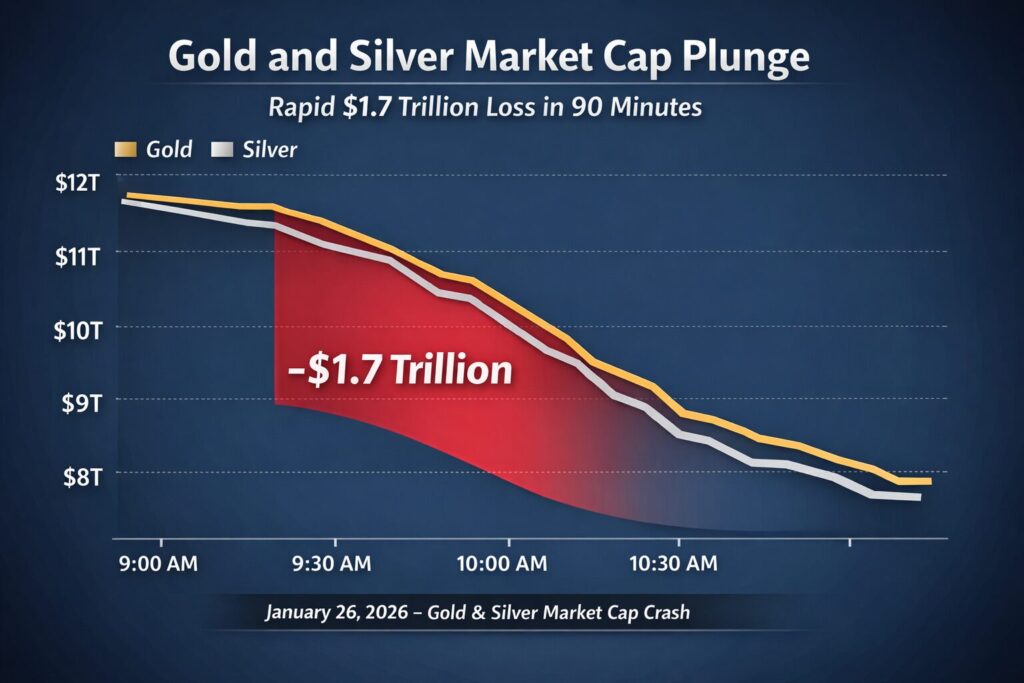
Financial markets were jolted on January 26, 2026, when gold and silver prices experienced an abrupt and historic collapse. According to widely cited market data, the combined market capitalization of these two traditional safe-haven assets fell by approximately $1.7 trillion in just 90 minutes.
Such a move is almost without precedent. Precious metals markets are typically deep, liquid, and comparatively slow-moving relative to equities or cryptocurrencies. A collapse of this magnitude, compressed into such a short time window, signals extreme stress somewhere in the system—whether in leverage, positioning, or liquidity provision.
This was not a gradual correction. It was a violent reversal, unfolding faster than many institutional risk models are designed to handle.
【Gold and Silver Market Capitalization Drop (Intraday, USD)】
Volatility Exposed: The Fragility Beneath “Safe Havens”
Gold and silver have long been considered the ultimate stores of value—assets that protect purchasing power during inflation, geopolitical instability, and systemic financial stress. However, the recent plunge has exposed a less-discussed reality: even safe havens are not immune to speculative excess.
In the months leading up to the crash, both metals had enjoyed strong upward momentum. Futures markets showed rising leverage, ETF inflows accelerated, and narrative-driven buying intensified amid persistent inflation concerns and global monetary uncertainty.
When sentiment turned—even slightly—the unwinding was brutal. Margin calls triggered forced selling, algorithmic strategies amplified downward momentum, and liquidity temporarily evaporated. This combination created a cascading effect that rapidly erased trillions in notional value.
The lesson is not that gold and silver are “broken,” but that modern financial markets transmit stress at unprecedented speed, regardless of asset class.
Bitcoin’s Contrarian Performance: Calm Amid the Chaos
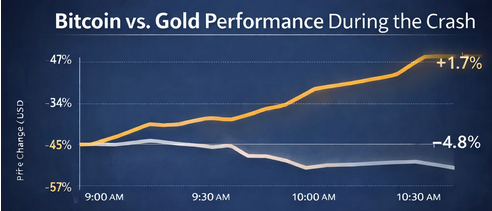
While precious metals were imploding, Bitcoin told a very different story. Over the same 24-hour window, BTC rose approximately 1.7%, maintaining relative stability and even modest strength.
This divergence immediately reignited debate around Bitcoin’s role as “digital gold.” Historically, critics have argued that Bitcoin behaves more like a risk asset than a safe haven, especially during equity sell-offs. Yet in this instance, Bitcoin decoupled not only from equities, but also from traditional safe assets.
This performance matters not because of the percentage gain itself, but because of what did not happen: Bitcoin did not experience panic selling. There was no cascading liquidation comparable to the metals market. Network activity remained stable, and spot demand absorbed volatility efficiently.
【Bitcoin vs. Gold Performance During the Crash (USD)】
Did Capital Actually Flow from Gold to Bitcoin?
A popular narrative quickly emerged: investors were fleeing gold and silver and reallocating directly into Bitcoin. While appealing, this explanation is likely overly simplistic.
The gold and silver crash appears largely driven by internal market dynamics—specifically, the unwinding of crowded long positions after a prolonged rally. There is limited evidence, at least in the immediate data, of massive, synchronous capital flows directly from metals ETFs into Bitcoin spot markets.
Instead, what we are observing is asynchronous market behavior. Gold corrected because it had become overheated. Bitcoin held firm because its supply-demand dynamics, investor base, and leverage profile are structurally different.
In other words, Bitcoin did not rise because gold fell. Bitcoin rose because nothing forced it to fall.
Structural Differences: Why Bitcoin Behaved Differently
To understand this divergence, it is critical to examine the structural contrasts between these markets.
Gold and silver markets are heavily intermediated. They rely on futures exchanges, bullion banks, custodians, ETFs, and rehypothecation. Leverage is deeply embedded. When stress emerges, selling pressure can multiply rapidly.
Bitcoin, by contrast, operates on a globally distributed, 24/7, spot-settled network. While derivatives exist, the underlying asset can be held directly without counterparty risk. There is no central clearinghouse that can suddenly tighten margin requirements across the entire system.
Moreover, Bitcoin’s supply is programmatically fixed. No new issuance can be accelerated in response to price signals. This creates a fundamentally different reflexivity compared to commodities, where supply expectations and inventory dynamics play a major role.
Implications for Investors Seeking New Crypto Opportunities
For readers interested in discovering new crypto assets or identifying the next sustainable revenue stream, this episode offers several insights.
First, Bitcoin is increasingly behaving as a macro asset in its own right, rather than merely a high-beta speculation vehicle. This strengthens its role as a portfolio anchor within digital assets.
Second, the event underscores the importance of on-chain liquidity and settlement finality. Assets that can be transferred, settled, and custodied without intermediaries may prove more resilient during periods of systemic stress.
Third, the divergence opens space for second-layer opportunities: yield strategies, infrastructure tokens, and blockchain-based financial primitives that benefit from volatility without depending on leverage-driven speculation.
【Traditional Safe Haven vs. Bitcoin Market Structure】

Beyond Price: Practical Blockchain Use in Volatile Markets
Price performance alone does not define value. One reason Bitcoin maintained stability is that it continues to function as a global settlement layer, independent of market narratives.
During periods of volatility, capital controls tighten, cross-border transfers slow, and counterparty risk becomes more salient. Bitcoin’s utility as a censorship-resistant, borderless asset becomes more than theoretical—it becomes operational.
This is where practical blockchain use cases intersect with macro market behavior. Payment rails, treasury diversification, collateralization, and even accounting frameworks increasingly incorporate digital assets not for speculation, but for resilience.
What This Means for the “Digital Gold” Thesis
The events surrounding the $1.7 trillion gold and silver crash do not definitively prove that Bitcoin has replaced precious metals. However, they do suggest that the investment landscape has changed.
Bitcoin is no longer merely an outsider asset reacting to traditional markets. It is increasingly one of the variables shaping those markets. Its behavior during stress events is becoming as informative as its performance during bull runs.
The digital gold thesis is evolving—from a metaphor into a measurable market phenomenon.
Conclusion: A Turning Point, Not a Verdict
The historic collapse in gold and silver prices was a stark reminder that no asset is immune to modern market dynamics. At the same time, Bitcoin’s resilience highlighted the growing maturity of the crypto market.
This was not a simple story of capital rotation. It was a demonstration of structural divergence. Traditional safe havens and digital assets now respond to stress through different mechanisms, on different timelines, and with different risk profiles.
For investors seeking new crypto assets, future revenue streams, or real-world blockchain applications, the message is clear: understanding how assets behave under pressure is now as important as understanding why they rise.
Bitcoin’s calm amid the storm may not mark the end of gold’s relevance—but it strongly suggests that the definition of “safe haven” is being rewritten.