Main Points :
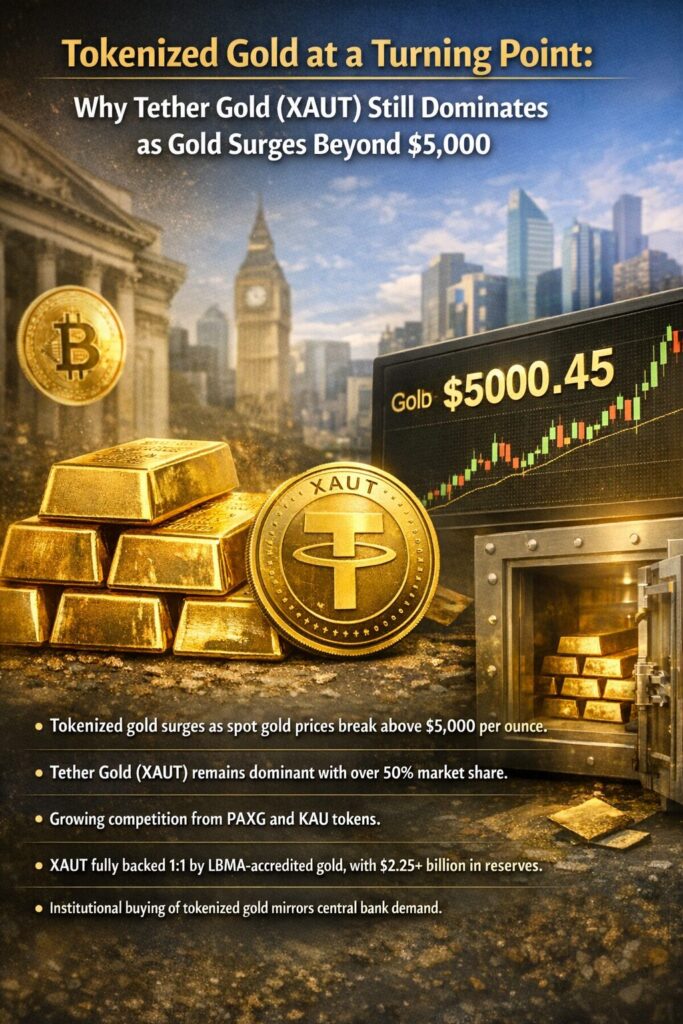
- Tokenized gold is rapidly expanding as spot gold prices break above $5,000 per ounce, attracting both crypto-native and traditional capital.
- Tether Gold (XAUT) has seen its market share decline from around 60% to just over 50%, yet it remains the dominant tokenized gold product.
- Rising competition from tokens such as PAXG and KAU reflects diversification rather than weakness in XAUT’s fundamentals.
- XAUT is fully backed 1:1 by LBMA-accredited physical gold, with total reserves exceeding $2.25 billion.
- Institutional-style accumulation of gold via tokenization is increasingly comparable to central bank activity.
- Tokenized gold is emerging as a practical bridge between traditional commodities and blockchain-based finance.
1. The Rapid Expansion of the Tokenized Gold Market
The tokenization of real-world assets (RWAs) has long been discussed as one of blockchain’s most practical use cases, but few sectors demonstrate this potential as clearly as gold. In early 2026, tokenized gold entered a decisive phase as global gold prices surged past $5,000 per troy ounce, reaching intraday highs above $5,100.
This dramatic price movement coincided with a noticeable expansion in the overall market capitalization of gold-backed cryptocurrencies. While Tether’s gold-linked token XAUT experienced a decline in relative market share, this shift reflects a growing ecosystem rather than a loss of confidence. The tokenized gold market itself is becoming broader, deeper, and more competitive.
Gold has historically functioned as a hedge against currency debasement, geopolitical instability, and systemic financial risk. In an environment characterized by a weakening U.S. dollar, persistent inflationary pressure, and geopolitical uncertainty, gold’s renewed appeal is unsurprising. What is new, however, is the increasing role of blockchain infrastructure in distributing and managing gold exposure.
2. XAUT’s Market Share Decline: A Sign of Maturity, Not Weakness
According to data compiled by The Block, XAUT’s share of the tokenized gold market fell from approximately 60% at the end of 2025 to slightly above 50% in January 2026. At first glance, such a decline may appear concerning. In context, however, it reflects structural maturation.
As tokenized gold gains legitimacy, investors are no longer confined to a single issuer. Competing products such as PAXG and KAU have attracted inflows from users seeking diversification, alternative custodianship models, or different jurisdictional risk profiles. This mirrors the evolution of stablecoins, where early dominance gradually gives way to a multi-issuer landscape.
Crucially, XAUT has not lost absolute scale. On the contrary, its supply and underlying gold reserves have continued to grow in nominal terms, even as competitors expand alongside it.
3. Inside the Reserves: How XAUT Is Backed
A December 31, 2025 report published by El Salvador–based issuer TG Commodities provides rare transparency into XAUT’s backing structure. As of that date, the issuer held 528,989.350 troy ounces of LBMA-accredited gold, backing 528,989.300 XAUT tokens on a strict 1:1 basis.
At prevailing gold prices, this translated into total reserves exceeding $2.25 billion. The marginal difference between gold held and tokens issued reflects operational buffers rather than fractional backing.
Of the total issued supply:
- Over 409,200 XAUT had already been sold and distributed to market participants.
- Approximately 118,700 tokens remained available for future issuance.
This reserve structure places XAUT closer to an exchange-traded commodity product than to an algorithmic or partially collateralized crypto asset. Unlike synthetic exposure via derivatives, XAUT represents direct ownership claims on specific physical gold bars stored in accredited vaults.
4. Tokenized Gold vs. Central Banks: A New Scale of Accumulation
One of the most striking disclosures in the report was that Tether Gold Investments added nearly 27 metric tons of gold exposure in Q4 2025 alone. This volume exceeds the quarterly purchases of most national central banks during the same period.
Paolo Ardoino, CEO of Tether, stated that the company now operates at a scale comparable to sovereign gold holders. While such claims warrant scrutiny, the underlying numbers support the broader point: tokenized gold has reached a level of institutional relevance.
This shift challenges the traditional assumption that meaningful gold accumulation is restricted to states, central banks, and large financial institutions. Blockchain-based issuance allows private entities to aggregate capital globally and deploy it into physical gold with unprecedented efficiency.
5. Why Gold Is Surging Above $5,000
Gold’s price breakout above $5,000 per ounce did not occur in isolation. Analysts broadly attribute the rally to three overlapping forces:
First, sustained weakness in the U.S. dollar has eroded confidence in dollar-denominated reserves. As real yields compress and fiscal deficits expand, gold has reasserted itself as a neutral reserve asset.
Second, geopolitical uncertainty—ranging from regional conflicts to trade fragmentation—has reinforced gold’s role as a non-sovereign store of value.
Third, global liquidity dynamics have favored hard assets. As capital seeks insulation from both inflation and policy risk, gold and silver have benefited disproportionately.
Tokenized gold magnifies these dynamics by lowering barriers to entry. Investors who might never purchase or store physical bullion can now gain exposure through blockchain wallets, decentralized finance platforms, or centralized exchanges.
6. Practical Use Cases: Beyond Simple Price Exposure
While speculative demand remains a factor, tokenized gold is increasingly used for practical financial applications:
- Collateral in DeFi protocols, enabling borrowing without liquidating long-term gold exposure.
- Cross-border settlement, where gold-backed tokens act as neutral value units outside the dollar system.
- Treasury diversification, particularly for crypto-native companies seeking to reduce volatility.
- On-chain accounting, allowing transparent verification of commodity-backed reserves.
These use cases align closely with the broader RWA narrative, where blockchain serves not to replace traditional assets but to make them more programmable, liquid, and globally accessible.
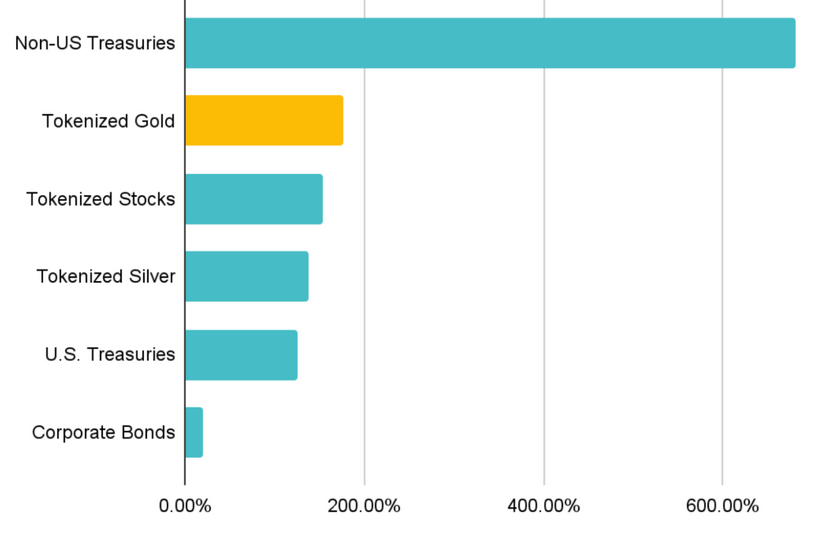
Tokenized Gold Market Share Breakdown (XAUT vs. Competitors, 2024–2026)
7. Comparing XAUT with Other Gold-Backed Tokens
The rise of competitors such as PAXG and KAU highlights differing design philosophies within the same asset class. Some emphasize regulatory alignment, others prioritize on-chain composability, and still others focus on regional custody diversification.
XAUT’s distinguishing feature remains its scale and integration with the broader Tether ecosystem. For users already operating within crypto markets, this integration reduces friction and enhances liquidity. However, increased competition may ultimately benefit users by driving higher transparency standards and more robust reserve disclosures across the sector.
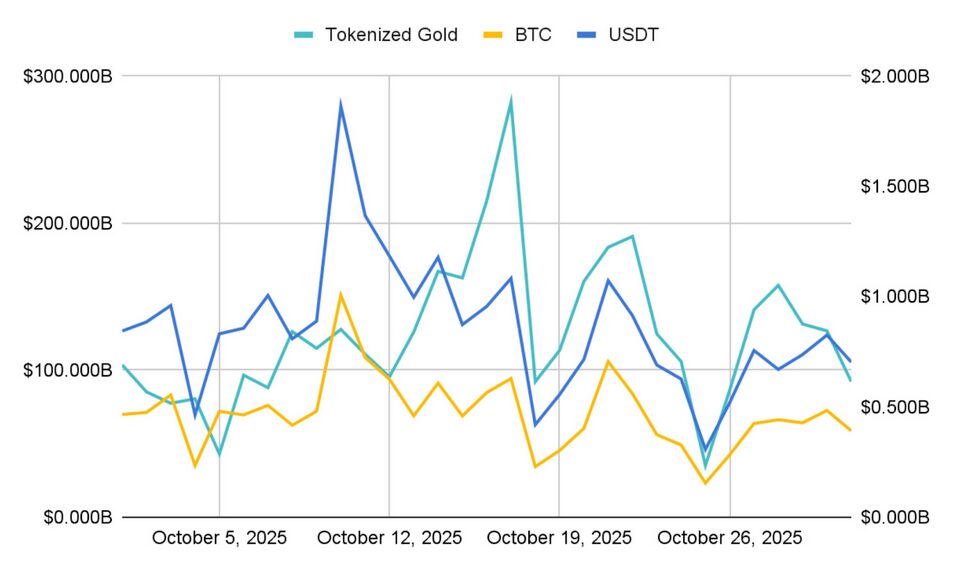
Gold Price Surge and Tokenized Gold Supply Growth (USD-denominated)
8. Implications for Crypto Investors and Builders
For investors seeking new crypto assets and revenue opportunities, tokenized gold occupies a unique middle ground. It lacks the upside volatility of early-stage tokens but offers stability, composability, and macro relevance.
For builders and institutions, the sector demonstrates how blockchain can support large-scale, compliant financial products anchored in real-world value. As regulatory frameworks for RWAs mature, tokenized commodities may become a foundational layer of digital finance rather than a niche product.
9. Conclusion: Tokenized Gold as a Pillar of the Next Financial Stack
Tether Gold’s declining market share does not signal retreat; it signals arrival. As gold prices surge beyond $5,000 and tokenized exposure becomes mainstream, dominance naturally gives way to pluralism.
XAUT remains the single largest and most influential tokenized gold product, backed by billions of dollars in physical reserves and operating at a scale comparable to sovereign actors. At the same time, rising competition underscores the sector’s credibility and long-term potential.
For those exploring the intersection of blockchain, commodities, and global finance, tokenized gold is no longer an experiment. It is an emerging pillar of a more programmable, transparent, and multipolar financial system.