
Main Points :
- Bitcoin fell to $86,166, marking its lowest level in 40 days, as global investors rotated into traditional safe-haven assets such as gold and silver.
- Severe winter storms in the United States forced a large number of Bitcoin miners offline, sharply reducing hash rate and triggering a decline in mining difficulty.
- Miner profitability has deteriorated significantly, raising the risk of short-term selling pressure and a potential retest of the $85,000 level.
- While the sell-off reflects short-term stress, it also reveals structural dynamics that long-term investors and infrastructure builders should closely monitor.
1. Bitcoin’s Price Drop in Context: Risk-Off Sentiment Returns
Bitcoin opened the week of January 26 under heavy selling pressure, sliding to $86,166 in early Asian trading. This level represented the lowest price since December 19, 2025, effectively wiping out Bitcoin’s year-to-date gains and pushing performance back into negative territory.
The immediate catalyst was not crypto-specific news, but a broader shift in global risk sentiment. Ahead of the U.S. market open, capital flowed aggressively into traditional safe-haven assets. Gold surged to fresh all-time highs near $5,000 per ounce, while silver extended its rally above $100, marking gains of roughly 18% and 60% year-to-date respectively.
Bitcoin, increasingly treated by macro traders as a high-beta risk asset rather than a defensive hedge, was sold alongside equities and other risk-sensitive instruments. Although prices rebounded intraday toward $88,900, the recovery lacked conviction.
What makes this episode particularly important is that the price decline coincided with visible stress inside the Bitcoin network itself, especially on the mining side. Unlike purely sentiment-driven pullbacks, this downturn reflects a combination of macro fear and operational disruption.
2. Macro Pressure and Extreme Weather: A Rare Double Shock
The broader macro environment entering late January was already fragile. Persistent geopolitical tensions, uncertainty around U.S. monetary policy, and slowing global growth had put investors on edge. Against this backdrop, a severe winter storm system—known as Winter Storm Fern—swept across key regions of the United States.
The storm caused widespread power outages, infrastructure disruptions, and emergency shutdowns. For Bitcoin, the impact was immediate and measurable.
The United States currently accounts for approximately 40% of the global Bitcoin hash rate, making it the single most important geographic contributor to network security. When U.S.-based miners go offline en masse, the effects ripple through the entire system.
As the storm intensified, multiple large-scale mining facilities were forced to halt operations to prevent hardware damage and comply with local grid restrictions. This was not a marginal event—it represented one of the most significant weather-driven mining disruptions in recent years.
3. Mining Difficulty and Hash Rate Decline: On-Chain Signals Turn Bearish
[Bitcoin Mining Difficulty (Blockchain.com) – showing decline from early January to late January]
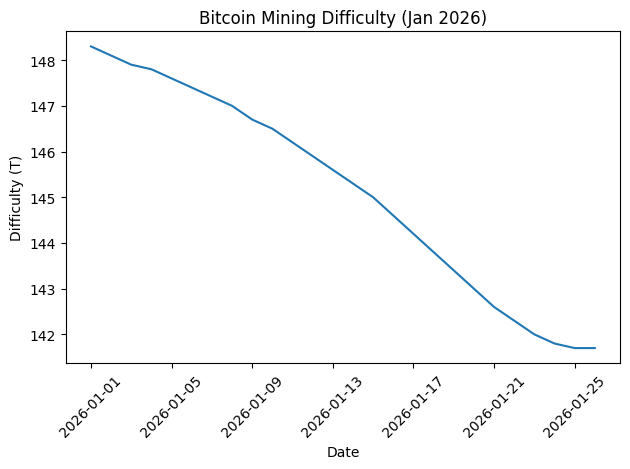
On-chain data quickly confirmed the operational impact. According to real-time metrics from Blockchain.com, Bitcoin’s mining difficulty fell to 141.7 trillion (T) on January 26, down from 148.3T on January 7. This represents a decline of approximately 4.5% over just 20 days.
Mining difficulty is adjusted every 2,016 blocks to keep average block times close to 10 minutes. A decline of this magnitude indicates that a significant portion of miners had dropped offline.
Blockspace Intelligence has gone further, estimating that if current conditions persist until the end of the ongoing adjustment cycle, the network could see an additional downward difficulty adjustment of up to 16%.
For experienced crypto participants, this is a critical signal. Difficulty declines are not inherently negative—in fact, they can improve profitability for miners who remain online. However, in this case, the drop reflects forced outages, not voluntary optimization.
4. Miner Shutdowns and Network Slowdown: Structural Stress Emerges
[Bitcoin Hash Rate by Major Mining Pools – highlighting Foundry USA decline]
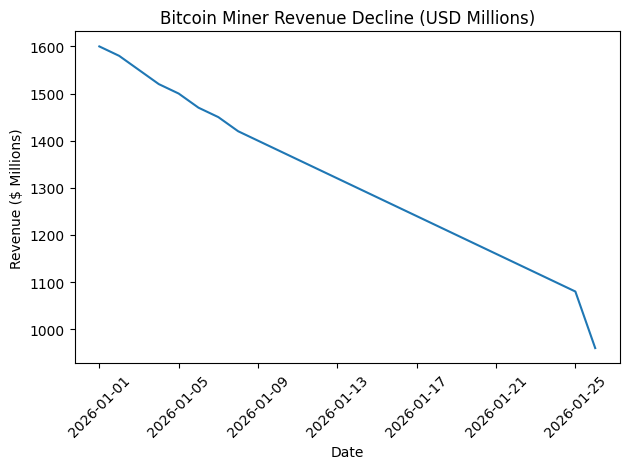
The most dramatic evidence of disruption came from Foundry USA, the world’s largest Bitcoin mining pool. Reports indicate that Foundry’s hash rate dropped by nearly 60% during the peak of the storm.
As a result, the average Bitcoin block time extended beyond 12 minutes, signaling a noticeable slowdown in transaction processing and network efficiency.
While users may not immediately feel the impact unless congestion rises, these delays matter for miners. Slower block production means fewer block rewards distributed per unit of time, directly affecting revenue.
This combination—lower hash rate, slower blocks, and declining fees—creates a feedback loop that places additional financial stress on miners already operating on thin margins.
5. Miner Revenue Collapse: From Peak to Pressure
[Monthly Bitcoin Miner Revenue Since October 2025 – steady decline]
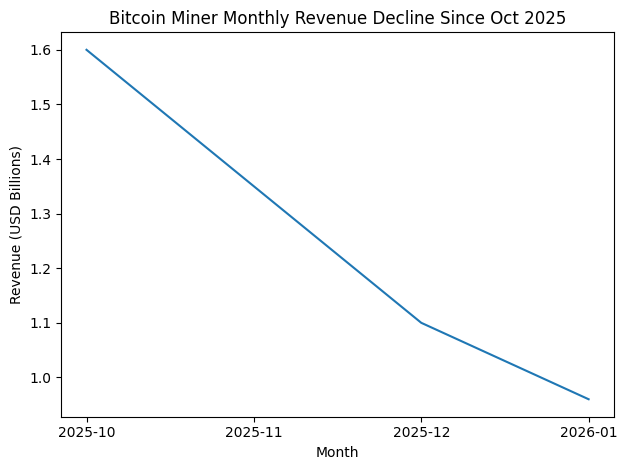
Data from Newhedge shows that total Bitcoin miner revenue for January 2026 is projected to remain below $960 million, marking the first time in several months that monthly revenue has fallen under the $1 billion threshold.
This is a sharp contrast to October 2025, when miner revenue peaked at approximately $1.6 billion. Since then, revenue has declined steadily due to a combination of:
- Lower transaction fees
- Rising operational costs
- Increased competition prior to the storm
- Now, forced downtime and slower block production
For publicly listed miners and highly leveraged operations, this environment is particularly dangerous. When revenue drops quickly, miners often have no choice but to sell Bitcoin holdings to cover operating expenses, increasing short-term sell pressure in the spot market.
6. Short-Term Price Outlook: Why $85,000 Matters
The rebound above $88,000 on Monday provided temporary relief, but structurally it failed to establish a strong support base. From a market-structure perspective, the combination of:
- Declining mining difficulty
- Slower block times
- Falling miner revenue
- Persistent macro risk aversion
suggests that downside risks remain elevated.
If safe-haven flows continue to favor gold and silver, and if miner stress persists into the next difficulty adjustment, Bitcoin could realistically retest the $85,000 level in the near term.
Importantly, this scenario does not require panic or systemic failure—only continued liquidity needs among miners and cautious positioning by macro investors.
7. Strategic Implications for Investors and Builders
For readers seeking new crypto assets, yield opportunities, or practical blockchain applications, this episode offers several important lessons.
First, infrastructure matters. Bitcoin’s decentralization is real, but physical realities—energy grids, weather, and geography—still influence network behavior. Similar risks apply to other proof-of-work systems and even to proof-of-stake networks with concentrated validator infrastructure.
Second, miner stress often precedes short-term volatility but long-term opportunity. Historically, periods of declining difficulty and miner capitulation have laid the groundwork for more resilient network conditions once equilibrium is restored.
Third, for builders and investors focused on revenue generation, this environment favors:
- Energy-efficient mining technologies
- Hedging strategies using derivatives
- Infrastructure plays that reduce geographic concentration
- Layer-2 solutions and fee-optimization services
Rather than viewing the downturn as purely bearish, sophisticated participants can treat it as a stress test revealing where value will accrue next.
Conclusion: A Temporary Shock with Lasting Insights
Bitcoin’s drop to a 40-day low near $86,000 reflects more than a routine price correction. It highlights the intersection of macro risk aversion, physical infrastructure constraints, and the evolving economics of mining.
In the short term, the path of least resistance may still point lower, with $85,000 acting as a key psychological and technical level. However, the underlying network continues to function, adjust, and adapt exactly as designed.
For long-term investors, system builders, and those searching for the next sustainable crypto revenue model, this period offers valuable insight into how Bitcoin behaves under real-world stress—and where the next opportunities may emerge once the storm passes.