
Main Points :
- Public price bets on Ethereum reveal more about crypto culture than price reality
- The failure of the $25,000 ETH bet highlights structural limits of mature crypto assets
- For ETH to reach $25,000, a fundamental re-rating of global financial infrastructure is required
- ETFs, scaling upgrades, and staking alone are insufficient to justify a multi-trillion-dollar valuation
- Ethereum’s real opportunity lies not in price speculation, but in cash-flow-generating on-chain activity
1. The $25,000 Ethereum Bet: What Actually Failed
In late 2024, a public wager between Kain Warwick, founder of Infinex, and **Kyle Samani at Multicoin Capital, captured the crypto community’s imagination.
Warwick confidently predicted that Ethereum would reach $25,000 by the end of 2025, offering odds as high as 10:1. Samani accepted the bet publicly. When the deadline passed, Ethereum was trading near $3,000, missing the target by more than 700%.
On the surface, this looks like a simple failed price prediction. In reality, it exposed a deeper issue:
Ethereum is no longer an “undiscovered asset.”
This distinction matters.
Early-stage assets can reprice violently due to information discovery. Ethereum, however, is one of the most liquid, institutionally monitored, and heavily analyzed assets in the digital economy.
A 7–8× move at this stage does not happen by optimism alone.
2. Why Public Bets Matter in Crypto Culture
Public bets like this one serve a cultural function in crypto. They replace traditional analyst reports with performative conviction.
In earlier cycles, such bets often paid off because:
- Market capitalization was small
- Use cases were speculative
- Capital inflows were asymmetric
In 2025–2026, Ethereum no longer fits this profile.
The wager’s failure highlights a shift:
Crypto markets are transitioning from narrative-driven discovery to valuation-driven accountability.
This is not bearish. It is maturation.
3. What $25,000 ETH Actually Implies (The Math)
At $25,000 per ETH, Ethereum’s fully diluted valuation would exceed $3 trillion.
That places Ethereum alongside:
- The largest sovereign bond markets
- Global systemically important banks
- The largest payment and settlement infrastructures
To justify this valuation, Ethereum must demonstrate:
- Sustained, non-speculative transaction demand
- Meaningful protocol-level revenue
- Institutional dependency, not just exposure
- Clear dominance over competing execution layers
This is not impossible—but it is far from guaranteed.
[Ethereum Valuation vs Global Financial Infrastructure (Conceptual Comparison)]
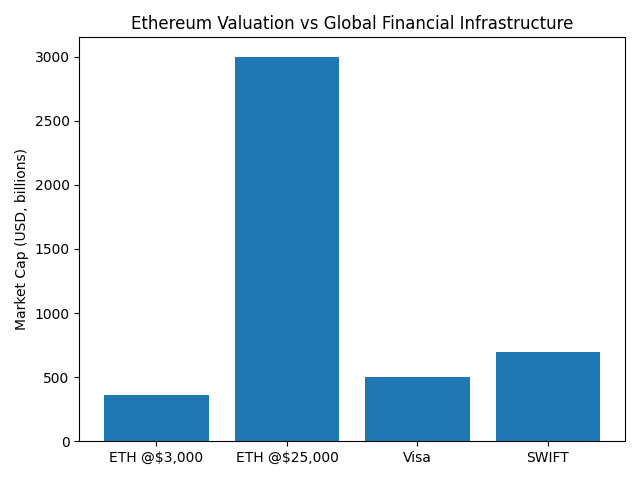
Bar chart comparing Ethereum market cap at $3,000 vs $25,000 ETH against Visa, SWIFT, major banks
Purpose: Visualize the scale problem ETH must overcome
4. ChatGPT’s View: Repricing Requires Structural Proof
When asked about Ethereum’s $25,000 prospects, ChatGPT delivered a notably sober assessment.
Its core argument:
Ethereum does not need better sentiment—it needs proof of expanded economic necessity.
Specifically:
- Growth in on-chain fee generation
- Demonstrable institutional reliance on Ethereum settlement
- A measurable increase in real economic throughput, not just token velocity
In other words, Ethereum must behave less like a speculative asset and more like a global operating system for finance.
5. Grok’s Counterpoint: Maturity Is a Constraint
Grok offered a harsher—but realistic—counterview.
Its key insight:
Ethereum’s long trading history is not a strength for price explosions—it is a constraint.
A 7× move implies the market has fundamentally misunderstood ETH’s value for nearly a decade. That is a strong assumption.
Grok correctly points out:
- ETFs improve access, not valuation
- Scaling upgrades improve efficiency, not demand
- Staking improves holder behavior, not necessarily revenue
These are necessary conditions, not sufficient catalysts.
6. Technical Analysis: Why the Market Is Hesitating
Technical indicators reinforce this skepticism.
Rising exchange reserves suggest increasing sell-side liquidity. Historically, this correlates with downward or sideways price action.
Analysts warn that Ethereum could revisit $2,500 before any sustained breakout attempt.
[ETH Exchange Reserves vs Price Trend (Illustrative)]
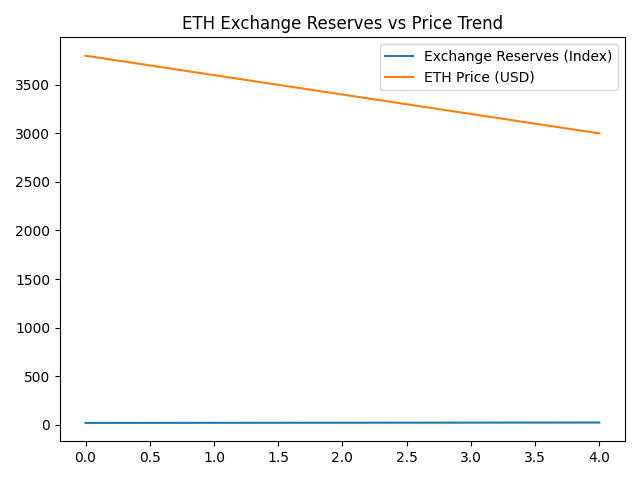
Line chart showing rising reserves alongside flat or declining price
Purpose: Explain why liquidity signals matter more than narratives
7. The Real Bull Case: Ethereum as a Cash-Flow Network
The strongest long-term case for Ethereum is not price—it is cash flow.
Key areas that matter more than speculation:
a) Layer-2 Fee Capture
Ethereum increasingly acts as a settlement layer for rollups. Sustainable fee extraction from L2s is critical.
b) Real-World Assets (RWA)
Tokenized treasuries, funds, and credit instruments settle preferentially on Ethereum.
c) Institutional Settlement
If banks, brokers, and payment firms rely on Ethereum—not just invest in ETH—valuation logic changes.
d) MEV and Protocol Revenue
Transparent, protocol-captured MEV could convert volatility into yield.
[Ethereum Value Flow: Speculation vs Economic Utility]
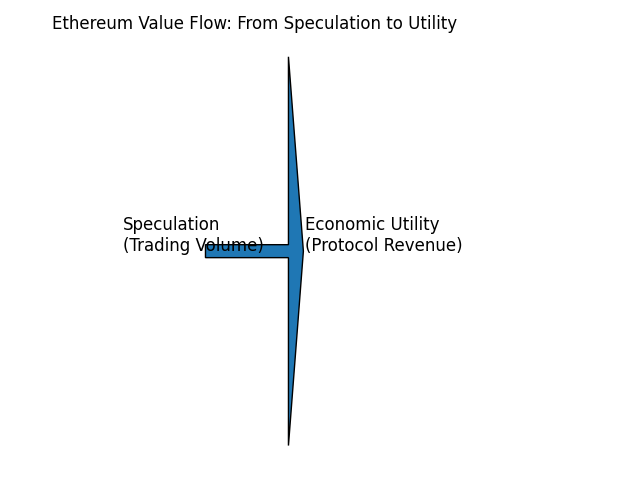
Diagram showing shift from trading volume to protocol revenue
Purpose: Reframe ETH as infrastructure, not lottery ticket
8. Can ETH Reach $25,000 by 2026? A Realistic Answer
Yes—in theory.
But only if multiple conditions align simultaneously:
- Global macro liquidity expansion
- Regulatory clarity favoring on-chain settlement
- Ethereum capturing dominant share of institutional tokenization
- Sustained protocol-level revenue growth
Absent these, $25,000 remains a narrative target, not a valuation outcome.
Conclusion: From Hope to Discipline
The failed $25,000 bet was not an embarrassment—it was a signal.
Ethereum is graduating from myth to measurement.
For investors and builders, the next cycle will not reward hope.
It will reward execution, revenue, and utility.
Ethereum’s future is still enormous—but it will be earned, not wished into existence.