
Main Points :
- Colombia’s second-largest pension fund manager, Protección, is preparing a Bitcoin-linked investment option for qualified pension clients.
- This move signals accelerating institutional acceptance of Bitcoin in Latin America, particularly within conservative retirement systems.
- The initiative emphasizes portfolio diversification rather than speculative exposure.
- Regulatory clarity is improving, as Colombia introduces crypto reporting rules aligned with OECD standards.
- For investors and builders, Latin America is emerging as a critical frontier for real-world crypto integration.
Introduction: A Quiet but Historic Shift in Pension Investing
In early 2026, Colombia crossed a subtle but meaningful threshold in the global evolution of digital assets. Protección, the country’s second-largest private pension and severance fund manager, confirmed that it is preparing an investment fund offering exposure to Bitcoin (BTC). While the announcement was framed conservatively—emphasizing limited access and strict advisory procedures—the implications extend far beyond Colombia’s borders.
Pension funds are among the most risk-averse institutional investors in the world. Their mandates prioritize capital preservation, long-term stability, and regulatory compliance over aggressive returns. When such institutions begin to incorporate Bitcoin, even in small proportions, it reflects a deeper structural change in how digital assets are perceived: not as speculative instruments, but as potential components of long-term, diversified portfolios.
This article examines what Protección’s move really means, places it in the broader Latin American and global context, and explores why this development matters for investors seeking new crypto assets, new revenue streams, and practical blockchain use cases.
Protección’s Bitcoin Initiative: What Was Announced
Protección’s CEO, Juan David Correa, disclosed in an interview with local media outlet Valora Analitik that the firm is preparing a Bitcoin-linked investment fund. Access to the product will be limited and offered only through individualized advisory processes that assess each client’s risk tolerance.
Only investors who meet predefined suitability criteria will be allowed to allocate a portion of their pension portfolios to Bitcoin exposure. Correa emphasized that diversification is the core principle behind the initiative, stating that eligible investors may choose to allocate a small percentage of their portfolios to this new asset class if it aligns with their risk profile.
Crucially, Protección clarified that this product will not alter the core structure of Colombia’s pension system. Traditional assets such as bonds and equities will remain the foundation of pension portfolios, with Bitcoin positioned strictly as a supplementary diversification tool.
The Scale of Protección and Colombia’s Pension Market
Founded in 1991, Protección manages pension and severance assets for approximately 8.5 million clients. The firm oversees more than $55 billion in assets under management. Across Colombia’s mandatory pension fund system, total assets reached approximately $132 billion as of late 2025, with nearly half invested internationally.
In this context, even a modest Bitcoin allocation—say 1–3% for a limited subset of investors—could translate into hundreds of millions of dollars in indirect crypto exposure over time. More importantly, it establishes institutional precedent.
Illustrative Pension Portfolio Allocation with Bitcoin
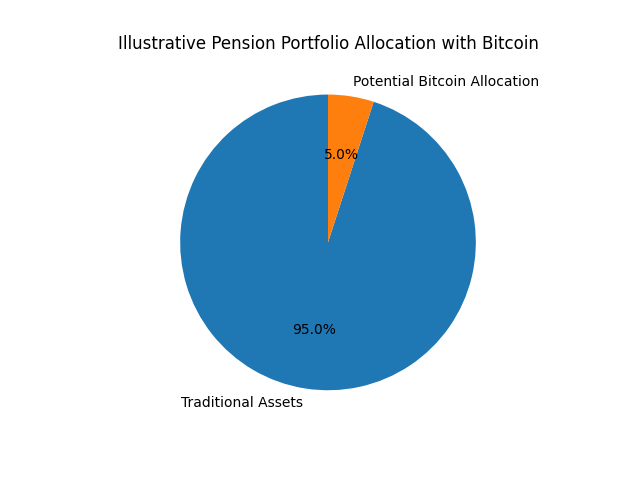
Figure 1 illustrates a conceptual pension portfolio where Bitcoin represents a small, controlled allocation alongside traditional assets.
Following the First Movers: Scandia and the Emerging Pattern
Protección is not Colombia’s first pension manager to explore Bitcoin. In September of the previous year, Scandia Administradora de Fondos de Pensiones y Cesantías began offering Bitcoin exposure to a portion of its portfolio.
With Protección now following suit, Colombia has two major pension managers actively engaging with digital assets. This is no longer an isolated experiment—it is an emerging pattern.
Globally, similar developments can be observed:
- In the United States, spot Bitcoin ETFs have enabled indirect pension exposure via public markets.
- In Canada, pension funds have invested in crypto-related infrastructure and custodians.
- In Europe, regulatory sandboxes are increasingly accommodating tokenized funds and crypto-linked instruments.
Latin America’s entry into this trend is particularly significant due to the region’s history of currency volatility, capital controls, and financial exclusion.
Why Bitcoin, and Why Now?
Portfolio Diversification and Non-Correlated Assets
Bitcoin’s primary institutional appeal lies in its historical behavior as a non-correlated or weakly correlated asset relative to traditional equities and bonds. While volatility remains high, long-term data suggests that small allocations can improve risk-adjusted returns in diversified portfolios.
For pension funds, the goal is not to “bet on Bitcoin,” but to hedge against systemic risks such as inflation, currency depreciation, and geopolitical instability.
Demographic Pressure and Client Demand
Pension fund clients are becoming younger, more digitally literate, and more aware of alternative assets. Ignoring Bitcoin entirely risks pushing savers toward informal or unregulated channels. By offering regulated exposure, pension funds can retain trust while adapting to changing expectations.
Colombia’s Regulatory Shift: Crypto Reporting and OECD Alignment
Earlier this month, Colombia’s tax authority, DIAN, introduced a formal reporting framework for crypto service providers. Exchanges, custodians, and intermediaries are now required to collect and submit user identification data and transaction records.
This framework aligns with the OECD’s Crypto-Asset Reporting Framework (CARF), enabling automatic exchange of tax information with foreign authorities. Under the new rules, service providers must comply with due diligence and valuation standards or face penalties.
Rather than stifling innovation, this regulatory clarity lowers institutional risk. Pension funds, banks, and insurers can only engage with crypto when compliance obligations are clearly defined. In this sense, regulation becomes an enabler, not an obstacle.
Implications for Crypto Investors and Builders
For Investors Seeking New Assets
Institutional adoption tends to compress extreme volatility over time while increasing liquidity and legitimacy. While this may reduce speculative upside, it strengthens Bitcoin’s role as a macro asset rather than a niche trade.
For Those Seeking New Revenue Models
Institutional participation creates demand for:
- Regulated custodial services
- Portfolio risk analytics
- Crypto-index and structured products
- Compliance, reporting, and audit tooling
These are revenue-rich segments often overlooked by retail-focused crypto projects.
For Practical Blockchain Applications
Pension fund involvement accelerates experimentation with:
- Tokenized funds and securities
- On-chain settlement and reporting
- Smart-contract-based compliance automation
Latin America, with its mix of regulatory reform and real economic need, is likely to become a testing ground for such applications.
Conclusion: A Small Allocation with Large Implications
Protección’s planned Bitcoin-linked fund does not represent a radical overhaul of Colombia’s pension system. It is cautious, limited, and heavily controlled. Yet precisely because of that, it is significant.
When conservative institutions move slowly but deliberately, they reshape the financial landscape in durable ways. Colombia’s pension funds are signaling that Bitcoin has crossed an important threshold—from speculative curiosity to legitimate portfolio component.
For investors, builders, and policymakers alike, the message is clear: institutional crypto adoption is no longer confined to North America and Europe. Latin America is entering the next phase, where regulation, capital, and technology begin to converge.


