
Key Takeaways :
- Bitcoin is heading into a highly sensitive weekly close amid growing macroeconomic uncertainty.
- Downside risks currently outweigh upside momentum, with $86,000 emerging as a decisive support level.
- Heavy long liquidations suggest excessive bullish positioning has been flushed out in the short term.
- Macro events—including U.S. fiscal uncertainty, tariffs, and Federal Reserve policy—are increasing volatility.
- A rare bullish divergence between Bitcoin and silver hints at potential medium-term rotation opportunities.
- For investors and builders, this phase offers important signals for capital allocation and infrastructure planning.
Bitcoin Weakens Ahead of a Macro-Heavy Week
Bitcoin entered the final stretch toward its weekly close under sustained selling pressure, marking its lowest levels in several days. According to TradingView data, BTC/USD declined approximately 1.6%, briefly touching $87,471 on Bitstamp before stabilizing.
This price action is not occurring in isolation. It reflects a broader environment where risk assets are recalibrating expectations in response to mounting macroeconomic uncertainty. Over the past 24 hours alone, more than $250 million in crypto positions were liquidated, with the majority coming from leveraged long positions. This indicates that bullish traders had grown overly confident, leaving the market vulnerable to downside moves.
Illustrative Bitcoin Weekly Trend
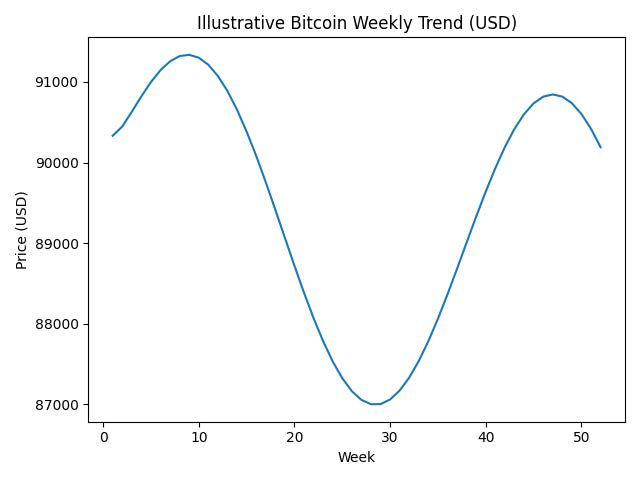
While short-term volatility is uncomfortable, it is also structurally important. Weekly closes often define market psychology, especially in late-cycle or post-rally environments like the current one.
Macro Uncertainty Returns as a Dominant Market Driver
One of the most pressing concerns weighing on markets is the renewed possibility of a U.S. government shutdown. Market analysts, including The Kobeissi Letter, have warned that fiscal gridlock could resurface within days, adding pressure to already fragile sentiment.
Compounding this uncertainty are several overlapping factors:
- Potential new tariffs on Canadian imports suggested by President Donald Trump
- A dense schedule of macroeconomic data releases
- The upcoming Federal Open Market Committee (FOMC) meeting
Although political pressure for interest rate cuts has increased, futures markets suggest that the Federal Reserve is unlikely to lower rates at its January 28 meeting. According to CME Group’s FedWatch Tool, the probability of a rate cut exceeding 0.25% remains minimal.
This disconnect between political expectations and monetary reality has historically led to heightened volatility—not just in equities, but also in Bitcoin, which increasingly trades as a macro-sensitive asset.
Why the $86,000 Level Matters More Than It Looks
From a technical standpoint, traders are closely watching the $86,000–$86,300 range as a critical support zone. Market analyst CrypNuevo noted that Bitcoin has slipped below the midpoint of its recent trading range—a classic bearish signal.
Order book data shows concentrated bid liquidity near $86,300, suggesting that bulls are actively defending this level. However, if this support fails, the path toward the low $80,000 range becomes significantly clearer.
Importantly, this is not merely about price. It is about positioning. Open interest has risen sharply heading into the weekly close, implying that traders are still crowding into leveraged bets. In such conditions, even small price movements can trigger cascading liquidations.
For short-term traders, any rebound may represent a tactical shorting opportunity rather than a sustainable trend reversal.
Liquidations as a Market Reset Mechanism
Liquidations often carry a negative connotation, but structurally, they serve a vital function. Excess leverage distorts price discovery. When it is flushed out, markets can reset on a healthier foundation.
The recent wave of long liquidations suggests that speculative excess has been reduced. This does not automatically mean that Bitcoin will rally—but it does reduce the probability of sharp, disorderly crashes driven purely by leverage.
For institutional players and long-term investors, such resets often present clearer signals for accumulation, especially when combined with macro or intermarket indicators.
A Subtle but Important Signal from Silver
One of the more intriguing developments comes from Bitcoin’s relationship with precious metals—specifically silver. Analyst Michaël van de Poppe highlighted a potential bullish divergence on the BTC/XAG (Bitcoin-to-silver) ratio on the three-day chart.
Illustrative BTC to Silver Ratio
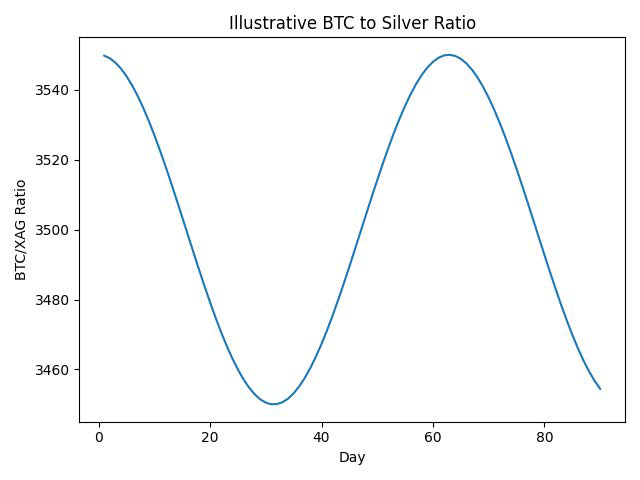
This would mark the first time Bitcoin shows a bullish divergence against silver on this timeframe. Historically, such divergences often appear near inflection points, particularly when capital begins rotating out of traditional safe havens.
Gold and silver recently posted record highs, suggesting that risk aversion may be peaking. If capital begins rotating away from metals, Bitcoin—and select digital assets—could benefit disproportionately.
This does not guarantee an immediate price surge. However, it provides a contextual signal that downside momentum may be weakening beneath the surface.
What This Means for Crypto Investors and Builders
For readers seeking new crypto assets, revenue opportunities, or practical blockchain use cases, the current environment demands strategic patience.
From an investment perspective:
- Volatility favors disciplined capital deployment over emotional trading.
- Strong support zones offer better risk-adjusted entry points than chasing momentum.
- Cross-asset analysis (BTC vs. metals, rates, equities) is increasingly essential.
From a business and infrastructure standpoint:
- Periods of consolidation are ideal for building, not speculating.
- Payment systems, custody solutions, and compliance-ready wallets benefit from calmer market phases.
- Institutional interest continues to grow, even when prices stagnate.
Bitcoin’s role is evolving—from a speculative instrument to a macro-aligned digital asset and settlement layer. Understanding this transition is key for identifying the next generation of crypto opportunities.
Conclusion: A Defining Moment, Not a Final Verdict
Bitcoin’s struggle near the $86,000 level should not be mistaken for weakness alone. Rather, it represents a stress test—of market structure, leverage, and macro resilience.
Short-term risks remain skewed to the downside, particularly if macro conditions deteriorate further. Yet beneath the surface, leverage has been reduced, intermarket signals are stabilizing, and long-term narratives remain intact.
For investors, this is a moment to observe, not panic.
For builders, it is a reminder that the most important work often happens when markets are quiet.
The weekly close may not decide Bitcoin’s fate—but it will almost certainly shape the next chapter.