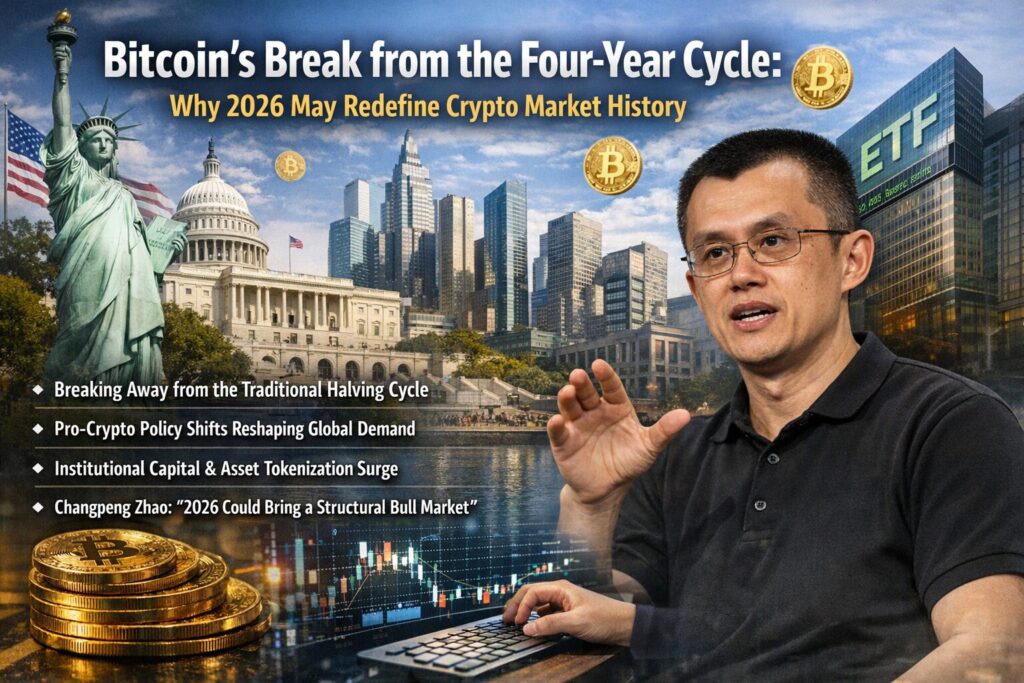
Main Points :
- Bitcoin is increasingly deviating from its traditional four-year halving-driven market cycle.
- Pro-crypto policy shifts in the United States and other major economies are reshaping global demand.
- Institutional capital, ETFs, and asset tokenization are changing Bitcoin’s role from speculative asset to financial infrastructure.
- Binance co-founder Changpeng Zhao argues that 2026 could mark a structural, not cyclical, bull market.
- For investors and builders, Bitcoin’s cycle break signals new revenue models and long-term blockchain use cases.
Introduction: The End of a Predictable Bitcoin Era
For more than a decade, Bitcoin’s price behavior has followed what many investors regarded as an almost immutable law: the four-year cycle. Tied closely to Bitcoin’s halving events—when mining rewards are cut in half—this cycle produced a familiar rhythm of accumulation, rapid appreciation, speculative excess, and eventual correction. Entire investment strategies, hedge fund models, and retail narratives were built around this pattern.
Yet in early 2026, a growing number of industry leaders argue that this era of predictability is coming to an end. Among them is Changpeng Zhao, co-founder of Binance, who stated in a recent interview that Bitcoin is likely to “break” its historical four-year cycle and reach new all-time highs driven by fundamentally different forces.
This article examines why the four-year cycle may no longer define Bitcoin’s future, how global policy and institutional adoption are reshaping the market, and what this shift means for investors seeking new crypto assets, revenue opportunities, and practical blockchain applications.
1. Understanding Bitcoin’s Traditional Four-Year Cycle
Bitcoin’s four-year cycle has its roots in code rather than economics. Approximately every 210,000 blocks, the Bitcoin protocol halves the reward paid to miners. Historically, this supply shock reduced new Bitcoin issuance, tightened circulating supply, and—after a lag—contributed to significant price increases.
From 2012 to 2021, the pattern was striking:
- A halving event reduces new supply.
- Accumulation follows as miners and long-term holders reduce selling.
- A speculative rally accelerates, often culminating in a blow-off top.
- A prolonged bear market resets excess leverage and speculation.
This cycle reinforced the belief that Bitcoin’s price action was mechanically predictable. However, predictability also attracted increasingly sophisticated players—derivatives traders, arbitrage desks, and macro funds—whose actions may have diluted the cycle’s original impact.
2. Why the Four-Year Cycle Is Losing Power
Changpeng Zhao’s assertion that Bitcoin will break the cycle is not based on optimism alone. It reflects structural changes in how Bitcoin is owned, traded, and regulated.
First, Bitcoin supply dynamics have changed. A significant share of circulating BTC is now held by long-term institutional custodians, ETFs, and corporate treasuries. These holders are less sensitive to short-term price fluctuations and less likely to liquidate during downturns.
Second, global liquidity conditions now matter more than halving mechanics. Bitcoin increasingly trades as a macro asset, influenced by interest rates, dollar liquidity, and geopolitical risk rather than purely crypto-native events.
Third, derivatives markets have matured. Futures, options, and perpetual swaps allow traders to hedge or speculate without directly buying or selling spot Bitcoin, smoothing extreme price moves that once defined cycle peaks and crashes.
3. Pro-Crypto Policy Shifts Reshaping Global Demand
One of Zhao’s key arguments is political rather than technical. According to him, Bitcoin’s next phase will be driven by policy alignment rather than scarcity narratives.
In the United States, regulatory hostility toward crypto has softened markedly compared with the early 2020s. Lawmakers are now debating comprehensive market-structure legislation rather than relying on enforcement-driven regulation. Several administrations worldwide have followed suit, recognizing digital assets as strategic financial infrastructure rather than fringe speculation.
Zhao noted that he is currently advising approximately twelve governments on crypto regulation and asset tokenization. These discussions are no longer theoretical. Governments are exploring blockchain-based bonds, tokenized real-world assets, and national payment rails that integrate with public blockchains.
This shift creates structural demand for Bitcoin—not just as an investment, but as a neutral, global reserve digital asset.
4. Bitcoin, ETFs, and the Institutional Flywheel
The approval and expansion of Bitcoin ETFs fundamentally altered market structure. ETFs allow pensions, insurers, and asset managers to gain exposure to Bitcoin without custody or operational complexity.
This has three major effects:
- Sticky Capital: Institutional ETF inflows are long-term by nature.
- Reduced Volatility: ETF arbitrage narrows price dislocations.
- Legitimization: Bitcoin increasingly resembles a macro asset like gold.
As a result, Bitcoin’s role is shifting from a speculative trade to a portfolio allocation. This transformation undermines the violent boom-bust cycles of earlier years.
5. Asset Tokenization and Bitcoin’s Expanding Financial Role
Beyond price, Zhao emphasized asset tokenization as a major growth vector. Tokenized bonds, funds, real estate, and commodities increasingly rely on blockchain infrastructure, even when settlement ultimately references traditional currencies.
Bitcoin plays a unique role in this ecosystem. While most tokenization occurs on smart-contract platforms, Bitcoin serves as collateral, treasury reserve, and risk hedge. In effect, Bitcoin is becoming the “base asset” of the digital financial system.
This structural integration supports sustained demand independent of halving cycles.
6. Visualizing the Shift: From Cycles to Structure
[Bitcoin Price vs Halving Events and ETF Inflows (Conceptual Chart)]
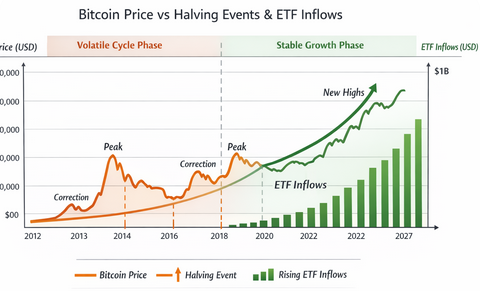
This chart illustrates how post-ETF inflows dampen traditional post-halving volatility, suggesting a transition from cyclical to structural price behavior.
[Global Crypto Policy Alignment Map (Pro-Crypto vs Restrictive Jurisdictions)]
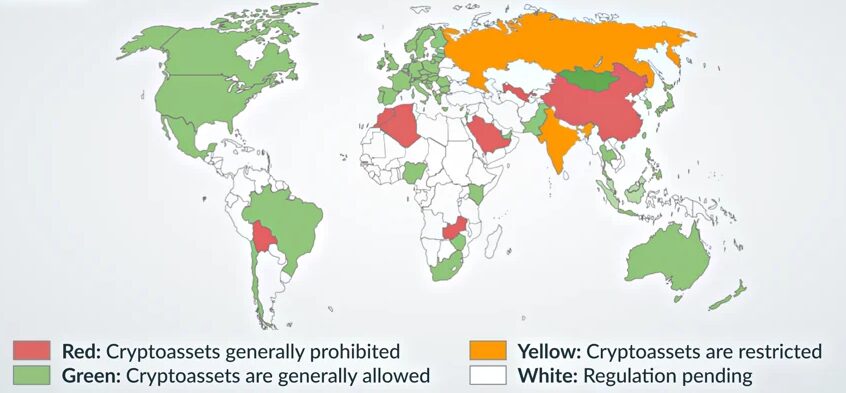
This diagram shows the expanding number of jurisdictions adopting supportive crypto frameworks, reinforcing Zhao’s policy-driven thesis.
7. What This Means for Investors and Builders
For investors seeking the “next Bitcoin cycle,” the implication is clear: waiting for a familiar post-halving crash may no longer work. Instead, returns may come from:
- Long-term BTC accumulation as digital reserve asset
- Yield strategies built around regulated crypto infrastructure
- Exposure to tokenization platforms linked to institutional finance
For builders, the message is even more profound. Bitcoin’s cycle break signals that blockchain is entering an infrastructure phase. Applications focused on payments, settlement, custody, and compliance-ready tokenization may outperform purely speculative DeFi models.
Conclusion: A Structural Bull Market, Not a Cyclical One
Bitcoin’s four-year cycle was a product of its youth—limited liquidity, fragmented markets, and regulatory ambiguity. As those constraints fade, so too does the cycle.
Changpeng Zhao’s prediction that Bitcoin will break its historical pattern in 2026 reflects deeper changes underway. Policy alignment, institutional adoption, ETFs, and asset tokenization are transforming Bitcoin from a cyclical speculation into a structural component of the global financial system.
For those searching for new crypto assets, revenue opportunities, and practical blockchain use cases, the most important shift is not price alone—but the realization that Bitcoin’s future may finally be less predictable, and far more durable, than its past.