Main Points :
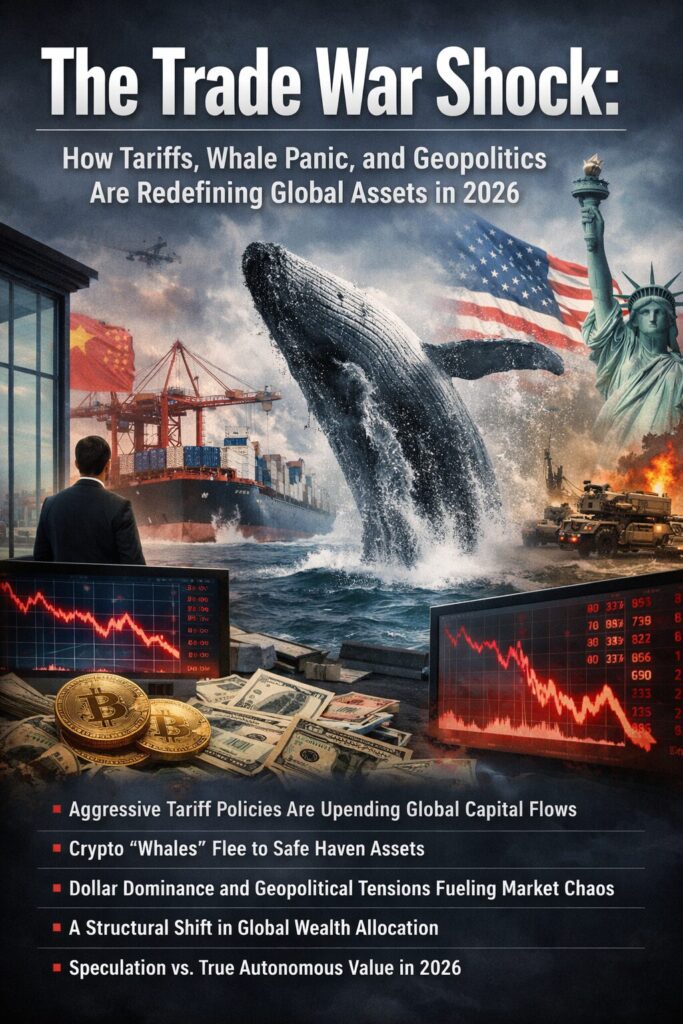
- Aggressive tariff policies are dismantling the long-held assumption of frictionless global capital movement.
- Large institutional investors and crypto “whales” are preemptively reallocating portfolios toward liquidity and geopolitical safety.
- Assets once considered borderless—including crypto—remain deeply exposed to U.S. dollar dominance and state power.
- The current market drawdown is not a temporary correction but a structural transition in global wealth allocation.
- Surviving the 2026 trade conflict requires distinguishing speculative narratives from assets with durable, autonomous value.
1. When Physical Borders Crush Borderless Ideals: How State Power Is Rewriting Asset Ownership Rules
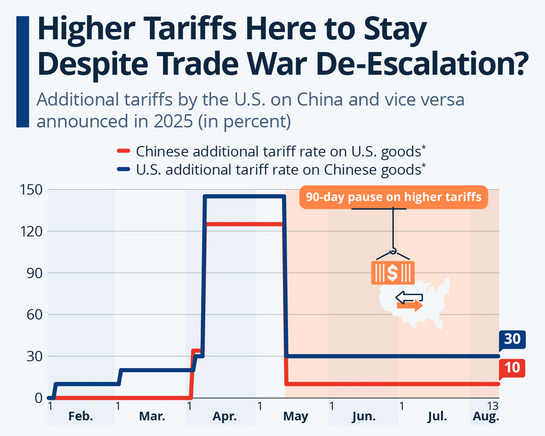
The resurgence of aggressive tariff policies under the Trump administration marks a historic reversal in how global assets are treated. Assets once assumed to transcend borders—capital, securities, digital tokens—are increasingly encountering invisible yet formidable walls built by national policy.
What was marketed for decades as a frictionless global financial system is now colliding with geopolitical reality. As tariffs escalate, even assets traditionally viewed as safe havens are being destabilized by a surging U.S. dollar. The dollar’s appreciation, fueled by protectionist trade measures and capital repatriation, has overwhelmed portfolios that once relied on diversification across borders.
The idea that digital assets exist independently of political gravity is being brutally tested. Despite their decentralized architecture, most crypto assets remain priced, settled, and psychologically anchored to the U.S. dollar. When tariff shocks strengthen the dollar, crypto liquidity contracts—revealing that decentralization does not equal immunity.
Invisible trade barriers are reviving inflationary pressure by increasing import costs, threatening to reignite inflation just as markets anticipated interest rate cuts. This directly undermines the Federal Reserve’s prior easing trajectory and injects volatility into every risk asset class.
In this environment, wealth defense is no longer decided by algorithms alone. It is being redrawn in diplomatic meetings, executive orders, and trade negotiations. The assumption of neutral, apolitical markets is collapsing, replaced by a world where capital flows obey national interest first.
Those who fail to recognize this shift are being systematically eliminated by market volatility. The global financial order is not merely adjusting—it is regressing into a form where sovereignty outweighs efficiency, and political leverage overrides market logic.
[Global Trade & Capital Fragmentation]
2. Whale Panic and Cold Calculations: How Massive Capital Is Quietly Repositioning
On-chain data and exchange flows reveal a clear pattern: large wallets are moving assets to exchanges and liquidating positions. This is not retail fear—it is institutional foresight.
Major capital holders, including funds historically supportive of crypto exposure, are shifting toward defensive postures. Even giants such as BlackRock-aligned vehicles have reduced risk allocations amid rising macroeconomic uncertainty.
These actors do not wait for headlines. They read political signals early—tariff drafts, diplomatic rhetoric, election probabilities—and act before narratives reach mainstream investors. What appears to the public as “sudden selling” is often months in the making.
Crucially, this wave of selling is not about profit-taking. It is about liquidity survival. Trade wars compress global growth, tighten dollar liquidity, and reduce risk tolerance across markets. When liquidity dries up, only cash-equivalent assets retain optionality.
Speculative positions inflated by years of cheap money are now being forcibly unwound. Leverage that thrived in a low-rate, globalized environment cannot survive in a protectionist, dollar-scarce regime.
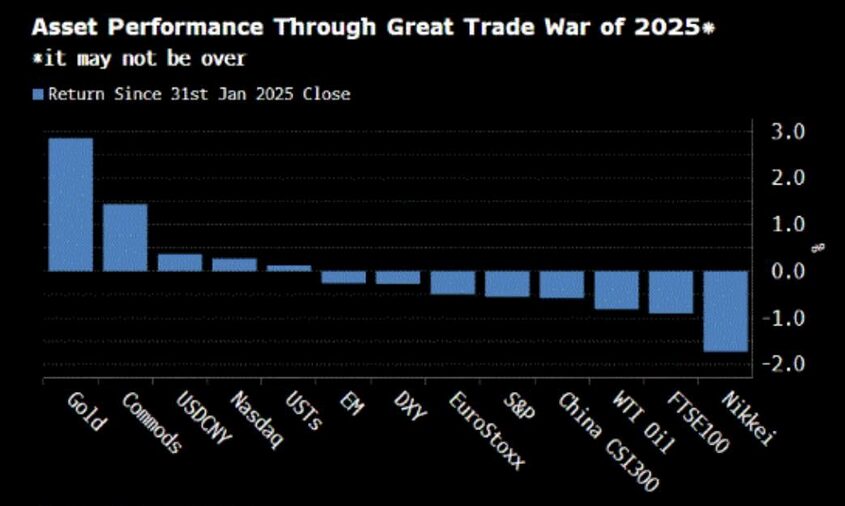
Capital is retreating toward assets backed by overwhelming state power (USD) or long-standing trust (gold). Abstract narratives are giving way to tangible security.
What markets are experiencing is not noise—it is a structural reallocation of global wealth. Prices are falling not because of temporary fear, but because ownership itself is being reorganized.
Those who can read whale movements are not copying trades—they are learning survival logic. Emotional conviction has lost relevance. Only political realism and balance-sheet durability remain.
[Whale Activity & Liquidity Shift]
3. Surviving the 2026 Trade Conflict: The New Order and the Assets That Endure
Every tariff announcement injects distortion into asset pricing, obscuring intrinsic value beneath political noise. This is not an anomaly—it is the defining feature of the era ahead.
Only assets that endure this purge will qualify as leaders of the next cycle. The path forward is brutal, marked by widespread destruction of capital misallocated under false assumptions of perpetual globalization.
Investors now face a binary choice: interpret this drawdown as a temporary correction, or recognize it as the end of an era. The distinction determines survival.
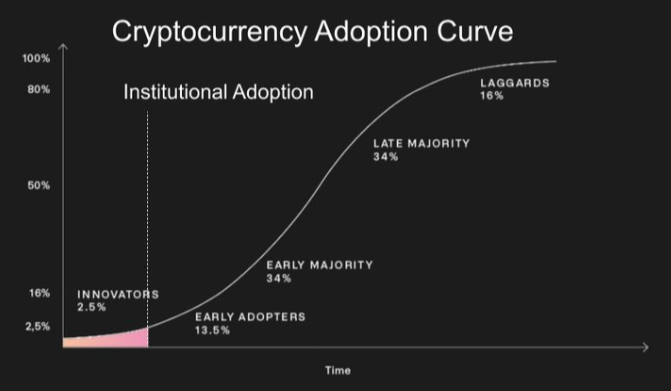
Politics has stripped markets of autonomy. Even whales are forced into retreat. The promise of digital freedom is being tested against the oldest force in economics: state sovereignty.
Yet history suggests that after every purge, a stronger system emerges. What survives is not hype, but resilience—systems designed to function despite political hostility.
This transition demands extraordinary patience. Like the aftermath of historical gold rushes, most participants will leave empty-handed. Only assets with real utility, autonomous settlement, and non-discretionary value will remain.
Protecting assets in this geopolitical storm is no longer mere investment—it is a fight for future optionality. In 2026, the only reliable refuge is value that requires no permission.
Assets that withstand tariff shields, dollar shocks, and political interference will define the next financial architecture. We are not observers—we are participants in a generational reset.
[Asset Survival Through Political Cycles]
Conclusion: From Borderless Dreams to Hard Reality
The trade war has exposed the limits of globalization and the fragility of assumptions underpinning modern finance. Capital is rediscovering gravity. Borders matter again.
This is not the death of crypto or innovation—but it is the end of naïve narratives. The next era belongs to assets that can prove their worth under pressure, not in ideal conditions.
History is being rewritten in real time. Survival will belong to those who adapt early, think politically, and invest with ruthless clarity.