
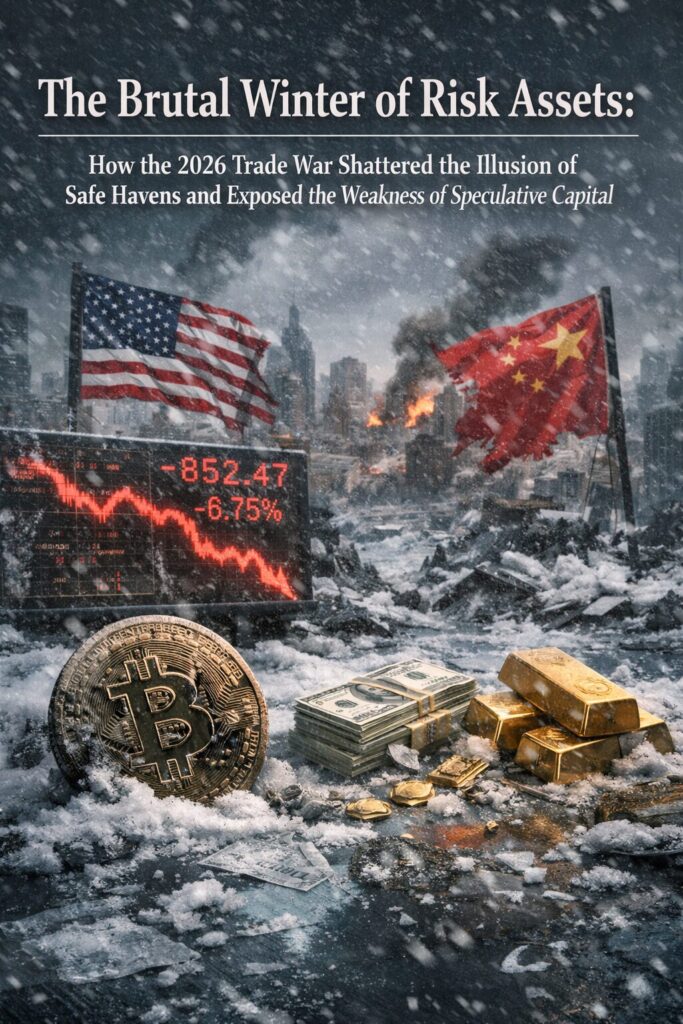
Key Takeaways :
- The resurgence of protectionism under the Trump administration has reignited inflationary pressures, destroying the Federal Reserve’s long-anticipated rate-cut narrative.
- Higher tariffs are not a short-term shock but a structural reversal of decades of global supply-chain efficiency.
- Risk assets, including cryptocurrencies, are facing a brutal repricing as capital costs remain structurally high.
- Bitcoin’s long-held narrative as a “safe haven in times of crisis” was decisively challenged when markets fled to gold and the U.S. dollar.
- The ongoing purge of leverage and speculation is painful but necessary, laying the groundwork for a more resilient and autonomous financial system.
- True financial sovereignty will only emerge after this period of ruthless selection.
1. Protectionism Reignites Inflation and Destroys the Fed’s Rate-Cut Fantasy
The rapid succession of tariff measures announced by the Trump administration has injected extreme and unpredictable volatility into the global economy, freezing investor sentiment at a critical juncture. These tariffs are not merely political gestures; they represent a fundamental shift in economic philosophy—one that directly contradicts the globalization-driven efficiency that defined the past several decades.
By raising the cost of imported goods, tariffs act as an immediate and persistent inflationary force. Just as inflation appeared to be stabilizing, this policy shock threatens to re-anchor price pressures at higher levels. The Federal Reserve’s carefully constructed narrative of imminent rate cuts—a cornerstone of bullish risk-asset expectations—now stands on dangerously fragile ground.
For years, financial markets thrived on cheap money. Equities, venture capital, real estate, and cryptocurrencies all benefited from a world in which capital was abundant and opportunity costs were negligible. That world is ending. In an environment where inflation proves stubborn and interest rates remain elevated, the cost of holding non-yielding, speculative assets rises dramatically.
Protectionism is not simply a pricing issue; it is a rejection of the global supply chains that once optimized production and suppressed costs. Investors are now forced to confront a harsh reality: the era of structurally low interest rates may never return. This realization is sending shockwaves through crypto markets, which were largely built on assumptions of perpetual liquidity.
Many market participants clung to the comforting belief that governments and central banks would always step in to stabilize markets. That illusion has been shattered against the thick walls of protectionism. In a world where borders can close overnight and costs can spike due to political decisions, traditional investment playbooks offer little guidance.
We are entering a phase of capital redistribution in its most ruthless form. Survival will require abandoning past success stories and reassessing risk with unprecedented discipline. As economic rules are rewritten, yesterday’s winners are quietly becoming tomorrow’s casualties.
This resurgence of inflation is nothing less than a funeral bell for the “lukewarm bath” era of crypto markets—a period defined by easy gains and minimal accountability. In a geopolitical landscape where economic rationality is subordinate to national interests, maintaining purchasing power becomes the ultimate survival strategy.

Concept:
Tariffs → Import Costs → Inflation Persistence → High Interest Rates → Pressure on Risk Assets
2. When Real-World Economics Pierced the Digital Shield
Amid this macroeconomic upheaval, Bitcoin—the flagship risk asset—has entered a severe correction phase. Long praised as a hedge against systemic chaos, Bitcoin faced its moment of truth when tariff shocks hit global markets.
Instead of flocking to digital scarcity, investors sought refuge in assets with tangible weight: gold and the U.S. dollar, backed by unmatched military and economic power. This stark reaction revealed an uncomfortable truth—Bitcoin has not yet earned universal trust as a crisis-proof safe haven.
The “Trump tariff shield” deflected speculative capital with ruthless efficiency. In times of genuine stress, markets prioritize assets that can enforce order and guarantee liquidity. Digital ideals, however elegant, proved fragile against the blunt force of economic nationalism.
This realization triggered a mass exodus of younger, highly leveraged investors who had mistaken volatility for inevitability and liquidity for permanence. Yet this retreat is not purely destructive. It is a necessary purification process.
Gold itself required centuries to establish its role as a store of value. Digital assets are now undergoing a similar trial by fire. As prices collapsed, opportunistic capital fled, leaving behind a smaller but more conviction-driven cohort quietly accumulating assets based on long-term belief rather than short-term profit.
With speculative noise stripped away, crypto markets can begin rediscovering their foundational principle: freedom from centralized power. The failure of the digital shield under political pressure exposes not an endpoint, but a challenge—to forge a stronger one.
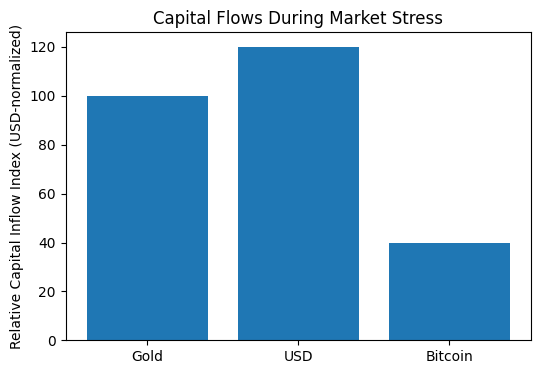
Concept:
Market Stress Event → Capital Flow Comparison (Gold, USD, Bitcoin)
3. True Autonomy and the Financial System Forged by Selection
This correction is not merely a downturn—it is a structural reset. Excessive leverage is being purged, leaving behind investors capable of operating with long-term conviction. Such cleansing processes are brutal but essential.
Ironically, the very trade frictions that destabilize markets also expose the fragility of fiat-based systems. As governments weaponize tariffs and rewrite rules at will, the appeal of assets immune to political interference grows stronger.
The more states rely on economic coercion, the stronger the societal desire becomes to exit centralized control structures. The question for investors is no longer about short-term price movements, but about long-term survivability in a geopolitically hostile environment.
Beyond this painful adjustment lies the possibility of a more resilient financial system—one less vulnerable to political whim and more aligned with transparent, rule-based trust. Only assets that survive this wave of selection will earn a place in the next bull market.
True autonomy resides in protocols that require no permission and tolerate no arbitrary interference. The 2026 trade war may mark the end of a controllable, elite-engineered financial order—and serve as the final catalyst toward genuine decentralization.
This painful transition is the labor required to elevate crypto from speculative entertainment to a foundational survival tool. As state-backed shields fracture, individuals must forge new instruments to protect future value.
History teaches us that the harshest winters produce the strongest life. The responsibility for shaping the next financial order now rests on individual investment decisions.
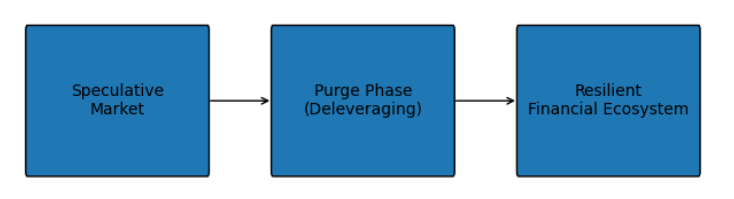
Concept:
Speculative Market → Purge Phase → Resilient Financial Ecosystem
Conclusion
The 2026 trade war has exposed the fragility of speculative capital and dismantled comforting myths about effortless safety. For crypto markets, this brutal winter is not the end—but a reckoning. Those who endure will help define a financial system built not on political favor, but on resilience, autonomy, and hard-earned trust.


