Main Points :
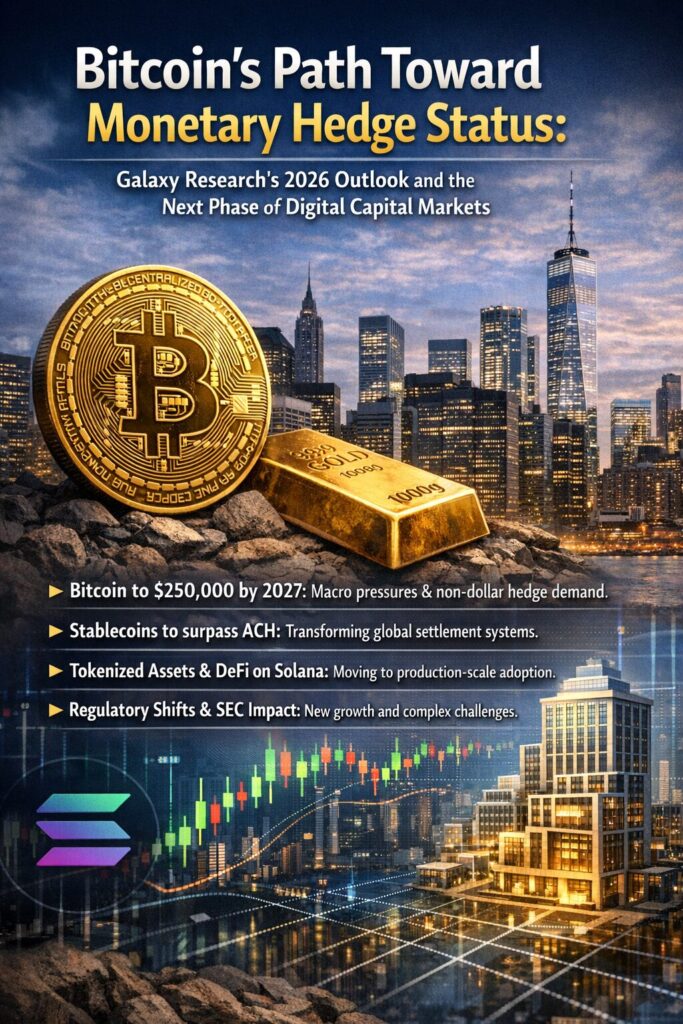
- Institutional access, regulatory clarification, and financial infrastructure integration are accelerating Bitcoin’s transition from a speculative asset to a monetary hedge comparable to gold.
- Galaxy Research projects Bitcoin could reach $250,000 by the end of 2027, driven by macroeconomic pressures and non-dollar hedge demand.
- Stablecoins are expected to surpass traditional payment rails such as ACH in transaction volume, reshaping global settlement infrastructure.
- Tokenized assets, DeFi, and blockchain-native capital markets—particularly on Solana—are moving from experimentation to production-scale usage.
- Regulatory shifts, especially involving the U.S. Securities and Exchange Commission, may unlock new growth while introducing legal and political complexity.
1. A Market Entering Its Institutional Phase
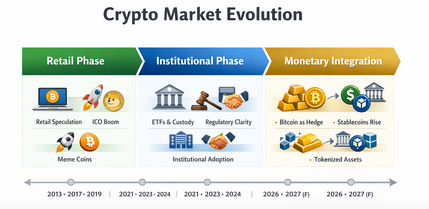
The digital asset market is undergoing a structural transformation. No longer driven solely by retail speculation or cyclical hype, crypto markets are increasingly shaped by institutional participation, regulatory engagement, and integration with traditional financial systems. According to Galaxy Research’s December outlook, the period leading into 2026 represents a consolidation phase—one where short-term volatility matters less than long-term adoption.
Galaxy emphasizes that even if 2025 ends with muted price performance, the year will have succeeded in laying the groundwork for the next expansionary phase. Institutional-grade custody, regulated trading venues, ETFs, and clearer policy frameworks are reducing friction for capital allocators who previously remained on the sidelines.
This transition mirrors earlier phases of financial innovation. Just as the internet required standardized protocols and enterprise adoption before unleashing its full economic impact, blockchain-based finance is now moving from fragmented experimentation toward scalable infrastructure.
[“Crypto Market Evolution: Retail Phase → Institutional Phase → Monetary Integration”
Format: Timeline / infographic showing phases from 2013–2027]
2. Bitcoin’s Long-Term Trajectory: From Volatility to Monetary Hedge
Within Galaxy’s outlook, Bitcoin occupies a central role. Alex Thorn, Head of Firmwide Research, argues that Bitcoin’s future should be assessed less by annual price targets and more by its evolving function in global portfolios.
Whether Bitcoin ends a given year at $70,000 or $150,000, Galaxy’s conviction lies in its increasing adoption as a hedge against monetary debasement. In a world of expanding sovereign debt, persistent fiscal deficits, and politically constrained central banks, investors are searching for non-sovereign stores of value.
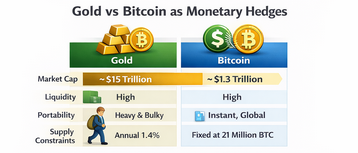
Gold has historically filled this role. However, Bitcoin offers attributes that gold cannot: absolute scarcity enforced by code, instant global transferability, and native compatibility with digital financial systems. Galaxy therefore sees a credible path for Bitcoin to follow gold’s trajectory—initial skepticism, gradual institutional acceptance, and eventual normalization as a macro hedge.
The projection that Bitcoin could reach $250,000 by the end of 2027 is not framed as speculative exuberance, but as a consequence of structural demand. If even a small percentage of global hedge allocations shift toward Bitcoin, the supply-demand imbalance becomes significant.
[“Gold vs Bitcoin as Monetary Hedges”Format: Comparative chart showing market cap, liquidity, portability, supply constraints]
3. Macroeconomic Forces Driving Demand for Non-Dollar Assets
One of Galaxy’s most important assumptions is not crypto-native at all—it is macroeconomic. The global financial system is increasingly characterized by:
- High and rising public debt levels
- Structural inflationary pressures
- Geopolitical fragmentation
- Declining confidence in fiat currency neutrality
In this environment, investors are not merely seeking yield; they are seeking resilience. Bitcoin’s appeal grows precisely because it sits outside the direct control of any single government or monetary authority.
This does not imply the collapse of the dollar system. Rather, it suggests diversification at the margins. Even modest reallocation by sovereign wealth funds, pension funds, or corporate treasuries could have outsized effects on Bitcoin’s valuation due to its fixed supply.
4. Stablecoins and the Reinvention of Payment Rails
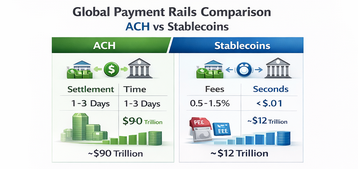
Beyond Bitcoin, Galaxy’s outlook highlights stablecoins as one of the most transformative forces in financial infrastructure. The report forecasts that stablecoins will surpass ACH in transaction volume, signaling a fundamental shift in how value moves across borders.
Unlike traditional payment rails, stablecoins operate continuously, settle near-instantly, and integrate directly with programmable financial logic. This makes them particularly attractive for:
- Cross-border remittances
- Corporate treasury operations
- On-chain settlement of tokenized assets
- Emerging market financial inclusion
Importantly, Galaxy notes that the next phase will be dominated not by isolated crypto-native stablecoins, but by those integrated with traditional financial institutions. Banks and payment firms are increasingly viewing stablecoins as infrastructure rather than competition.
[“Global Payment Rails Comparison”Format: Bar chart comparing ACH, SWIFT, card networks, and stablecoins by speed and cost]
5. Tokenization and Blockchain-Native Capital Markets
Another core theme of the 2026 outlook is tokenization. Galaxy expects tokenized assets—ranging from treasuries to private credit and equities—to move decisively into mainstream capital markets.
This shift is not merely about efficiency. Tokenization enables:
- Real-time settlement
- Fractional ownership
- Programmable compliance
- Broader collateral utility
On-chain representations of assets can be used directly within DeFi protocols, unlocking new forms of liquidity and capital efficiency. Galaxy predicts that Solana’s “internet capital markets” could grow from approximately $750 million today to $2 billion in market capitalization, driven by high-throughput infrastructure and low transaction costs.
6. Regulation: Catalyst and Constraint
Regulation remains a double-edged sword. Galaxy anticipates that the SEC may allow limited exemptions under its “innovation exemption” framework, enabling the use of tokenized securities within DeFi environments.
Such moves could legitimize entire sectors of on-chain finance. However, Galaxy also expects legal challenges from traditional market participants who view these exemptions as unfair advantages. The result is likely to be a period of regulatory experimentation accompanied by litigation and political debate.
For builders and investors, this environment rewards adaptability. Jurisdictional diversification, compliance-by-design, and modular infrastructure will be essential strategies.
7. Corporate Balance Sheets and Public Markets
Galaxy’s outlook extends to corporate behavior. The firm predicts that more than 15 crypto-related companies will pursue IPOs or public listings in the United States. At the same time, not all treasury strategies will prove sustainable.
Galaxy warns that at least five digital asset treasury companies may be forced to sell assets, merge, or shut down entirely. This underscores a key lesson of the next cycle: exposure alone is not strategy. Risk management, liquidity planning, and governance discipline will separate survivors from casualties.
Conclusion: From Speculation to Financial Integration
Galaxy Research’s 2026 outlook presents a vision of crypto markets that is notably sober—and therefore powerful. The emphasis is not on meme-driven rallies or short-term narratives, but on infrastructure, policy, and institutional behavior.
Bitcoin’s potential evolution into a widely accepted monetary hedge represents a profound shift in global finance. Stablecoins are redefining payment rails. Tokenization is reengineering capital markets. And regulation, while contentious, is slowly providing the clarity required for scale.
For investors seeking new digital assets, revenue opportunities, or practical blockchain applications, the message is clear: the next phase of crypto will reward those who think less like traders and more like system architects.