Main Points :
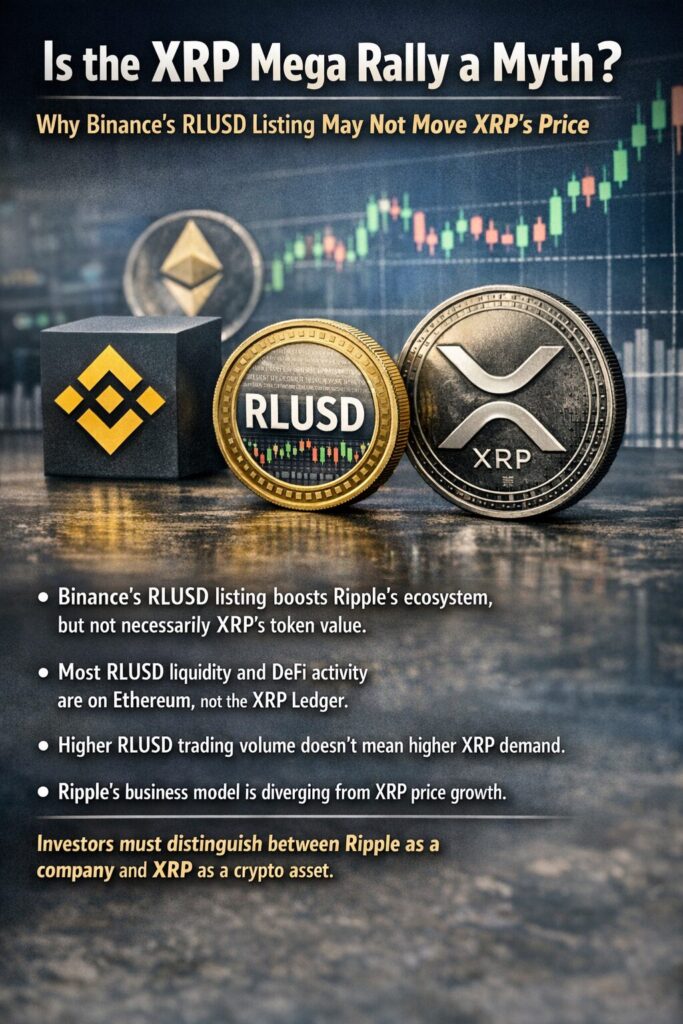
- Binance’s decision to list RLUSD significantly boosts Ripple’s corporate ecosystem, but not necessarily XRP’s token value.
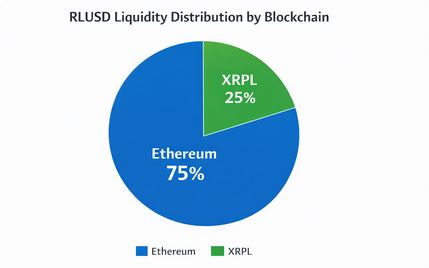
- Most RLUSD liquidity and DeFi activity currently resides on Ethereum, not the XRP Ledger (XRPL).
- Increased RLUSD trading volume does not automatically translate into higher XRP demand.
- Ripple’s evolving business model increasingly decouples corporate success from XRP price appreciation.
- Investors must distinguish between Ripple as a company and XRP as a crypto asset.
Introduction: The Excitement and the Doubt
The recent announcement that Binance has begun supporting Ripple’s U.S. dollar–pegged stablecoin RLUSD—alongside a zero-fee trading campaign—sparked widespread excitement across crypto markets. Many XRP holders immediately speculated that this development could trigger a sharp rally in XRP prices, reviving the long-standing narrative that Ripple ecosystem expansion directly fuels XRP demand.
However, a deeper examination of RLUSD’s technical architecture, liquidity distribution, and actual usage patterns suggests a more restrained conclusion. While RLUSD’s listing is undeniably positive for Ripple as an infrastructure provider, its impact on XRP’s supply-demand dynamics may be far more limited than market enthusiasm implies.
RLUSD’s Dual-Chain Reality: XRPL vs. Ethereum
RLUSD is issued on both the XRP Ledger and Ethereum networks. In theory, this dual-chain deployment allows Ripple to serve both its native ecosystem and the broader DeFi landscape.
In practice, however, liquidity tells a different story.
Where the Liquidity Actually Lives
Most decentralized finance protocols—lending, yield farming, derivatives, and automated market makers—are deeply entrenched in Ethereum’s ecosystem. As a result, the majority of RLUSD liquidity, trading volume, and composability currently resides on Ethereum-based infrastructure.
For exchanges like Binance, prioritizing Ethereum-based deposits and withdrawals makes operational sense. Users benefit from wallet compatibility, DeFi integrations, and existing tooling, all of which are significantly more mature on Ethereum than on XRPL.
Implication: Even if RLUSD trading volume grows dramatically, much of that activity may never touch the XRP Ledger.
【RLUSD Liquidity Distribution by Blockchain】
Pie chart comparing RLUSD liquidity share on Ethereum vs. XRPL
Why RLUSD Growth Does Not Equal XRP Demand
A common assumption among retail investors is that any Ripple-related success automatically increases XRP demand. This assumption held more weight in earlier phases of Ripple’s strategy, when XRP was positioned as a central bridge asset.
Today, that linkage is far weaker.
Network Fees and XRP Burn
XRP demand increases when:
- XRPL transaction volume rises,
- XRP is used as a bridge currency,
- Network fees are paid and burned in meaningful volume.
If RLUSD activity remains primarily Ethereum-based, none of these mechanisms scale proportionally. XRPL transaction counts remain flat, XRP fees remain minimal, and bridge usage does not materially expand. 📊 Image Placeholder 2
Title: Value Flow Comparison: RLUSD on Ethereum vs. XRPL
Description: Flow diagram showing RLUSD transactions bypassing XRP usage on Ethereum
Insert here
Ripple’s Strategic Shift: Beyond XRP Dependency
Over the past few years, Ripple has systematically diversified its business model. Through acquisitions of custody providers, payment infrastructure firms, and compliance-oriented platforms, Ripple has repositioned itself as a full-stack blockchain infrastructure company.
RLUSD fits squarely into this strategy:
- A regulated stablecoin,
- Usable across multiple chains,
- Attractive to institutions regardless of XRP exposure.
From a corporate standpoint, this is a rational evolution. From an XRP investor’s perspective, however, it introduces a critical distinction: Ripple’s success as a company is no longer synonymous with XRP’s success as an asset.
The Binance Effect: Powerful but Misinterpreted
Binance’s support undeniably accelerates RLUSD adoption. Zero-fee campaigns, deep liquidity pools, and global distribution can quickly elevate RLUSD into a top-tier stablecoin by market usage.
Yet stablecoin adoption typically benefits:
- Trading efficiency,
- Exchange revenues,
- Payment rails,
- Corporate partners.
It does not inherently create upward pressure on a separate volatile asset unless explicit token dependencies are designed into the system. 📊 Image Placeholder 3
Title: Who Benefits from RLUSD Adoption?
Description: Comparison table charting benefits for Ripple, Binance, DeFi users, and XRP holders
Insert here
Market Psychology vs. Structural Reality
Crypto markets often react to headlines faster than to structural details. “Binance lists RLUSD” sounds, at first glance, like “XRP adoption accelerates.” But structurally, RLUSD can thrive even if XRP remains peripheral.
This divergence creates a familiar pattern:
- Short-term speculative XRP spikes,
- Followed by retracements once on-chain data fails to confirm sustained demand growth.
Sophisticated investors increasingly monitor where value flows—not just what is announced.
Conclusion: A Corporate Win, Not a Guaranteed Token Rally
RLUSD’s Binance listing is a milestone—for Ripple. It validates the company’s role as a blockchain infrastructure provider and strengthens its position in regulated digital finance.
However, for XRP holders, expectations must be recalibrated. Unless RLUSD usage materially increases XRPL transaction volume or mandates XRP as an operational dependency, its success alone is unlikely to drive sustained XRP price appreciation.
In today’s market, understanding the difference between corporate ecosystem growth and token-level value capture is no longer optional—it is essential.