Main Points :
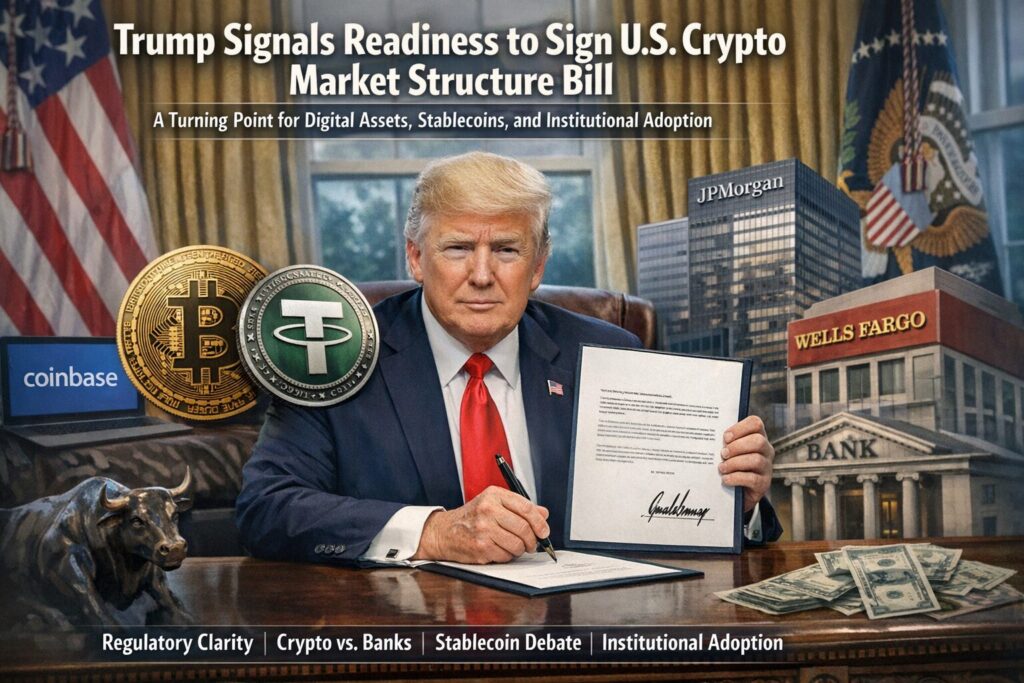
- President Donald Trump has publicly stated his intention to sign a comprehensive U.S. crypto market structure bill, signaling a major policy shift.
- The bill aims to establish regulatory clarity for Bitcoin, digital assets, and stablecoins, positioning the U.S. as a global crypto hub.
- Conflict between the crypto industry and traditional banks—especially over yield-bearing stablecoins—remains the most controversial issue.
- Coinbase’s temporary withdrawal of support highlights the political and structural fragility of the bill.
- Despite imperfections, industry leaders argue that a clear framework is better than prolonged regulatory uncertainty.
- For builders, investors, and institutions, the U.S. market is entering a new phase of rule-based expansion.
1. Davos Statement: Trump’s Message to Global Markets
At the World Economic Forum Annual Meeting in Davos, President Donald Trump made a statement that immediately reverberated across global crypto markets: he expressed his desire to sign the crypto market structure bill currently under deliberation in Congress “in the near future.”
By explicitly framing the United States as a future “center of cryptocurrency,” Trump sent a strong political signal. Unlike previous years—when U.S. crypto policy was often defined by enforcement actions and legal ambiguity—this statement suggested a transition toward legislative clarity.
For Bitcoin and broader digital asset markets, such political endorsement is not merely symbolic. Regulatory clarity directly affects capital allocation, institutional participation, and long-term infrastructure investment.
2. What Is the Crypto Market Structure Bill?
The crypto market structure bill is designed to define:
- Jurisdictional boundaries between regulators (primarily the SEC and CFTC)
- Legal classifications of digital assets
- Rules for exchanges, brokers, custodians, and stablecoin issuers
- Consumer protection and disclosure standards
In contrast to “regulation by enforcement,” this bill attempts to codify rules in advance, enabling compliance-by-design rather than retroactive punishment.
From an industry perspective, the bill is not about deregulation—it is about predictability.
3. Coinbase’s Opposition: “No Bill Is Better Than a Bad Bill”
Despite broad industry support, turbulence emerged when Coinbase temporarily withdrew its endorsement of the bill.
CEO Brian Armstrong stated that “no bill is better than a bad bill,” citing unresolved concerns around stablecoin yield provisions.
This move triggered the postponement of a Senate Banking Committee hearing, underscoring how fragile consensus remains—even among pro-crypto stakeholders.
4. The Stablecoin Yield Controversy: Banks vs Crypto
At the heart of the conflict lies stablecoin yield.
Under the previously passed GENIUS Act, stablecoin issuers are prohibited from directly paying interest. However, third-party platforms—such as exchanges—may still offer rewards funded through other mechanisms.
Traditional banks argue that if yield-bearing stablecoins scale without strict limits, trillions of dollars in deposits could migrate away from the banking system, destabilizing regional banks.
Crypto firms counter that this argument masks an attempt to suppress competition and preserve legacy monopolies.
5. White House Mediation and Industry Pressure
White House AI and Crypto Advisor David Sacks acknowledged the controversy in a CNBC interview, stating his intention to help broker compromise and deliver a workable bill to the president’s desk.
Meanwhile, Ripple CEO Brad Garlinghouse emphasized that no legislation is perfect, but innovation requires a clear and enforceable framework.
Their argument is pragmatic: uncertainty is more damaging than imperfection.
6. Role of the Senate Agriculture Committee and the CFTC
The Senate Agriculture Committee—overseeing the Commodity Futures Trading Commission (CFTC)—is scheduled to hold a hearing on January 27 to amend and vote on the bill.
This committee is expected to play a larger role in crypto oversight, especially for assets classified as commodities rather than securities.
In contrast, the Senate Banking Committee has yet to reschedule its delayed hearing, reflecting ongoing political tension.
7. Market Implications for Investors and Builders
For investors seeking new digital assets and revenue opportunities, this bill represents:
- Reduced regulatory tail risk
- Increased likelihood of U.S.-based token issuance
- Greater institutional participation in Bitcoin and stablecoins
- Expansion of compliant yield, custody, and settlement products
For builders, the bill lowers the cost of compliance planning and encourages long-term product development.
8. Practical Impact on Stablecoins and Payments
From a practical blockchain perspective, stablecoins are the backbone of on-chain payments, remittances, and DeFi liquidity.
Clear rules around issuance, custody, and yield determine whether stablecoins become:
- Regulated digital cash instruments, or
- Shadow banking tools operating offshore
The market structure bill strongly favors the former.
9. Illustrative Chart: Regulatory Clarity and Market Growth
Illustrative Impact of Regulatory Clarity on Crypto Market Activity (Conceptual)

This conceptual chart shows how increased regulatory clarity correlates with rising market activity. While not based on specific market data, it reflects observed historical patterns across jurisdictions.
10. Conclusion: A Political and Economic Inflection Point
President Trump’s willingness to sign the crypto market structure bill marks a decisive inflection point.
While the bill is imperfect and politically contested, its passage would end a prolonged era of uncertainty and reposition the U.S. as a rule-setter rather than an enforcement-driven outlier.
For investors, builders, and institutions, the message is clear: the next phase of crypto growth in the U.S. will be regulated, institutional, and strategically significant.