Key Takeaways :
- Trump’s new tariff announcement triggered a sharp divergence between Bitcoin and gold, exposing fundamental differences in how markets perceive these assets.
- While tariffs function as a hidden consumption tax on U.S. consumers, their inflationary impact does not automatically benefit Bitcoin in the short term.
- Gold continues to behave as a traditional safe haven, whereas Bitcoin is still traded primarily as a risk asset, closely correlated with equities.
- Geopolitical escalation and the potential “weaponization of capital flows” pose a larger threat to crypto markets than tariffs themselves.
- For investors seeking new revenue sources in crypto, understanding Bitcoin’s macro sensitivity is now essential.
1. The Tariff Announcement That Shook Global Markets
On January 17, former U.S. President Donald Trump announced a new wave of tariffs targeting eight European countries—Denmark, Norway, Sweden, France, Germany, the United Kingdom, the Netherlands, and Finland. The policy proposed a 10% tariff starting February 1, with a threat to raise it to 25% by June 1 if no agreement on the acquisition of Greenland were reached.
Markets reacted immediately. Bitcoin fell nearly 3%, sliding toward $92,000, while more than $875 million in leveraged crypto positions were liquidated within 24 hours. This reaction was not unprecedented. Similar tariff announcements in the past—most notably the 100% tariff on Chinese goods in October 2025—triggered mass deleveraging, erasing $19 billion in leveraged positions and liquidating over 1.6 million traders in a single day.
These repeated reactions reveal a consistent pattern: tariff shocks provoke rapid risk-off behavior in crypto markets.
2. Bitcoin’s Repeated Sell-Offs After Tariff Shocks
Despite being widely branded as “digital gold,” Bitcoin continues to behave very differently from precious metals during macroeconomic stress events.
According to Bloomberg Intelligence, senior strategist Mike McGlone warned in December that Bitcoin’s inability to sustain levels above $100,000 could signal a broader mean reversion scenario. While extreme forecasts such as a return to $10,000 are controversial, the warning underscored Bitcoin’s vulnerability to macro shocks.
Every major tariff announcement has followed a similar script:
- Immediate decline in Bitcoin price
- Large-scale liquidation of leveraged positions
- Correlated sell-offs in equities and other risk assets
This behavior suggests that Bitcoin is still primarily positioned as a speculative, liquidity-sensitive instrument rather than a defensive hedge.
3. Who Really Pays for Tariffs? The U.S. Consumer
A recent study by the Kiel Institute for the World Economy, cited by the Wall Street Journal, provides critical context. According to the research, 96% of the economic burden of Trump-era tariffs is borne by U.S. consumers and companies, not foreign exporters.
Lead researcher Julian Hinz emphasized that foreign exporters did not significantly lower prices. Instead, they reduced export volumes, effectively turning tariffs into a domestic consumption tax. Of the approximately $200 billion in tariff revenue collected last year, nearly all came directly from U.S. households and businesses.
This finding undermines the political narrative that tariffs transfer wealth from foreign producers to the U.S. economy. In practice, they raise domestic prices and suppress consumption.
4. Inflationary Theory vs. Market Reality
In theory, inflationary pressure should benefit scarce, non-sovereign assets such as Bitcoin. Tariffs increase costs, raise consumer prices, and reduce purchasing power—conditions often cited as bullish for “hard money” assets.
Yet reality tells a different story.
In response to the same tariff announcement:
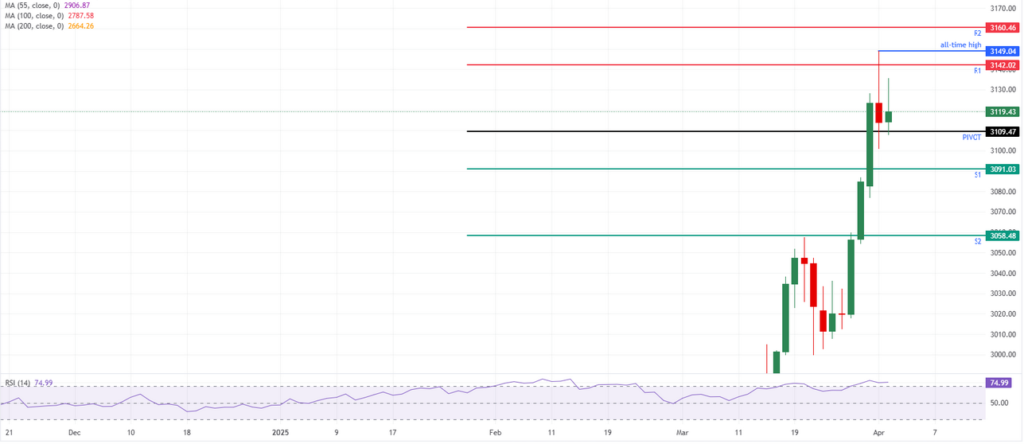
- Gold rose 1.5% to $4,663 per ounce, briefly touching an all-time high of $4,689
- Silver surged 4.4%, exceeding $94 per ounce
- Bitcoin declined, alongside equities
This divergence highlights a critical distinction: Bitcoin’s inflation hedge narrative has not yet been fully accepted by markets in real-time macro shocks.
5. Gold’s Unbroken Safe-Haven Status
Gold has already gained more than 64% in 2025, followed by an additional 8% rise in early 2026. The latest tariff escalation only reinforced its upward momentum.
Unlike Bitcoin, gold benefits from:
- Centuries of monetary history
- Deep integration into central bank reserves
- Minimal reliance on leverage-driven speculation
As geopolitical and economic uncertainty rises, capital continues to flow into gold as a default hedge. This entrenched trust explains why gold reacts positively to tariff-driven inflation fears, while Bitcoin does not.
Bitcoin vs Gold Price Reaction to Tariff Announcements
6. Bitcoin as a Risk Asset, Not Yet “Digital Gold”
The broader market response reinforces this conclusion:
- S&P 500 futures fell 0.7%
- Nasdaq futures dropped 1.0%
- Bitcoin moved in tandem with equities
Despite its decentralized architecture and fixed supply, Bitcoin remains embedded in the global risk-on/risk-off cycle. Institutional investors still treat it as a high-beta asset rather than a crisis hedge.
This perception gap is crucial for crypto investors seeking sustainable revenue models. Bitcoin’s long-term thesis may remain intact, but its short-term price dynamics are driven by liquidity, leverage, and macro sentiment.
7. The Bigger Risk: Weaponization of Capital Flows
Looking ahead, tariffs may not be the most dangerous variable.
The European Union has hinted at invoking “anti-coercion measures,” with potential retaliatory tariffs estimated at $930 billion. Meanwhile, Deutsche Bank has warned about a far greater threat: the destabilization of capital flows.
European investors currently hold approximately $8 trillion in U.S. bonds and equities. If geopolitical tensions erode trust within the Western alliance, large-scale liquidation of U.S. assets could occur. Deutsche Bank analysts caution that “the weaponization of capital, not trade flows, is the most destructive force for markets.”
Such a scenario would likely trigger:
- Sharp tightening of global liquidity
- Equity market drawdowns
- Severe pressure on crypto markets
Global Capital Flows and Risk Asset Sensitivity

8. Implications for Crypto Investors and Builders
For investors and operators exploring new crypto assets, yield strategies, or blockchain-based financial services, the lesson is clear:
- Tariffs do not directly damage crypto fundamentals
- But they amplify macro volatility and investor risk aversion
- Bitcoin must still be managed as a risk asset, especially in leveraged environments
If tariff-driven inflation forces the Federal Reserve to maintain high interest rates, risk assets—including cryptocurrencies—will continue to face headwinds in 2026.
Conclusion: Rethinking Bitcoin’s Role in a Fragmenting Global Economy
The contrasting reactions of Bitcoin and gold to Trump’s tariff announcement reveal an uncomfortable truth for crypto proponents. While Bitcoin aspires to be digital gold, markets do not yet treat it as such under stress.
Gold thrives on fear, inflation, and geopolitical uncertainty. Bitcoin, for now, remains tethered to liquidity cycles and investor risk appetite. This does not invalidate Bitcoin’s long-term value proposition, but it demands realism.
For those seeking the next generation of crypto-based revenue models, the future lies not in narratives alone, but in understanding how macro forces shape capital behavior. In 2026, tariffs, geopolitics, and capital flows—not blockchain innovation alone—will define the contours of the crypto market.