Main Points :
- Bermuda is positioning itself as the world’s first jurisdiction to experiment with a “fully on-chain” national economic model, leveraging public blockchain infrastructure.
- The government is partnering with Coinbase and Circle, using USDC and Coinbase’s Base network as core financial rails.
- The initiative goes beyond payments, aiming to integrate stablecoins, tokenization, public-sector finance, and national digital literacy.
- This model represents a new policy archetype: a small, regulation-forward state acting as a live sandbox for global digital finance.
- The experiment carries significant implications for other countries, fintech operators, and investors seeking the next scalable on-chain economy.
1. Bermuda’s Strategic Shift Toward a Fully On-Chain Economy
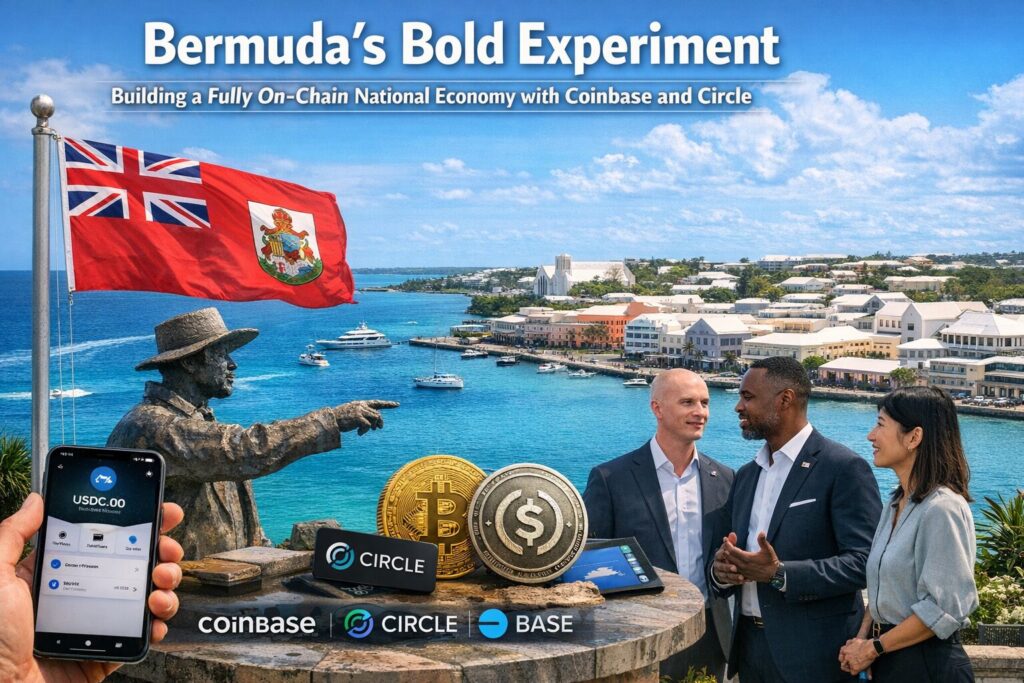
The government of Bermuda has announced one of the most ambitious national blockchain initiatives to date: a plan to build what it calls a “fully on-chain” economy. Rather than limiting blockchain adoption to isolated pilots or regulatory experiments, Bermuda is explicitly framing blockchain infrastructure as a foundational layer of its national economic system.
The announcement was made in conjunction with the annual meeting of the World Economic Forum (WEF) in Davos, a venue that has increasingly become a signaling ground for global digital asset policy. Standing alongside representatives from Coinbase and Circle, Bermuda’s Prime Minister David Burt emphasized that the goal is not technological novelty, but economic transformation.
This initiative builds on Bermuda’s long-standing ambition to serve as a digital finance hub. Since the passage of its Digital Asset Business Act in 2018, the country has deliberately attracted regulated crypto firms by offering legal clarity, licensing certainty, and regulatory dialogue, rather than permissive ambiguity.
2. Why Coinbase and Circle Matter in This Equation
The choice of partners is central to understanding Bermuda’s strategy. Coinbase is not merely a crypto exchange; it is one of the most systemically important on-ramps between traditional finance and blockchain markets. Circle, meanwhile, issues USDC, one of the world’s largest regulated dollar-backed stablecoins, with circulating supply historically ranging in the tens of billions of dollars.
By anchoring its on-chain economy to USDC, Bermuda is effectively outsourcing monetary settlement stability to a dollar-denominated digital asset already widely accepted across exchanges, wallets, and decentralized applications.
Coinbase’s Base network—a Layer 2 blockchain built on Ethereum—serves as the technical backbone. Base offers lower transaction costs and higher throughput while retaining compatibility with Ethereum’s developer ecosystem. For a national economy, this matters: transaction fees measured in cents rather than dollars are a prerequisite for everyday payments, government disbursements, and consumer use.
Diagram: “Bermuda’s On-Chain Economic Stack”
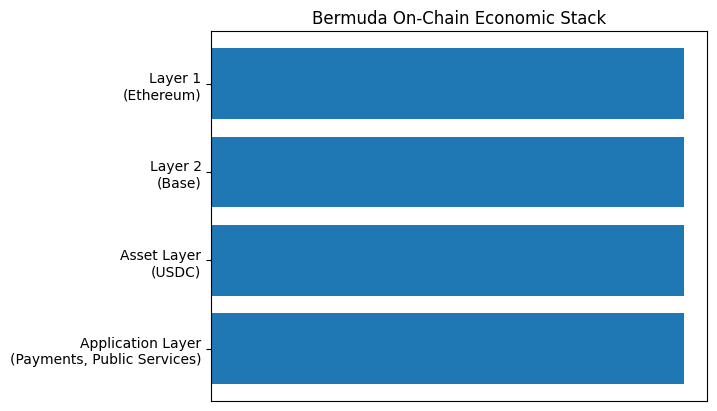
- Layer 1: Ethereum (Security & Settlement)
- Layer 2: Base (Scalability & Low Fees)
- Asset Layer: USDC (Dollar Settlement)
- Application Layer: Payments, Tokenized Assets, Public Services
3. The Pilot Program: From Theory to Daily Economic Activity
According to the joint statement, Bermuda will begin with a pilot program targeting three core areas:
- Stablecoin-based payments for residents and businesses
- Financial institutions integrating tokenization tools
- A nationwide digital literacy program to onboard citizens
This design acknowledges a critical lesson learned from earlier crypto experiments worldwide: technology alone does not drive adoption. Human understanding, trust, and usability are equally important.
The government has already tested public engagement. In May 2025, during the Bermuda Digital Finance Forum, a USDC airdrop was conducted. Following this event, a growing number of local merchants reportedly began accepting digital payments denominated in USDC, demonstrating that behavioral adoption can follow well-designed incentives.
4. Economic Rationale: Cost Reduction, Speed, and Financial Inclusion
Prime Minister Burt framed the initiative around three economic goals:
- Creating opportunity
- Reducing transaction costs
- Ensuring Bermudians benefit from the future of finance
From a macro perspective, stablecoin-based settlement can significantly reduce costs associated with card networks, correspondent banking, and cross-border remittances. Traditional payment rails often involve fees ranging from 1% to over 5%. On-chain USDC transfers on Layer 2 networks can settle for fractions of a dollar.
For small economies that rely heavily on tourism, international trade, and services, these savings are not marginal—they are structurally meaningful.
Graph: “Traditional Payment Fees vs On-Chain USDC Payments (USD)”
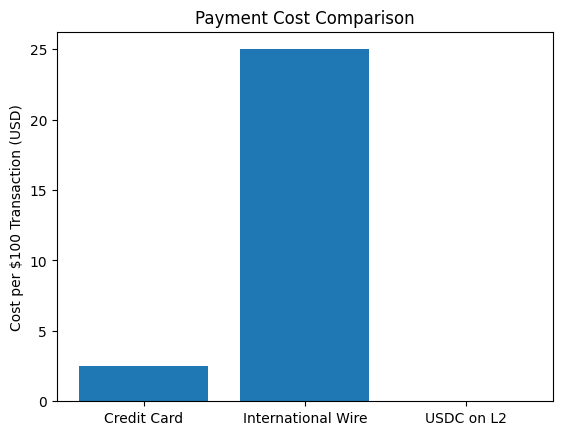
- Credit Cards: $1.50–$3.50 per $100
- International Wire: $15–$50 per transfer
- USDC on Layer 2: <$0.10 per transaction
5. Tokenization as the Next Phase of Capital Access
Beyond payments, Bermuda’s plan explicitly includes tokenization—the representation of real-world assets as on-chain tokens. This could apply to:
- Equity in local businesses
- Real estate interests
- Fund shares
- Government or municipal instruments
At WEF, Coinbase CEO Brian Armstrong emphasized tokenization as a way to broaden access to capital markets. For small jurisdictions, this is especially powerful: tokenized assets can be offered globally, reducing reliance on local banking capacity or traditional listing venues.
However, tokenization also raises regulatory questions around investor protection, disclosure, and secondary market trading—areas where Bermuda’s existing regulatory framework will be tested in real time.
6. The Global Context: Crypto at Davos and Shifting Policy Winds
The Bermuda announcement did not occur in isolation. Davos this year has seen renewed attention on crypto and digital assets after a period of regulatory uncertainty.
In previous years, crypto discussions at WEF were dominated by caution following market collapses and enforcement actions. More recently, however, the conversation has shifted toward integration rather than exclusion.
Last year, former U.S. President Donald Trump outlined policy visions touching on crypto and AI. In 2026, executives including Armstrong and Circle CEO Jeremy Allaire are expected to engage directly with policymakers on stablecoin regulation and market structure.
Armstrong has argued publicly that stablecoins can benefit both banks and crypto firms—provided a level competitive field exists. At the same time, Coinbase recently withdrew support for a U.S. digital asset market structure bill, signaling ongoing tension between innovation and regulation.
7. Risks and Open Questions
While Bermuda’s vision is compelling, it is not without risk:
- Dependence on external infrastructure (USDC issuers, Base network governance)
- Regulatory spillovers from U.S. and EU policy shifts
- Cybersecurity and operational resilience
- Public adoption fatigue or mistrust
A fully on-chain economy must also answer difficult questions about privacy, surveillance, and the role of the state in programmable money.
8. Implications for Investors, Builders, and Policymakers
For investors, Bermuda’s experiment provides an early signal of where real-world on-chain adoption may accelerate. Infrastructure providers, wallet developers, compliance technology firms, and tokenization platforms could all find opportunities in similar jurisdictions.
For builders, the lesson is clear: regulatory alignment and government partnership can unlock use cases that pure DeFi cannot achieve alone.
For policymakers elsewhere, Bermuda represents a test case—a small but serious attempt to move blockchain from the margins to the center of economic life.
Conclusion: A Small Nation, a Big Signal
Bermuda’s partnership with Coinbase and Circle is not just a local policy initiative; it is a global signal. It suggests that the next phase of blockchain adoption may come not from ideological decentralization alone, but from pragmatic alliances between states and regulated crypto infrastructure.
Whether Bermuda succeeds or stumbles, its experiment will be closely watched. For those searching for the next wave of digital assets, revenue models, and real-world blockchain applications, this is a development that deserves sustained attention.