
Main Takeaways :
- Strategy, led by Michael Saylor, has again hinted at additional Bitcoin purchases following its latest 13,627 BTC acquisition.
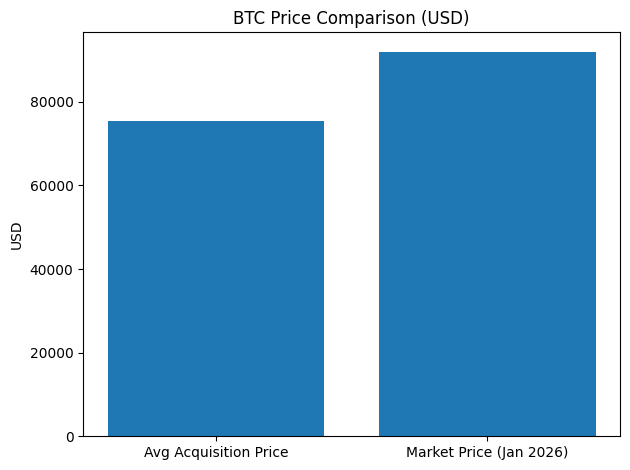
- The company now holds approximately 687,410 BTC, acquired at an average price of $75,353 per BTC, placing it firmly in unrealized profit at current market levels.
- Strategy’s capital-market-driven Bitcoin strategy continues to reshape how corporations treat BTC—not as a speculative asset, but as a treasury reserve and long-term financial infrastructure.
- This approach is increasingly influencing institutional investors, public markets, and blockchain-based financial engineering.
- For investors seeking new crypto assets, yield strategies, or practical blockchain use cases, Strategy’s model provides critical signals for the next phase of digital finance.
1. Saylor’s “₿igger Orange” Signal and What It Means
On January 19, Michael Saylor, Executive Chairman of Strategy, once again stirred the Bitcoin market with a familiar yet powerful signal. Posting on X, Saylor shared a screenshot from the company’s internal Bitcoin holdings tracker—a chart overlaying Bitcoin’s price trajectory with Strategy’s historical purchase markers. His caption, “₿igger Orange,” left little doubt among market participants: another Bitcoin acquisition may be imminent.
This pattern is not new. Over the past several years, Saylor has repeatedly used cryptic but consistent social signals to foreshadow formal disclosures of Bitcoin purchases. These posts typically precede SEC filings and press releases, functioning as early indicators for investors closely tracking institutional Bitcoin demand.
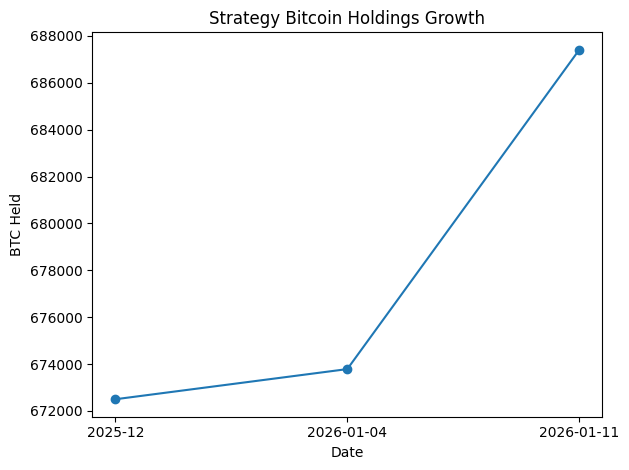
The January post followed a major purchase just days earlier. On January 11, Strategy acquired 13,627 BTC for approximately $1.25 billion, after already purchasing 1,287 BTC on January 4. In total, since the beginning of 2026, the company has added 14,910 BTC to its balance sheet.
What makes these signals important is not merely their short-term market impact, but what they reveal about Strategy’s long-term conviction: Bitcoin accumulation remains a core corporate policy, not a tactical trade.
2. Strategy’s Bitcoin Treasury: Scale, Cost, and Profitability
As of mid-January 2026, Strategy holds approximately 687,410 BTC, making it by far the largest corporate holder of Bitcoin globally. The company’s average acquisition cost of $75,353 per BTC places its total Bitcoin investment at tens of billions of dollars.
At current market prices, this reserve represents a substantial unrealized gain—estimated at roughly $13–14 billion, depending on spot BTC prices. Importantly, this profitability has been achieved despite significant volatility cycles, reinforcing Saylor’s thesis that Bitcoin’s long-term trajectory outweighs short-term drawdowns.
Unlike companies that treat crypto exposure as an experimental allocation, Strategy has effectively transformed its balance sheet into a Bitcoin-native treasury. The firm’s equity value, credit profile, and investor narrative are now structurally linked to Bitcoin’s adoption curve.
This creates a feedback loop:
- Rising BTC prices strengthen Strategy’s balance sheet.
- A stronger balance sheet improves access to capital markets.
- Access to capital enables further BTC accumulation.
This loop is central to understanding why Strategy continues to buy, regardless of market sentiment.
3. Financing the Accumulation: Convertible Debt and Equity Engineering
One of the most misunderstood aspects of Strategy’s approach is how it finances these purchases. Contrary to popular belief, the company is not simply “betting the house” on Bitcoin using operational cash flow. Instead, it employs sophisticated capital-market instruments, including:
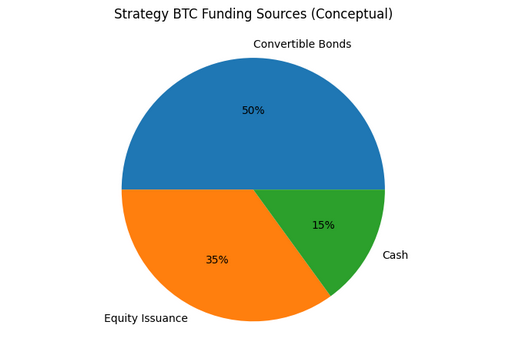
- Convertible bonds
- At-the-market (ATM) equity offerings
- Structured debt issuances
These instruments allow Strategy to raise capital at relatively low effective costs, particularly when investor demand for BTC-linked exposure is strong. Convertible debt, in particular, enables bondholders to benefit from upside in Strategy’s equity—an equity that itself is increasingly correlated with Bitcoin.
From a financial engineering perspective, Strategy has effectively turned Bitcoin into a form of synthetic productive capital. While BTC itself does not generate yield, the company’s ability to monetize its balance sheet through capital markets creates indirect returns.
For readers interested in blockchain’s practical financial applications, this model demonstrates how crypto assets can be integrated into legacy financial systems without relying on DeFi protocols alone.
4. Broader Market Impact: Institutional Signals and Index Inclusion
Strategy’s aggressive Bitcoin stance has not gone unnoticed by traditional financial institutions. Recently, MSCI considered—but ultimately decided against—excluding Bitcoin-holding companies from certain equity indices. As a result, Strategy and similar firms remain part of mainstream investment benchmarks.
This decision is significant. Index inclusion means:
- Passive funds continue to hold Strategy shares.
- Bitcoin exposure becomes embedded in traditional portfolios.
- Institutional investors gain indirect BTC exposure without custody complexity.
In effect, Strategy acts as a bridge between traditional finance and the crypto economy. For conservative capital pools that cannot hold Bitcoin directly, Strategy’s stock serves as a regulated proxy.
This dynamic supports a broader thesis: corporate Bitcoin treasuries may become a standard feature of public markets, especially in an environment of persistent fiat currency debasement and geopolitical uncertainty.
5. Implications for Crypto Investors and Builders
For investors searching for new crypto assets or revenue opportunities, Strategy’s actions offer several lessons:
First, Bitcoin remains the institutional entry point. Despite the proliferation of altcoins, Layer 2 solutions, and application-specific tokens, large-scale corporate adoption still centers on BTC.
Second, capital structure matters as much as technology. Strategy’s success is not solely due to Bitcoin’s price appreciation, but to its ability to integrate BTC into sophisticated financial frameworks.
Third, signaling and narrative control are powerful tools. Saylor’s communication strategy has effectively turned Bitcoin accumulation into a brand asset, reinforcing investor confidence even during downturns.
For blockchain builders, this underscores the importance of interoperability with traditional finance. Tools that enable compliant custody, reporting, hedging, and treasury optimization will be critical as more firms follow Strategy’s path.
6. Looking Ahead: Is There a Limit to Strategy’s Bitcoin Accumulation?
A natural question arises: how far can this strategy go?
From a theoretical standpoint, Strategy faces constraints related to:
- Capital market appetite
- Regulatory scrutiny
- Shareholder risk tolerance
However, as long as global liquidity conditions allow and Bitcoin continues to be perceived as a superior store of value, Strategy’s approach remains viable. In fact, Saylor has repeatedly argued that Bitcoin’s fixed supply makes early and aggressive accumulation rational, even at higher prices.
For the broader crypto ecosystem, this suggests a future where Bitcoin serves as base-layer collateral—while innovation and yield generation occur on top through other blockchain systems.
Conclusion: Strategy as a Blueprint for Bitcoin-Native Corporations
Michael Saylor’s latest “₿igger Orange” signal is more than a teaser for another purchase. It is a reaffirmation of a corporate philosophy that treats Bitcoin not as a trade, but as a foundation.
Strategy’s model—combining large-scale BTC accumulation, capital market engineering, and disciplined messaging—has created a new category of Bitcoin-native public company. Whether or not other firms replicate this approach exactly, its influence on institutional crypto adoption is undeniable.
For readers seeking the next wave of blockchain-driven financial opportunity, understanding Strategy’s playbook is essential. It shows how digital assets can be embedded into real-world balance sheets, governance structures, and long-term economic strategy—well beyond speculation.