
Key Takeaways :
- U.S.-listed Bitcoin mining and data center firms tracked by JPMorgan Chase added approximately $13 billion in market capitalization in the first two weeks of 2026, bringing the total to around $62 billion.
- A modest rise in Bitcoin’s price combined with a decline in network hash rate materially improved mining profitability, lifting hash price by roughly 11% from late December levels.
- Major miners are accelerating diversification into AI and high-performance computing (HPC) to reduce reliance on block rewards.
- U.S.-listed miners now command a record ~41% share of global hash rate, reshaping the geographic and industrial structure of the Bitcoin network.
- If Bitcoin prices stabilize and network conditions normalize, 2026 could mark a more constructive and sustainable phase for the mining sector.
Introduction: Why 2026 Matters for Bitcoin Mining
For much of the past decade, Bitcoin mining has been portrayed as a brutally cyclical business—capital intensive, energy constrained, and highly sensitive to price swings and halving events. Yet a new report released this week by JPMorgan Chase suggests that the early days of 2026 may represent a meaningful inflection point.
According to the bank’s analysis, operational fundamentals for publicly listed U.S. Bitcoin miners strengthened markedly at the start of the year. This improvement was not driven by speculative excess, but by a confluence of measurable factors: improving unit economics, easing competitive pressure, and—most notably—rapid strategic expansion beyond pure Bitcoin mining into AI and data center infrastructure.
For investors searching for the next revenue engine in crypto-adjacent industries, and for operators interested in practical blockchain-linked infrastructure plays, this shift deserves close attention.
A $13 Billion Market Capitalization Expansion in Just Two Weeks
JPMorgan tracks 14 U.S.-listed Bitcoin mining and data center operators, and its January 2026 report highlights a striking figure: approximately $13 billion in additional market capitalization accrued within the first two weeks of the year alone.
This brought the combined valuation of these firms to roughly $62 billion, a level that materially changes how traditional capital markets view the sector. The speed of this expansion is particularly notable given that Bitcoin itself only recorded a modest price increase over the same period.
Rather than being purely price-driven, the equity revaluation reflects improving confidence in the sustainability of miners’ business models—especially in a post-halving environment where inefficient operators are increasingly squeezed out.
The Mechanics Behind the Recovery: Hash Rate Decline Meets Stable Prices
To understand why miner profitability improved so quickly, one must look beyond headline Bitcoin prices and focus on network-level dynamics.
Hash Rate and Revenue per Exahash
JPMorgan analysts observed that average network hash rate declined by roughly 2% from late December into early January, falling well below October 2025 levels. When combined with a slight increase in Bitcoin’s dollar price, this created a favorable imbalance.
As a result, average daily revenue per exahash—a critical efficiency metric—rose materially. The industry’s core profitability indicator, hash price (which includes transaction fees), increased by approximately 11% from late December levels.
For miners, this translates directly into improved cash flow, better balance sheet resilience, and enhanced capacity to service debt or fund expansion.
Hash Price Explained: Why It Matters More Than BTC Price Alone
Hash price is often overlooked by non-specialists, yet it is arguably the most important variable in mining economics.
Put simply, hash price measures how much revenue a miner earns per unit of computational power. It captures:
- Bitcoin price (in USD),
- Block subsidy,
- Transaction fees,
- Network difficulty and hash rate.
An 11% increase in hash price, achieved without a dramatic Bitcoin rally, signals that competitive pressure temporarily eased. For well-capitalized miners, this breathing room can be reinvested strategically—precisely what JPMorgan now sees unfolding.
Strategic Diversification: Mining Meets AI and High-Performance Computing
Perhaps the most consequential trend identified in the report is the rapid convergence between Bitcoin mining infrastructure and AI/HPC data centers.
Large-scale miners already possess:
- Massive power access,
- Purpose-built data centers,
- Advanced cooling systems,
- Long-term energy contracts.
These assets are directly applicable to AI workloads, particularly as global demand for compute accelerates. JPMorgan highlights that miners are increasingly monetizing infrastructure outside of block rewards, reducing reliance on Bitcoin issuance alone.
This pivot reframes miners not merely as crypto-native actors, but as digital infrastructure providers—a narrative far more palatable to institutional capital.
Capacity Expansion and U.S. Hash Rate Dominance
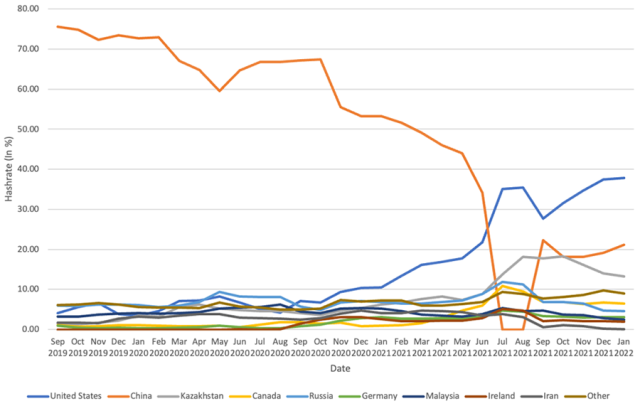
JPMorgan reports that since late November 2025, roughly 12 exahash of new capacity has been added, driven primarily by Bitdeer and Riot Platforms.
As a result:
- Total hash rate controlled by U.S.-listed miners reached approximately 419 exahash.
- This represents about 41% of global network hash rate, the highest share on record.
This concentration has profound implications:
- Greater regulatory visibility,
- Higher institutional participation,
- Increased pressure on marginal, offshore operators.
The Bitcoin network is becoming more industrialized—and more American—than ever before.
Riot Platforms and AMD: A Case Study in Hybrid Monetization
Among the most striking developments cited by JPMorgan is Riot Platforms’ expansion in Rockdale, Texas.
Riot announced:
- The acquisition of approximately 200 acres for $96 million.
- A long-term data center leasing agreement with AMD.
The AMD contract alone is expected to generate at least $311 million in revenue over an initial 10-year term, with extension options potentially pushing total value toward $1 billion.
This deal underscores a critical shift: miners are no longer betting solely on Bitcoin price appreciation. Instead, they are locking in predictable, fiat-denominated cash flows that smooth earnings volatility.
Galaxy Digital and the Rise of Mega-Scale Facilities
Another expansion highlighted in the report comes from Galaxy Digital Holdings, which received approval from the Texas grid operator to connect 830 megawatts to its Helios facility.
With a theoretical capacity of 1.6 gigawatts, Helios is poised to become the largest single mining and data center facility in the United States.
Such scale was unimaginable in Bitcoin’s early years. Today, it signals a transition from experimental infrastructure to utility-grade digital industrial assets.
Structural Shifts in the Global Mining Landscape
The JPMorgan report also references a broader structural trend already visible in 2025: the gradual decline of U.S. share in pure Bitcoin mining even as U.S.-listed firms dominate total hash rate.
This apparent paradox reflects consolidation:
- Smaller operators exit,
- Capital-intensive players scale,
- Revenue diversification becomes mandatory.
Mining is no longer a hobbyist or purely speculative endeavor—it is converging with energy markets, cloud computing, and capital-intensive infrastructure finance.
What This Means for Investors Seeking New Crypto Revenue Streams
For readers looking beyond spot Bitcoin exposure, the implications are significant.
Bitcoin mining equities are evolving into hybrid infrastructure plays:
- Part crypto derivative,
- Part data center REIT,
- Part energy arbitrage business.
The addition of AI and HPC revenue streams introduces:
- Lower earnings volatility,
- Improved financing terms,
- Broader institutional appeal.
This does not eliminate risk, but it fundamentally changes the risk profile.
Outlook for 2026: A More Constructive Year Ahead
JPMorgan concludes that if:
- Bitcoin prices remain relatively stable,
- Network hash rate growth normalizes,
- Revenue diversification continues,
then 2026 could prove to be a structurally constructive year for the entire mining sector.
Improving profitability and easing competitive pressure may allow miners to plan multi-year strategies rather than react defensively to each market cycle.
Conclusion: From Cyclical Speculation to Digital Infrastructure
The early-2026 surge in Bitcoin mining equities is not merely a relief rally. It reflects a deeper transformation underway—one where mining firms evolve into multi-purpose digital infrastructure companies at the intersection of blockchain, energy, and AI.
For investors seeking new crypto-adjacent opportunities, and for practitioners interested in the real-world deployment of blockchain-linked infrastructure, this shift may define the next chapter of the industry.