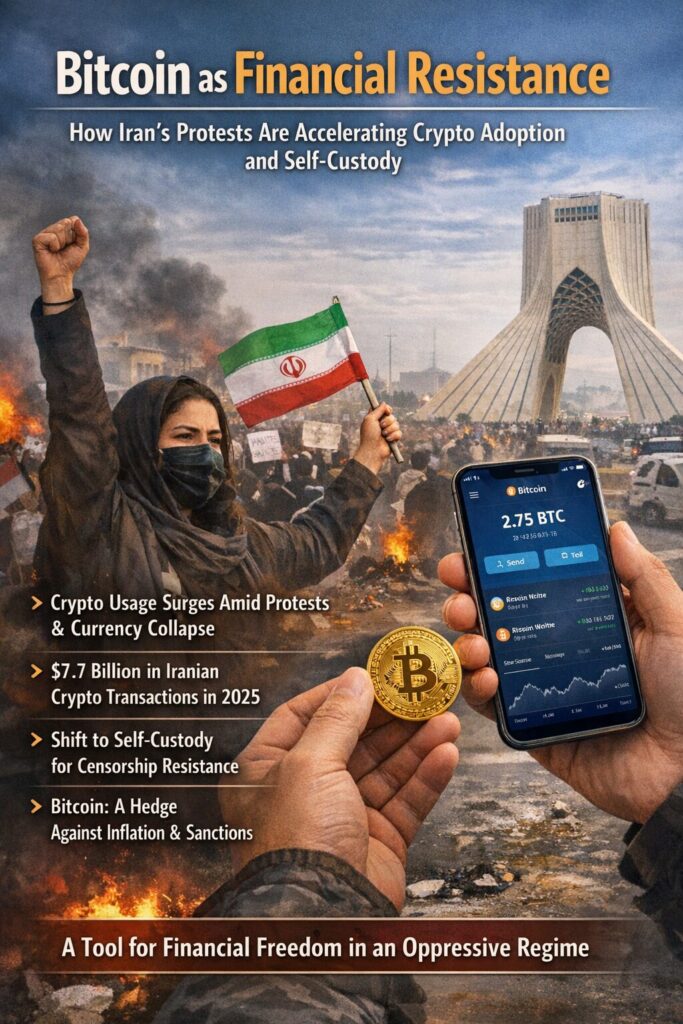
Iran’s ongoing protests and currency collapse have triggered a sharp rise in cryptocurrency usage, especially Bitcoin self-custody.
According to Chainalysis, Iran’s crypto ecosystem reached $7.7 billion in 2025, with transaction volumes surging during unrest.
Withdrawals of Bitcoin from domestic exchanges into personal wallets have accelerated as citizens seek value preservation and censorship resistance.
Crypto in Iran now functions not only as a hedge against inflation, but also as a tool of financial autonomy under sanctions and internet restrictions.
Similar patterns are emerging globally in regions facing sanctions, war, or capital controls, reinforcing Bitcoin’s role as a neutral financial infrastructure.
Introduction: When Currency Trust Breaks, Code Takes Over
In late December, widespread protests erupted across Iran amid rapidly deteriorating economic conditions. The Iranian rial plunged to historic lows against the U.S. dollar, eroding purchasing power and wiping out savings almost overnight. As demonstrations spread nationwide, the government responded with arrests, internet shutdowns, and tightened financial controls.
In this environment, a familiar pattern resurfaced—one increasingly observed in crisis-stricken economies around the world. Citizens began turning to cryptocurrencies, particularly Bitcoin, not for speculation, but for survival. Blockchain data shows a marked increase in crypto usage precisely as political and monetary instability intensified.
This article expands on recent findings by Chainalysis, integrates insights from other analytics firms, and places Iran’s situation within a broader global context. For readers interested in new digital assets, alternative revenue sources, and real-world blockchain applications, Iran provides a stark, data-driven case study of crypto’s role under extreme stress.
The Collapse of the Rial and the Surge in Crypto Activity
Iran’s economic stress is not new, but the pace of deterioration has accelerated. Persistent sanctions, restricted access to international banking, and domestic policy challenges have steadily weakened the rial. By the time protests began in late December, confidence in the national currency had effectively collapsed.
Key On-Chain Indicators
Chainalysis reports that:
Iran’s crypto ecosystem reached approximately $7.7 billion in total activity during 2025.
Daily transaction counts and volumes increased sharply following the onset of nationwide protests.
The most notable shift was a surge in Bitcoin withdrawals from local exchanges to personal wallets, indicating a move toward self-custody.
This behavior is significant. Exchange trading alone could indicate speculation. Large-scale withdrawals, however, signal a deeper motivation: the desire to hold assets beyond the reach of capital controls, bank freezes, or exchange shutdowns.
[“Bitcoin Withdrawals from Iranian Exchanges vs. Protest Timeline”]
Bitcoin Self-Custody as Value Defense
One of Chainalysis’ most striking observations is the rapid increase in Bitcoin self-custody among Iranian users. Compared to pre-protest levels, citizens are now transferring BTC into personal wallets at a significantly higher pace.
From an economic perspective, this is a rational response:
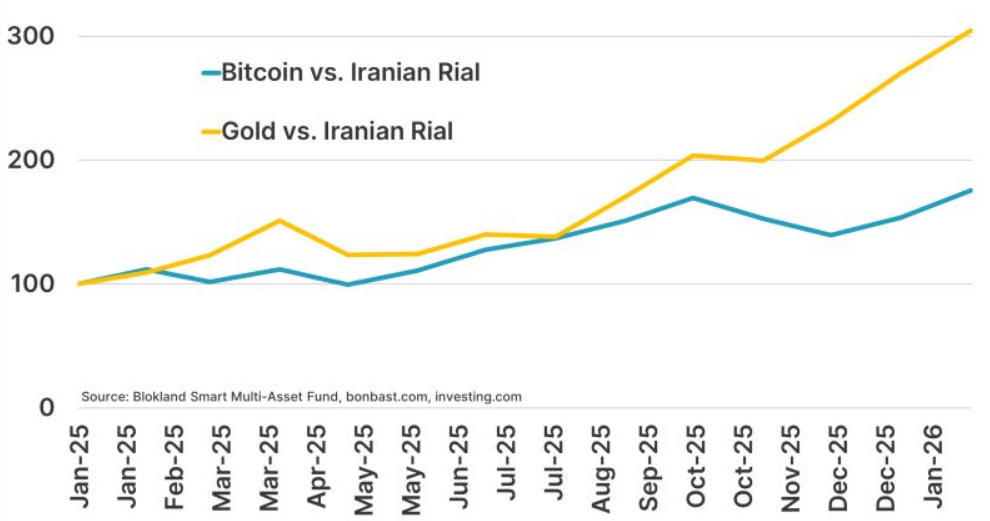
The rial has lost so much value that holding it long-term is effectively untenable.
Access to U.S. dollars and foreign bank accounts is restricted.
Gold and real estate are illiquid and difficult to move under crisis conditions.
Bitcoin, by contrast, offers:
Portability: Assets can be moved with a private key.
Censorship resistance: Transactions cannot be easily blocked by domestic authorities.
Self-custody: Ownership does not depend on banks or intermediaries.
Chainalysis describes this shift as a direct reaction to the rial’s collapse—an attempt to preserve value when conventional monetary instruments fail.
Crypto as More Than a Hedge: A Tool of Resistance
While inflation protection is a major driver, Bitcoin’s role in Iran extends further. Chainalysis characterizes crypto as a component of broader “financial resistance.”
In heavily controlled economies:
Bank accounts can be frozen.
Transfers can be delayed or denied.
Cross-border payments are tightly monitored.
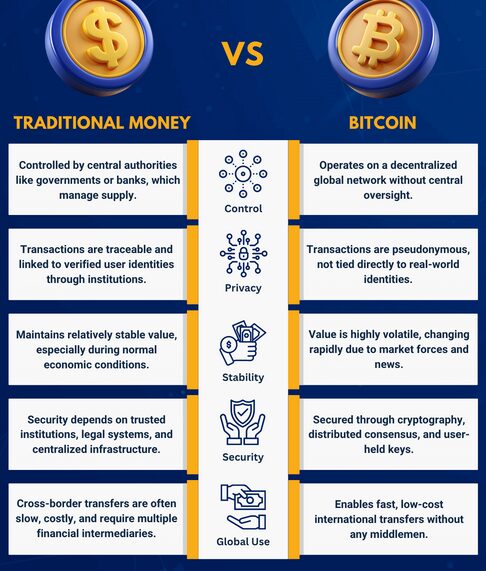
Bitcoin changes this equation. Its permissionless nature allows individuals to:
Transfer value across borders without traditional intermediaries.
Maintain financial continuity even during internet disruptions, using delayed broadcast or satellite-assisted methods.
This makes Bitcoin particularly valuable for individuals forced to relocate, support family members abroad, or operate outside official financial rails.
[“Traditional Assets vs. Bitcoin Under Capital Controls”]
Government and IRGC-Linked Crypto Activity: A Parallel Reality
Crypto adoption in Iran is not limited to civilians. Chainalysis also reports substantial activity linked to state-associated actors.
In Q4 2025, addresses associated with Iran’s Islamic Revolutionary Guard Corps (IRGC) reportedly accounted for nearly 50% of total crypto activity within the country’s ecosystem. Over the course of the year, these addresses received more than $3 billion in crypto inflows.
This highlights an uncomfortable but important truth: Cryptocurrency is neutral infrastructure. It can be used both to bypass sanctions for state purposes and to protect civilians from economic collapse.
For policymakers and compliance professionals, this dual-use nature underscores the importance of advanced blockchain analytics rather than simplistic bans.
Independent Data: TRM Labs and User Adoption
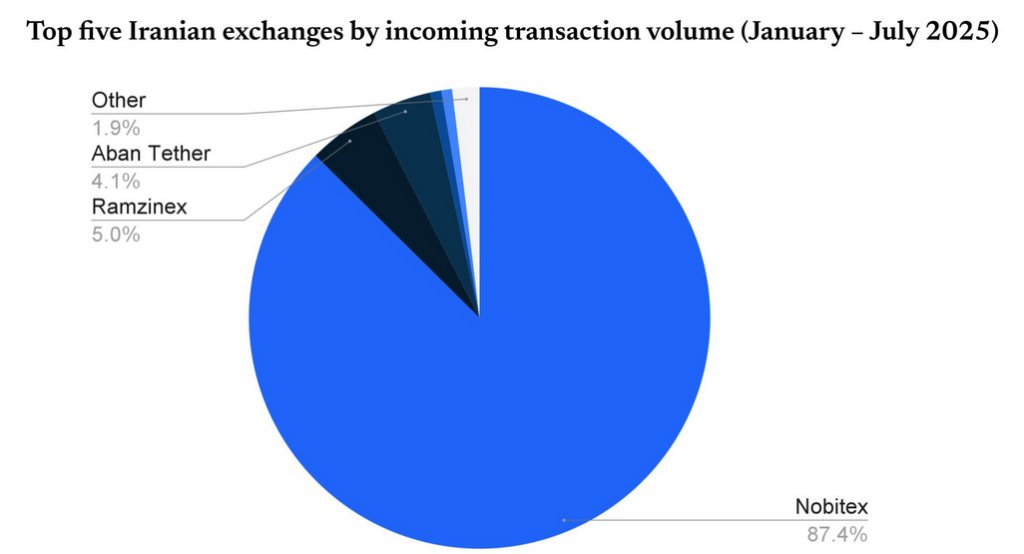
Other analytics firms corroborate Chainalysis’ conclusions. According to TRM Labs, crypto flows linked to Iran totaled approximately $3.7 billion between January and July 2025 alone.
Meanwhile, data from statistical platforms suggests that:
Iran has a population of roughly 92 million.
An estimated 7 million people—nearly 8% of the population—are crypto users.
This level of adoption rivals or exceeds that of many developed markets, reinforcing the idea that necessity, not speculation, is the primary driver.
[“Estimated Crypto User Penetration in Iran”]
A Global Pattern: Iran Is Not an Outlier
Iran’s experience fits a broader global trend. In regions affected by:
War (e.g., Ukraine),
Hyperinflation (e.g., Venezuela),
Capital controls (e.g., parts of Africa and the Middle East),
on-chain data consistently shows spikes in Bitcoin withdrawals and stablecoin usage during periods of crisis.
The common denominator is not ideology, but utility. When trust in institutions erodes, individuals gravitate toward systems that:
Are transparent,
Require minimal trust,
Function across borders.
Bitcoin’s fixed supply and predictable monetary policy further strengthen its appeal under these conditions.
Implications for Investors and Builders
For readers seeking new crypto assets, revenue opportunities, or practical blockchain use cases, Iran’s situation offers several lessons:
Real-World Demand Matters Adoption driven by survival is more durable than hype-driven cycles.
Self-Custody Infrastructure Is Critical Wallet UX, key management, and offline resilience are not niche features—they are core.
Compliance and Analytics Will Coexist with Decentralization Tools from firms like Chainalysis and TRM Labs demonstrate that transparency and decentralization are not mutually exclusive.
Bitcoin’s Value Proposition Is Context-Dependent In stable economies, Bitcoin may look like an investment. In unstable ones, it becomes infrastructure.
Conclusion: Bitcoin as a Tool of Financial Sovereignty
The surge in cryptocurrency usage during Iran’s protests is not an anomaly—it is a predictable response to currency collapse, political repression, and restricted financial access. Data from Chainalysis and other firms shows that Iranians are increasingly choosing Bitcoin self-custody as a way to defend value and retain autonomy.
At the same time, the presence of state-linked crypto activity reminds us that digital assets are neither inherently liberating nor oppressive. They are tools. Their impact depends on who uses them and why.
As sanctions persist and economic uncertainty continues, cryptocurrencies are likely to remain an essential financial instrument for millions of Iranians. More broadly, Iran’s experience reinforces a central lesson of the blockchain era: when traditional systems fail, neutral, decentralized networks do not disappear—they become indispensable.
About Us and Media
Blockchain and cryptocurrency media covering and exposing the practical application development on the blockchain industry and undiscovered coins.
Click edit button to change this text. Lorem ipsum dolor sit amet, consectetur adipiscing elit
Manage Consent
To provide the best experiences, we use technologies like cookies to store and/or access device information. Consenting to these technologies will allow us to process data such as browsing behavior or unique IDs on this site. Not consenting or withdrawing consent, may adversely affect certain features and functions.
Functional
Always active
The technical storage or access is strictly necessary for the legitimate purpose of enabling the use of a specific service explicitly requested by the subscriber or user, or for the sole purpose of carrying out the transmission of a communication over an electronic communications network.
Preferences
The technical storage or access is necessary for the legitimate purpose of storing preferences that are not requested by the subscriber or user.
Statistics
The technical storage or access that is used exclusively for statistical purposes.The technical storage or access that is used exclusively for anonymous statistical purposes. Without a subpoena, voluntary compliance on the part of your Internet Service Provider, or additional records from a third party, information stored or retrieved for this purpose alone cannot usually be used to identify you.
Marketing
The technical storage or access is required to create user profiles to send advertising, or to track the user on a website or across several websites for similar marketing purposes.