Main Points :
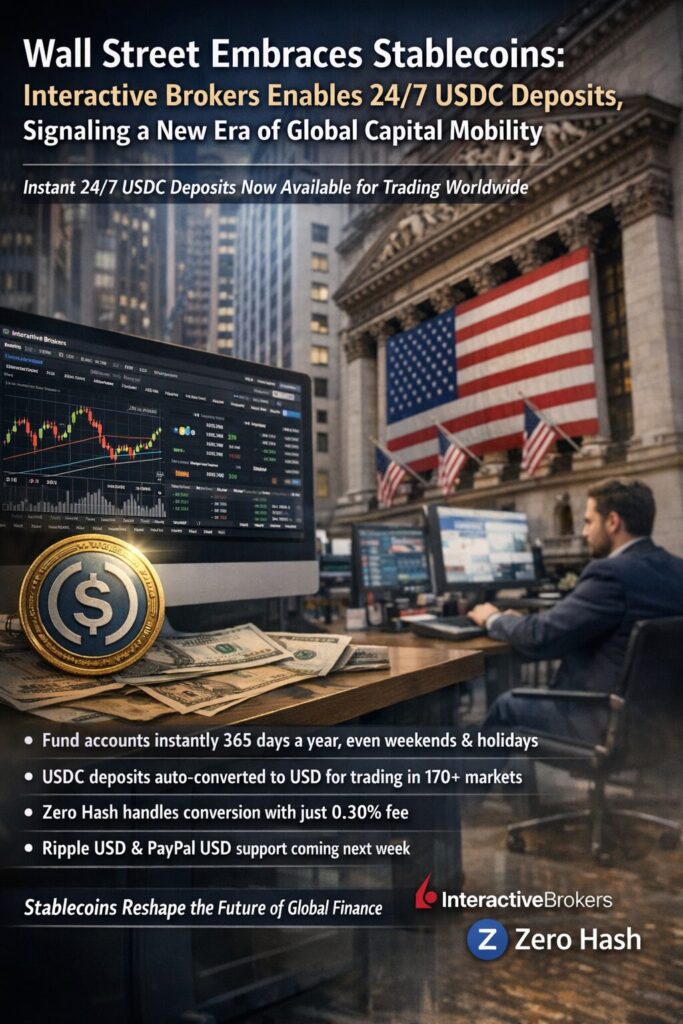
- Interactive Brokers has launched 24/7 instant deposits via USDC, allowing eligible clients to fund securities accounts within minutes.
- Deposited USD Coin (USDC) is automatically converted into USD, enabling immediate trading access across 170 global markets.
- The service operates 365 days a year, including weekends and holidays, dramatically reducing friction compared to traditional international bank transfers.
- Zero Hash acts as the conversion partner, charging a 0.30% FX/conversion fee, while Interactive Brokers charges no deposit fee.
- Support for Ripple USD (RLUSD) and PayPal USD (PYUSD) is scheduled to be added next week.
- This move reflects a broader institutional shift toward stablecoins as settlement infrastructure, not merely crypto trading assets.
1. From Bank Wires to Blockchain Rails: Why This Announcement Matters
On January 15, Interactive Brokers, one of the largest electronic brokerage firms in the United States, announced the launch of a new funding mechanism that allows eligible clients to deposit stablecoins directly into their securities accounts. While the headline may appear incremental at first glance, the implications are far-reaching.
For decades, global investors have been constrained by the limitations of traditional banking infrastructure: international wire transfers that take days, limited operating hours, high correspondent banking fees, and regional cutoffs during weekends and holidays. By contrast, blockchain-based settlement systems operate continuously, without regard to borders or banking calendars.
By enabling USDC deposits that settle within minutes and convert automatically into U.S. dollars, Interactive Brokers is effectively bridging the gap between crypto-native capital and traditional securities markets. This is not merely a convenience feature; it is a structural shift in how capital can move globally.
2. How the USDC Deposit Mechanism Works
The newly launched service allows eligible customers to send USDC from their external crypto wallets directly to their Interactive Brokers accounts. Upon receipt, the USDC is automatically converted into USD, making the funds immediately available for trading stocks, ETFs, options, futures, and other financial instruments.
Several operational features stand out:
- Speed: Funding is completed within minutes rather than days.
- Availability: The system runs 24 hours a day, 7 days a week, 365 days a year.
- Cost efficiency: Interactive Brokers does not charge a deposit fee; the only cost is the 0.30% conversion fee charged by Zero Hash.
- Scale: Clients gain access to more than 170 markets worldwide using funds that originated as stablecoins.
From a user-experience perspective, this effectively removes one of the largest bottlenecks in cross-border investing: the time and uncertainty associated with moving fiat money internationally.
3. Cost Comparison: Stablecoin Deposits vs Traditional International Transfers
【Cost and Time Comparison of International Wire Transfers vs Stablecoin-Based Funding】
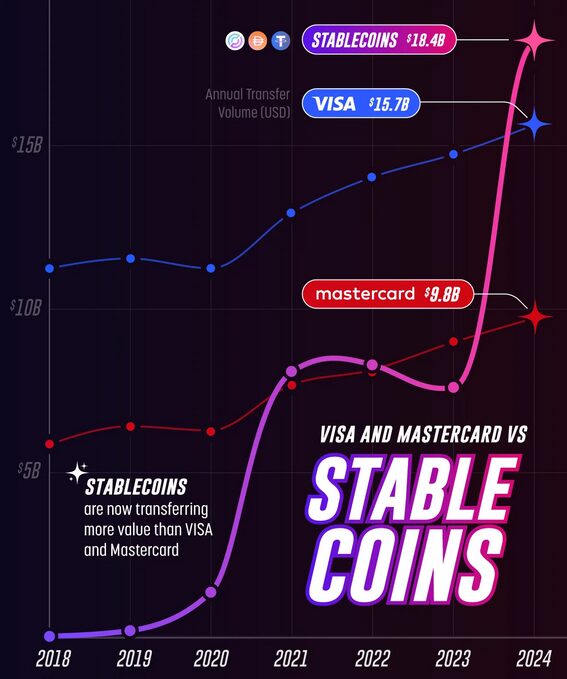
Traditional international wire transfers often involve multiple intermediaries—originating banks, correspondent banks, and receiving banks—each adding fees and delays. It is not uncommon for a $50,000 transfer to incur $50–$100 or more in cumulative costs, with settlement times ranging from one to five business days.
By contrast, a USDC transfer on a public blockchain settles within minutes, regardless of geography. Even after accounting for a 0.30% conversion fee (equivalent to $150 on a $50,000 transfer), the predictability and immediacy can outweigh the cost difference, especially for active traders and institutions that value time-sensitive execution.
4. Why RLUSD and PYUSD Matter
Interactive Brokers has confirmed that support for RLUSD and PYUSD will be added as early as next week. This is strategically significant.
RLUSD, issued within the Ripple ecosystem, is designed to integrate tightly with enterprise-grade payment and settlement systems. PYUSD, issued by PayPal, benefits from direct access to one of the world’s largest retail and merchant payment networks.
By supporting multiple USD-denominated stablecoins, Interactive Brokers is signaling neutrality toward issuers while embracing a multi-stablecoin future. For clients, this means flexibility: the ability to fund accounts using the stablecoin that best fits their operational, regulatory, or treasury needs.
5. Interactive Brokers’ Gradual but Deliberate Crypto Strategy
Founded in 1978, Interactive Brokers has long been known for its low-cost structure and technology-driven approach to brokerage services. Its move into digital assets has been cautious but consistent.
In late 2021, the firm partnered with Paxos to offer trading in a limited number of cryptocurrencies, including Bitcoin. Over time, it expanded support to additional assets such as Solana and Cardano, responding to client demand while maintaining a conservative risk posture.
The introduction of stablecoin-based funding marks a new phase. Rather than focusing on speculative crypto trading, Interactive Brokers is leveraging blockchain technology to optimize core financial infrastructure—specifically, funding and settlement.
6. The Institutional Signal: Stablecoins as Financial Plumbing
This development aligns with a broader trend among major financial institutions. Stablecoins are increasingly viewed not as volatile crypto assets, but as digital cash equivalents capable of operating as settlement layers.
For hedge funds, proprietary trading firms, family offices, and internationally mobile investors, the ability to hold capital in stablecoins and deploy it instantly into regulated markets represents a powerful new operating model.
It also hints at a future where:
- Treasury operations use stablecoins for intraday liquidity management.
- Cross-border capital allocation becomes near-instantaneous.
- The distinction between “crypto capital” and “traditional capital” continues to erode.
7. Practical Implications for Investors and Operators
For readers interested in new revenue opportunities and practical blockchain applications, this announcement offers several concrete insights:
- Capital efficiency: Idle capital can be redeployed faster, improving turnover and return on equity.
- Global arbitrage: Faster funding enables participation in time-sensitive opportunities across regions.
- Operational resilience: Reduced reliance on banking hours and correspondent networks lowers operational risk.
- Regulatory signaling: When a regulated broker adopts stablecoin rails, it legitimizes their use for compliant financial operations.
Conclusion: A Quiet but Profound Shift in Global Finance
Interactive Brokers’ decision to enable 24/7 USDC deposits may not generate the hype of a new ETF approval or a major token launch, but its significance should not be underestimated. This is infrastructure-level change.
By integrating stablecoins directly into the funding layer of a global brokerage platform, Interactive Brokers is acknowledging a reality that many in the blockchain industry have anticipated for years: the future of finance will not replace traditional markets, but it will rewire how money moves between them.
As support for RLUSD and PYUSD comes online, and as other institutions inevitably follow, stablecoins are poised to become a standard tool for global capital mobility. For investors and operators alike, understanding—and leveraging—this shift may define the next generation of financial advantage.