Main Points :
- Bitcoin’s long-term power law price model continues to suggest that multi-year cycles and bear markets remain structurally relevant, even as volatility declines.
- In a scenario where 2026 resembles a typical bear-market year, the $65,000 level may become a decisive battleground between long-term growth and deeper correction.
- Historical behavior shows that when Bitcoin diverges from its power law curve, price tends to “catch up” later through sharp relief rallies rather than the model breaking down.
- As Bitcoin matures into a global macro asset, cycles appear to be lengthening and compressing, not disappearing.
- For investors and builders seeking sustainable crypto opportunities, understanding these structural dynamics is more important than short-term price noise.
Introduction: A Market at a Crossroads
Bitcoin has entered a phase that feels unfamiliar to many participants. After years of explosive upside, extreme volatility, and clearly defined boom-and-bust cycles, price behavior has become more compressed, slower, and harder to interpret. This has led to renewed debate: Has Bitcoin finally “graduated” from bear markets, or is the market simply pausing before the next decisive move?
Recent analysis by Jurrien Timmer, Global Macro Director at Fidelity Investments, has brought renewed attention to the power law model, a framework that has long attempted to describe Bitcoin’s “fair value” trajectory over time. According to this view, if 2026 unfolds as a conventional bear-market year, Bitcoin may face a critical test around $65,000, with deeper structural support closer to $45,000.
This article expands on that analysis, integrates broader market context, and explores what this means for investors, operators, and builders searching for long-term opportunity in the crypto ecosystem.
Understanding the Power Law Model in Bitcoin
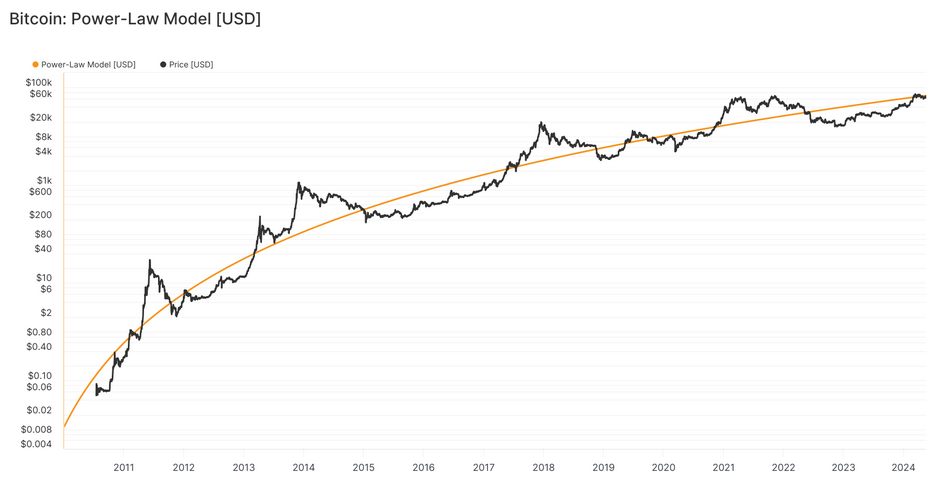
What Is the Power Law?
The power law model treats Bitcoin not as a speculative tech stock, but as a scarce, monetizing asset whose value grows according to a mathematical curve over time. Instead of linear growth, price increases slow gradually as adoption expands, producing a curved trajectory that historically has contained Bitcoin’s major peaks and troughs.
Unlike purely narrative-driven models, the power law attempts to anchor price action to long-term adoption and scarcity, rather than sentiment alone.
Historically, when Bitcoin trades significantly above the power law curve, the market enters euphoric phases. When price falls toward or below it, long-term accumulation and base-building often follow.
Why $65,000 Matters in 2026
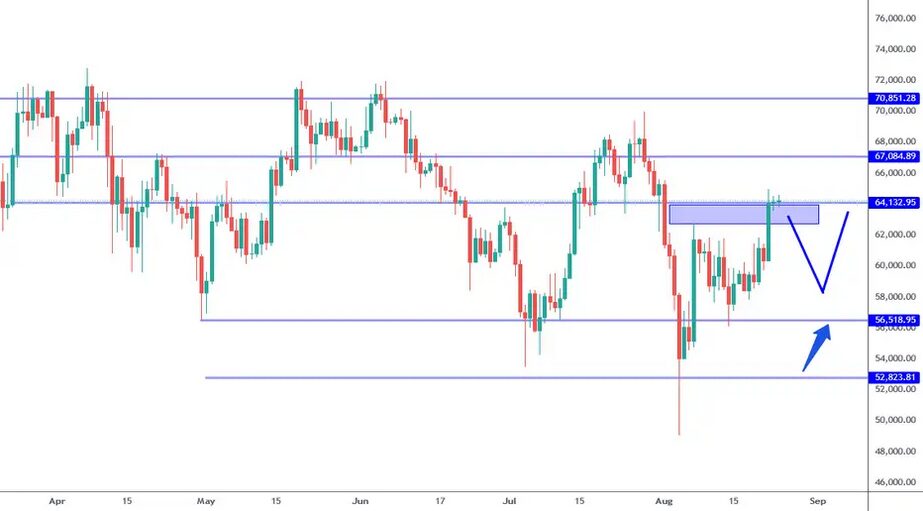
According to Timmer’s latest analysis, Bitcoin’s current reference line sits near $65,000, roughly corresponding to prior all-time-high territory. Below that, the lower power law trend line is currently around $45,000.
If Bitcoin enters a prolonged consolidation or mild downtrend over the next year, the power law curve itself will rise, gradually converging toward the $65,000 zone. At that point, price will face a decisive moment:
- Hold above the curve → confirms long-term growth remains intact
- Sustainably break below → signals a deeper structural reset
This is why the $65,000 region is described as a potential “moment of truth” for Bitcoin’s next macro phase.
Power Law vs. the S-Curve Narrative
Is Bitcoin Just Following an Internet-Style Adoption Curve?
Timmer acknowledges that recent price action looks closer to an S-curve, often used to describe technology adoption such as the internet. In such models, growth accelerates rapidly before flattening as saturation approaches.
However, this analogy has limits.
Bitcoin is not merely a network product. It is a financial asset embedded in global capital markets, competing with gold, bonds, equities, and sovereign currencies. Its price formation is driven by liquidity cycles, risk appetite, and macroeconomic conditions—not just user adoption.
This distinction is critical.
Why Bear Markets Haven’t Disappeared
Fidelity executive David Eng reinforces this view, arguing that the idea of Bitcoin “outgrowing” bear markets misunderstands how asset pricing works.
Bitcoin is a scarce, fixed-supply asset inside the financial system—not a single S-curve technology.
As Bitcoin matures:
- Volatility compresses
- Cycles lengthen
- Drawdowns become less violent
But cycles still exist. Risk is repriced, leverage is flushed, and capital rotates—just as in every other major asset class.
The Four-Year Cycle Debate Revisited
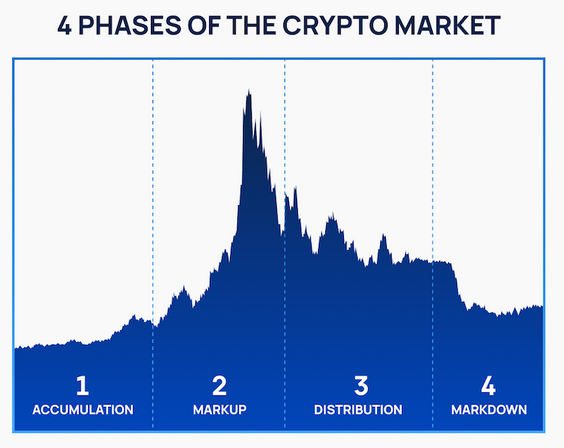
Bitcoin has historically followed a four-year rhythm aligned with halving events. Each cycle has produced:
- Post-halving accumulation
- Expansionary bull market
- Distribution near cycle highs
- Multi-month or multi-year correction
While some argue that diminishing issuance reduces halving impact, evidence suggests the cycle is evolving, not disappearing.
Instead of sharp crashes, the market now appears to be entering a “compressed” phase, where price coils below long-term growth trends.
Compression and the Case for a Relief Rally
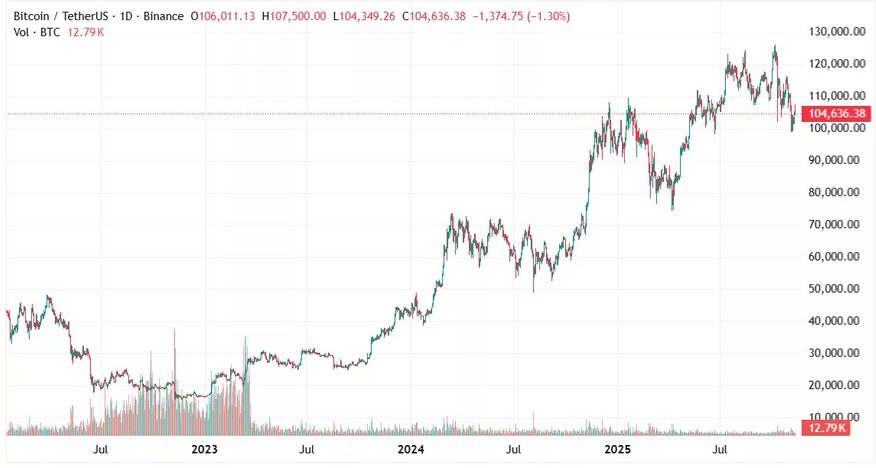
Eng describes the current market state as coiled, not stalled. Historically, when Bitcoin trades below its power law trajectory for extended periods, resolution comes through upward price adjustment, not abandonment of the model.
This suggests that:
- Long consolidations increase pressure
- Volatility suppression precedes expansion
- Relief rallies are structural, not speculative anomalies
For long-term participants, these periods often offer asymmetric risk-reward opportunities, especially for infrastructure builders and yield-focused strategies.
Recent Market Context and Broader Trends
Beyond models, several macro trends reinforce the relevance of structural analysis:
- Institutional participation continues via ETFs, custody solutions, and treasury allocations.
- Volatility decline aligns Bitcoin more closely with macro assets.
- Liquidity cycles, driven by interest-rate expectations and global monetary policy, increasingly dominate short-term price action.
- Layer-2 networks, tokenization, and payment rails are expanding Bitcoin’s utility beyond speculation.
These factors suggest that Bitcoin’s next major move will likely be structural, not emotional.
Implications for Investors and Builders
For readers seeking new crypto assets, revenue opportunities, or practical blockchain applications, the takeaway is clear:
- Short-term price direction matters less than structural positioning
- Bear-market phases are often where foundational value is built
- Models like the power law help frame risk, not predict dates
Bitcoin’s evolution favors participants who understand cycles, compression, and capital rotation, rather than those chasing momentum.
Conclusion: A Test of Maturity, Not Failure
Bitcoin approaching $65,000 as a critical zone does not imply weakness—it reflects maturation.
The power law model suggests that Bitcoin is not breaking down, but slowing into its next growth phase, where volatility compresses, cycles lengthen, and price must periodically realign with long-term fundamentals.
If history holds, resolution comes not through abandonment of growth laws, but through price catching up.
For long-term investors, operators, and builders, this “moment of truth” may ultimately define Bitcoin’s transition from speculative instrument to enduring financial infrastructure.