Main Points :
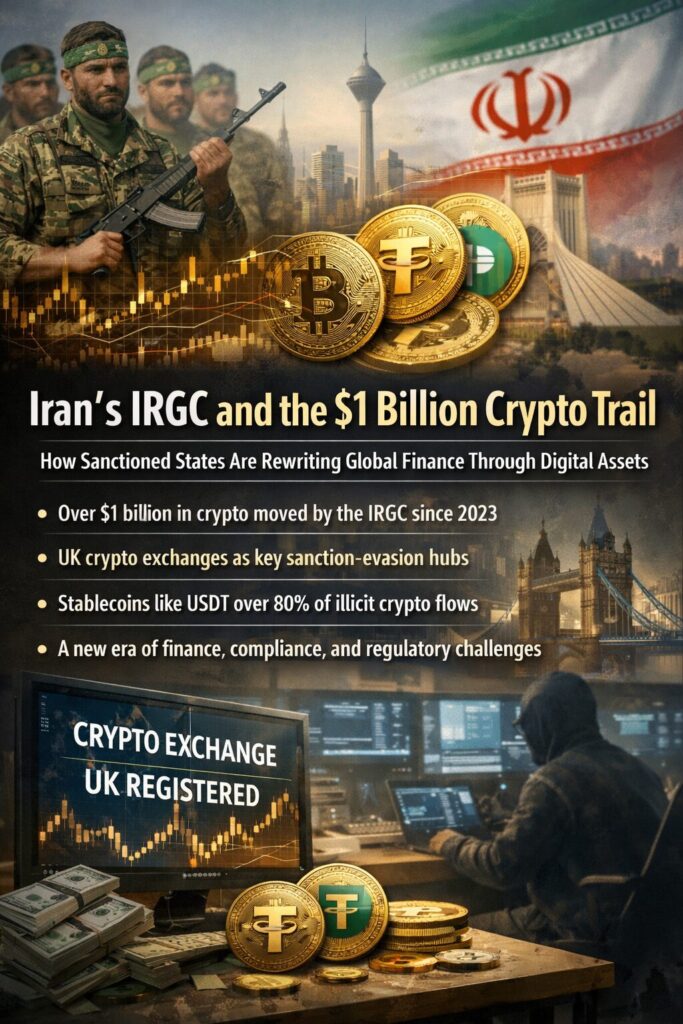
- Since 2023, Iran’s Islamic Revolutionary Guard Corps (IRGC) has allegedly moved over $1 billion in cryptocurrency, primarily using stablecoins.
- UK-registered crypto exchanges reportedly served as critical transit hubs for sanction-evasion flows.
- Stablecoins like USDT now dominate illicit and sanctions-related crypto transfers, accounting for over 80% of volume globally.
- This case reflects a structural shift: crypto is no longer peripheral but embedded in state-level financial strategy.
- The incident raises urgent questions about global compliance, AML/KYC effectiveness, and regulatory redesign in the digital era.
1. A Billion-Dollar Movement Hidden in Plain Sight
In January 2026, blockchain intelligence firm TRM Labs released a report that sent shockwaves through the global compliance and crypto industries. According to its findings, Iran’s Islamic Revolutionary Guard Corps (IRGC) had orchestrated the movement of approximately $1 billion worth of cryptocurrency between 2023 and 2025.
What made the revelation particularly alarming was not just the scale, but the method: funds were routed through UK-registered cryptocurrency exchanges, exploiting jurisdictional blind spots and the inherent efficiency of blockchain-based value transfer.
At the center of these flows were USD-pegged stablecoins, especially USDT, which provided the IRGC with near-frictionless access to cross-border liquidity while bypassing traditional banking rails that are tightly controlled by international sanctions regimes.
2. Why Stablecoins Became the Weapon of Choice
Unlike Bitcoin or Ethereum, stablecoins offer price stability, deep liquidity, and universal acceptance across exchanges and OTC desks. For sanctioned entities, this combination is critical.
TRM Labs’ analysis shows that over 70% of IRGC-linked transactions were conducted in stablecoins. This mirrors a broader global trend: sanctioned and illicit actors increasingly prefer stablecoins over volatile crypto assets.
【“Stablecoin Dominance in Sanctions-Related Crypto Flows”】
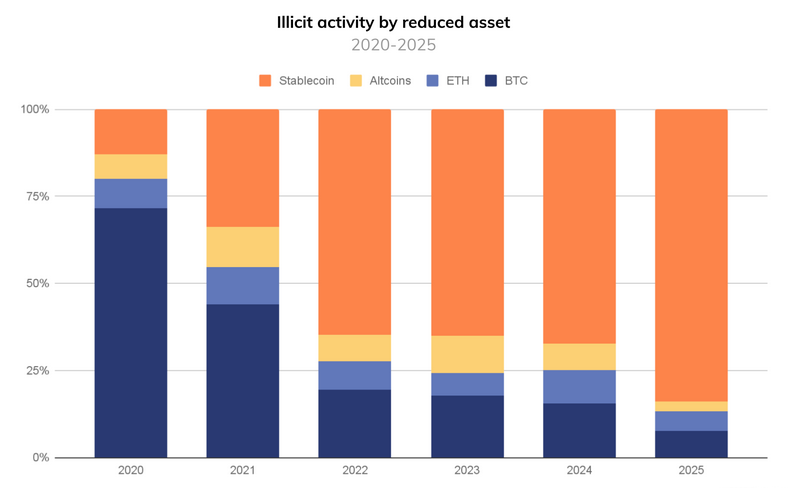
The implications are profound. Stablecoins now function as a shadow correspondent banking system, operating continuously, globally, and largely outside the legacy compliance architecture.
3. The Role of UK-Registered Exchanges as Financial Intermediaries
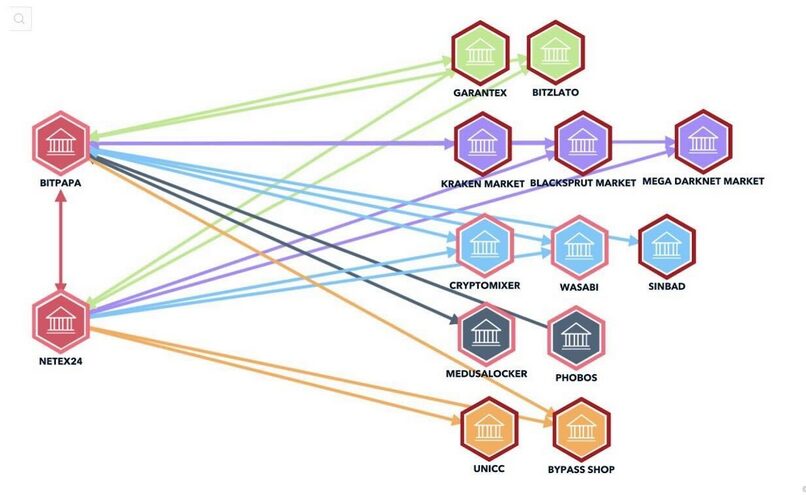
The report highlights two UK-registered exchanges—Zedcex and Zedxion—as pivotal infrastructure nodes in this network. Although formally separate entities, TRM Labs identified operational overlap, shared liquidity behavior, and synchronized wallet activity.
Between 2023 and 2025, IRGC-linked funds accounted for more than half of these exchanges’ total transaction volumes, suggesting that they functioned less as retail platforms and more as bespoke financial conduits.
Importantly, both exchanges publicly claimed adherence to AML/KYC standards. However, Iran was not explicitly listed as a prohibited jurisdiction, a gap that effectively neutralized sanctions enforcement.
4. Direct Funding of Armed Groups: A Confirmed Case
One of the most serious findings involved a direct transfer exceeding $10 million from an IRGC-controlled wallet to an address linked to Houthi financiers in Yemen, who are designated under US sanctions.
This transaction underscores a critical evolution: crypto is no longer merely used for evasion, but for direct operational financing of military and paramilitary groups.
【“IRGC Crypto Funding Network and Armed Group Transfers”】
5. The Shadow of a Sanctioned Financier
Corporate registry data added another layer of concern. TRM Labs noted that a listed director of Zedxion, “Babak Morteza,” may in fact be Babak Zanjani, a businessman sanctioned by the US and EU in 2013 and later sentenced to death in Iran for embezzlement.
If confirmed, this would strongly suggest that the exchange network was not an accidental compliance failure, but part of a deliberate, state-aligned financial architecture.
6. A Global Pattern: From Iran to Russia and North Korea
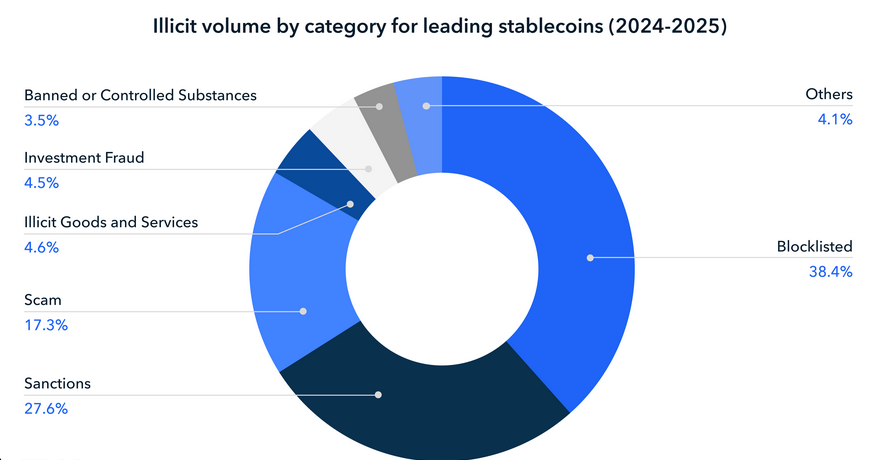
This case is not isolated. According to Chainalysis, total crypto-related illicit activity reached $154 billion in 2025, a 162% year-on-year increase.
Sanctions-related inflows alone grew nearly sevenfold, with stablecoins representing 84% of total volume. Similar patterns have been observed in:
- Russia, using BTC, ETH, and stablecoins for oil trade settlements with China and India.
- North Korea, funding state operations via large-scale crypto hacking.
- Iran, where cumulative sanctioned wallet flows now exceed $2 billion.
【“State-Level Crypto Utilization for Sanctions Evasion”】
7. Implications for Investors, Builders, and Policymakers
For crypto investors and builders, this story carries a dual message.
On one hand, it demonstrates the unmatched power of blockchain infrastructure: instant settlement, censorship resistance, and global liquidity. These are precisely the properties that make crypto attractive for legitimate use cases such as remittances, treasury management, and on-chain finance.
On the other hand, it exposes a critical vulnerability. Without robust, globally harmonized compliance frameworks, the same tools that empower innovation can be weaponized by sanctioned states.
8. Redesigning Compliance for the Digital Age
The IRGC case highlights a structural mismatch: 20th-century sanctions enforced on 21st-century finance.
Future solutions will likely require:
- Real-time, on-chain sanctions screening
- Stablecoin issuer-level enforcement
- Cross-border regulatory coordination
- Accountability not just for exchanges, but for infrastructure operators
Crypto is no longer outside geopolitics. It is now embedded within it.
Conclusion: Crypto as the New Geopolitical Financial Layer
The alleged $1 billion IRGC crypto operation marks a turning point. Digital assets have evolved from speculative instruments into strategic financial infrastructure at the state level.
For market participants, the takeaway is clear: understanding crypto today means understanding global power, regulation, and compliance, not just price charts.
The future of crypto will not be decided solely by technology—but by how the world chooses to govern it.