
Main Points :
- President Donald Trump announced a $200 billion mortgage-backed securities (MBS) purchase plan, triggering a global equity rally and renewed risk-on sentiment.
- As capital rotated into equities, Bitcoin (BTC) stalled around $91,000, losing its short-term macro advantage.
- Bitcoin derivatives activity cooled sharply, with futures and options volumes declining despite stable spot prices.
- Technical indicators show volatility compression, with $90,000 as key support and $93,500 as major resistance, defining the next breakout zone.
- For investors and builders in crypto, the episode highlights Bitcoin’s evolving role between risk asset and macro hedge.
Introduction: A Policy Shock That Reshaped Market Flows
On January 9–10, 2026, global financial markets were jolted by a major policy announcement from U.S. President Donald Trump. In an effort to ease housing affordability and stimulate economic activity, Trump unveiled plans for a $200 billion purchase of mortgage-backed securities (MBS), explicitly targeting lower mortgage rates and reduced monthly payments for American households.
The immediate market reaction was decisive. Equities across the United States, Europe, and Asia surged, reflecting expectations of improved liquidity, stronger consumption, and a renewed growth outlook. Yet amid this global rally, Bitcoin—the asset that had benefited earlier in the week from geopolitical tensions and risk hedging—suddenly lost momentum.
This article provides a comprehensive analysis of how Trump’s MBS plan reshaped capital allocation, why Bitcoin demand temporarily stalled, what derivatives data reveals about trader behavior, and how technical signals frame Bitcoin’s next decisive move. Beyond short-term price action, we also explore what this episode means for crypto investors seeking new opportunities, yield strategies, and real-world blockchain applications.
Trump’s $200 Billion MBS Purchase Plan: Liquidity as Economic Medicine
President Trump’s proposal centers on a straightforward but powerful mechanism: direct intervention in the mortgage market. By purchasing $200 billion worth of mortgage-backed securities, the administration aims to push mortgage rates below 6%, thereby lowering housing costs and boosting household disposable income.
In a statement posted on Truth Social, Trump declared:
“I have instructed our teams to purchase $200 billion in mortgage bonds. This will lower mortgage rates, reduce monthly payments, and make homeownership more affordable.”
From a macroeconomic perspective, this policy functions as a targeted liquidity injection. Lower mortgage rates increase housing demand, support construction activity, and free up consumer cash flow. In turn, this additional liquidity often finds its way into risk assets, particularly equities.
Global Equity Markets Surge as Risk Appetite Returns
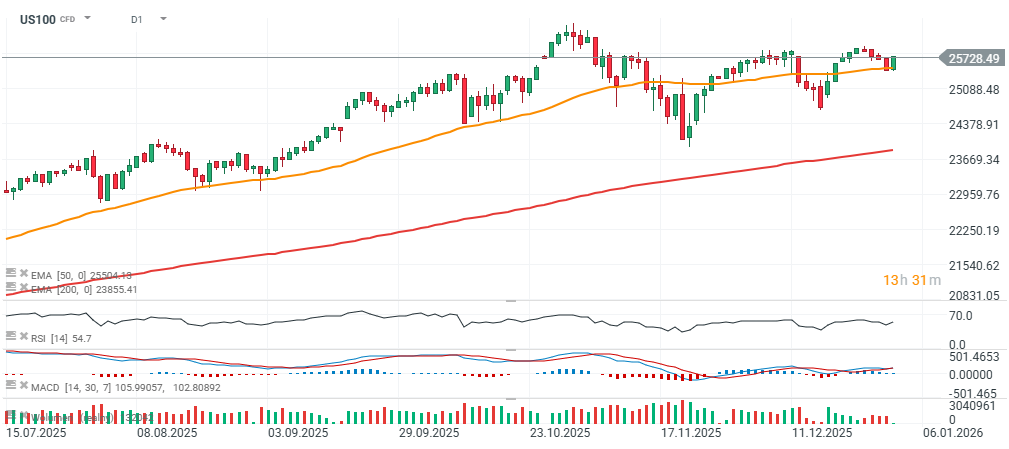
The global response was swift. According to data from TradingEconomics, U.S. equities led the rally. The U.S. technology-heavy index (US100) climbed 1.20%, driven by gains in mega-cap stocks such as Google, Apple, and Meta.
International markets followed suit:
- Japan’s Nikkei 225 surged 4.83%, reflecting both global risk appetite and domestic currency dynamics.
- Germany’s DE100 and the UK’s FTSE 100 also posted solid gains.
- Improved sentiment was further reinforced by expectations that Venezuelan crude oil would re-enter global supply, easing inflationary pressures.
This synchronized rally signaled a decisive shift toward risk-on positioning, drawing capital away from defensive or alternative hedges.
Bitcoin Stalls Near $91,000 as Capital Rotates
Against this backdrop, Bitcoin traded sideways near $91,100, with intraday volatility limited to roughly 1%. Earlier in the week, BTC had benefited from geopolitical uncertainty and macro hedging flows. However, Trump’s policy announcement altered the narrative.
As investors reallocated capital toward equities, Bitcoin’s short-term appeal as a macro hedge diminished. Rather than experiencing a sharp sell-off, BTC entered a consolidation phase, suggesting indecision rather than panic.
This price stability, despite reduced momentum, is an important signal. It indicates that long-term holders were not rushing to exit, even as short-term speculative interest cooled.
Derivatives Market Cooling: A Shift in Trader Behavior
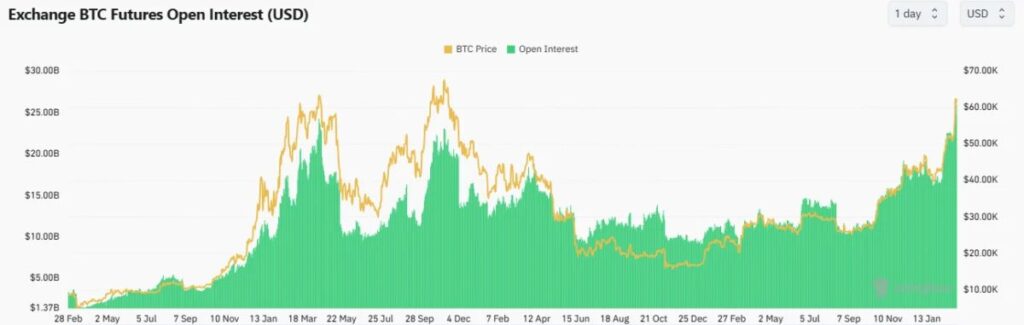
While spot prices remained stable, Bitcoin’s derivatives markets told a different story. Data from Coinglass shows a clear decline in speculative activity:
- Futures trading volume fell 10.73% to $80.95 billion.
- Open interest declined 2.68% to $60.81 billion.
- Options volume slipped 0.21% to $4.57 billion, while open interest dropped 1.51% to $32.81 billion.
This contraction suggests that traders reduced leveraged exposure, likely preferring liquidity-rich equity markets in the near term. Notably, spot market stability implies that active participants shifted toward short-term, low-leverage strategies rather than abandoning Bitcoin altogether.
Technical Outlook: Compression Before the Breakout
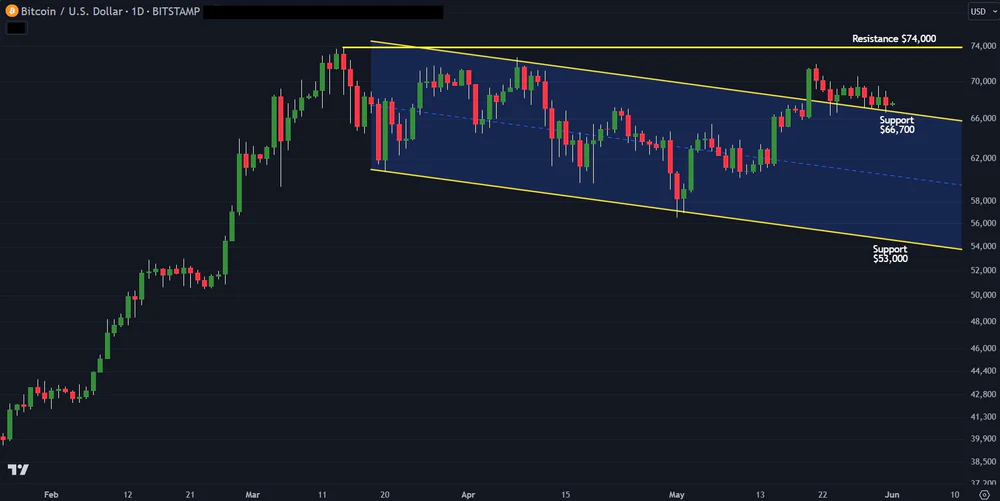
Technical analysis further reinforces the picture of consolidation. On the daily chart from TradingView, Bitcoin failed earlier in the week to break above the upper Bollinger Band near $93,400. Since then, price action has hovered around the $91,000–$90,000 zone.
Key technical observations include:
- Bollinger Bands are tightening, indicating declining volatility after early January’s rally.
- The 20-day simple moving average (SMA) sits near $89,300, acting as near-term support.
- The Relative Strength Index (RSI) has cooled to 50.42, signaling neutral momentum without strong bullish or bearish dominance.
Support and Downside Risks
If Bitcoin closes decisively below the 20-day SMA, downside risk increases. In such a scenario, BTC could retrace toward $85,000, and in a more extended correction, toward $86,500–$85,000 before the next attempt at a breakout.
Upside Scenario and Bullish Re-Acceleration
Conversely, a daily close above $93,500 would likely reignite bullish momentum. Such a move could validate earlier market expectations—echoed by prediction markets such as Kalshi—of a push toward the psychological $95,000 level.
What This Means for Crypto Investors and Builders
For readers seeking new crypto assets, revenue opportunities, or practical blockchain applications, this episode offers several lessons:
- Bitcoin’s Dual Identity Remains Intact
BTC continues to oscillate between being treated as a risk asset and a macro hedge. Policy-driven liquidity events can quickly tilt this balance. - Derivatives Data Matters
Spot prices alone do not tell the full story. Monitoring futures and options activity provides early insight into changing trader sentiment. - Volatility Compression Creates Opportunity
Periods of low volatility often precede large directional moves. For traders, this can mean breakout strategies; for builders, it offers a stable environment for product launches and infrastructure development. - Macro Policy Still Dominates Short-Term Price Action
Even in a maturing crypto market, traditional macro forces—interest rates, housing policy, and fiscal stimulus—continue to shape short-term dynamics.
Conclusion: Bitcoin Between Liquidity and Conviction
Trump’s $200 billion mortgage bond purchase plan underscores how swiftly global liquidity conditions can reshape financial markets. While equities enjoyed an immediate boost, Bitcoin entered a holding pattern, caught between fading macro hedging demand and resilient long-term conviction.
As volatility compresses and key technical levels converge, Bitcoin now stands at a crossroads. A break below $90,000 could invite deeper consolidation, while a decisive move above $93,500 may reignite the next leg of the bull cycle toward $95,000 and beyond.
For investors and practitioners focused on the future of digital assets, the message is clear: Bitcoin is no longer isolated from global macro forces—but its ability to absorb shocks without capitulation continues to strengthen its case as a core asset in the evolving financial system.