Key Takeaways :
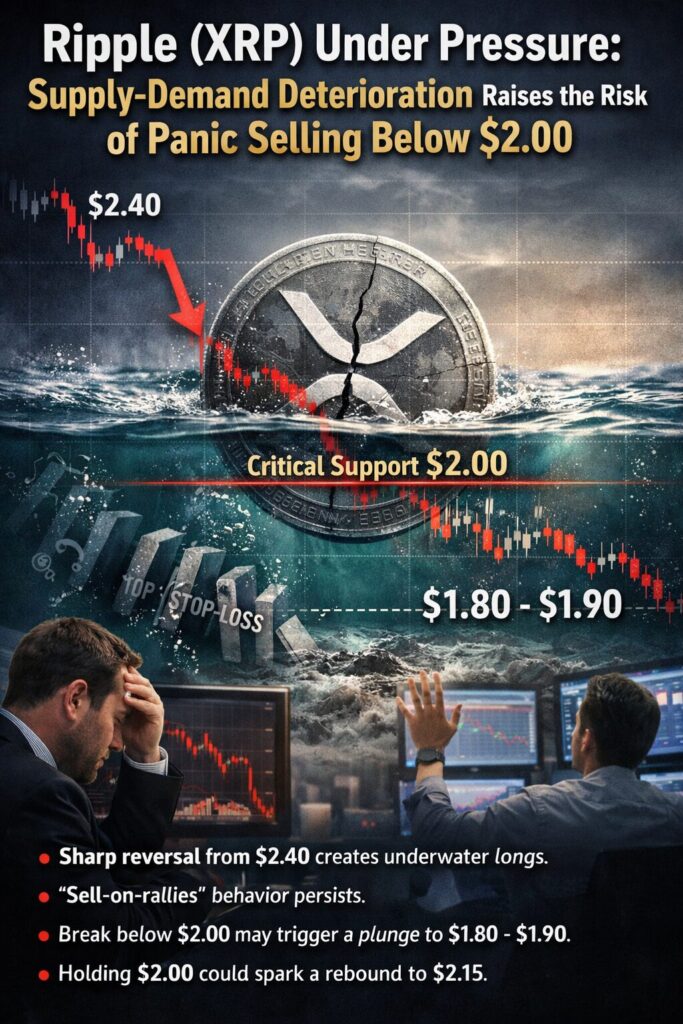
- XRP’s sharp reversal from $2.40 has created a large overhang of underwater long positions.
- Investor psychology suggests persistent “sell-on-rallies” behavior.
- The $2.00 level represents a critical psychological and technical support.
- A breakdown below $2.00 could trigger cascading stop-losses toward $1.80–$1.90.
- Conversely, repeated defense of $2.00 may lead to a short-covering rebound toward $2.15.
1. Market Context: From Euphoria to Structural Weakness
Ripple’s native token XRP has entered a critical phase after a rapid surge to $2.40 earlier this year. What initially appeared to be a strong continuation of the broader crypto recovery has quickly turned into a textbook example of deteriorating supply-demand dynamics.
At the core of the problem is positioning. A large number of investors entered long positions during the breakout phase above $2.20–$2.40, anticipating sustained upside momentum. When price reversed sharply, these positions became trapped, creating a heavy layer of unrealized losses now weighing on the market.
This phenomenon is not unique to XRP, but XRP’s relatively concentrated holder base and strong retail participation amplify the psychological impact. As a result, every minor rebound is now met with selling pressure from investors seeking relief rather than profit.
2. Investor Psychology and the “Overhead Supply” Problem
[XRP/USD 4H chart highlighting the $2.40–$2.00 drop and overhead supply zone]
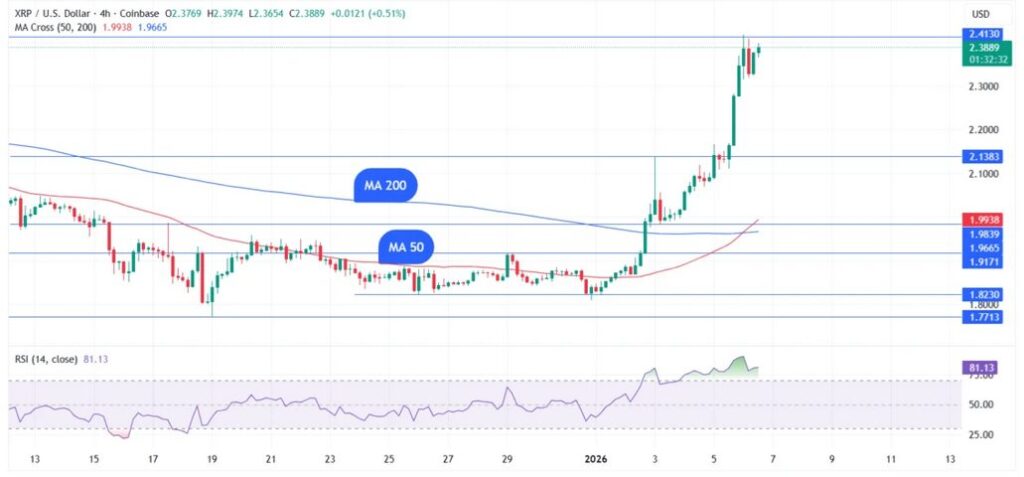
From a behavioral finance perspective, the XRP market currently reflects a classic overhead supply structure.
Investors who failed to exit during the rapid decline from $2.40 to $2.00 are now psychologically anchored to their entry prices. For these participants, any upward price movement is perceived not as an opportunity to profit, but as a chance to escape losses.
This creates a negative feedback loop:
- Price attempts to rebound.
- Trapped longs sell into strength.
- Upside momentum stalls.
- New buyers hesitate due to weak follow-through.
The unusually weak rebound following the latest sell-off further confirms that buying energy has largely evaporated. In technical terms, the market lacks both fresh demand and strong conviction.
3. The $2.00 Level: Why It Matters More Than Ever
The $2.00 price level is not just another technical support. It represents a convergence of:
- A round-number psychological threshold
- A high-volume trading area from previous consolidation
- A stop-loss clustering zone for short-term traders
In many crypto markets, round numbers act as behavioral magnets. For XRP, $2.00 has become the final line separating controlled correction from emotional capitulation.
4. Scenario Analysis: What Happens Next?
Scenario 1: Breakdown and Panic Selling
[Conceptual diagram showing stop-loss concentration below $2.00]
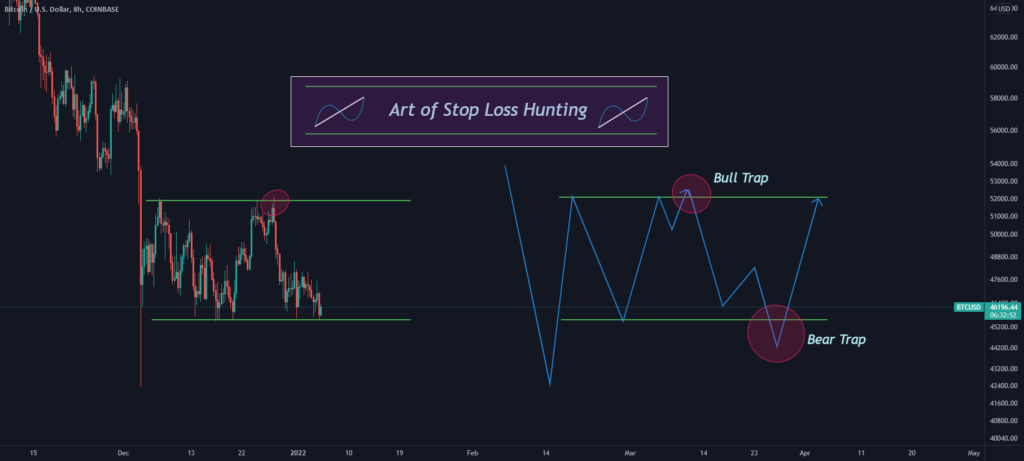
If XRP decisively breaks below $2.00, the consequences could be swift and violent.
Market structure suggests that a large number of stop-loss orders are stacked just below this level. Once triggered, these orders would convert into market sells, accelerating downside momentum. This type of liquidity cascade often leads to sharp, short-lived drops.
Estimated downside targets in this scenario lie between $1.80 and $1.90, where prior demand zones and potential bargain hunters may emerge.
Importantly, such a move would likely be driven more by mechanical selling than fundamental news—making it fast, emotional, and difficult to trade in real time.
Scenario 2: Failed Breakdown and Technical Rebound
[Scenario comparison chart showing breakdown vs rebound paths]
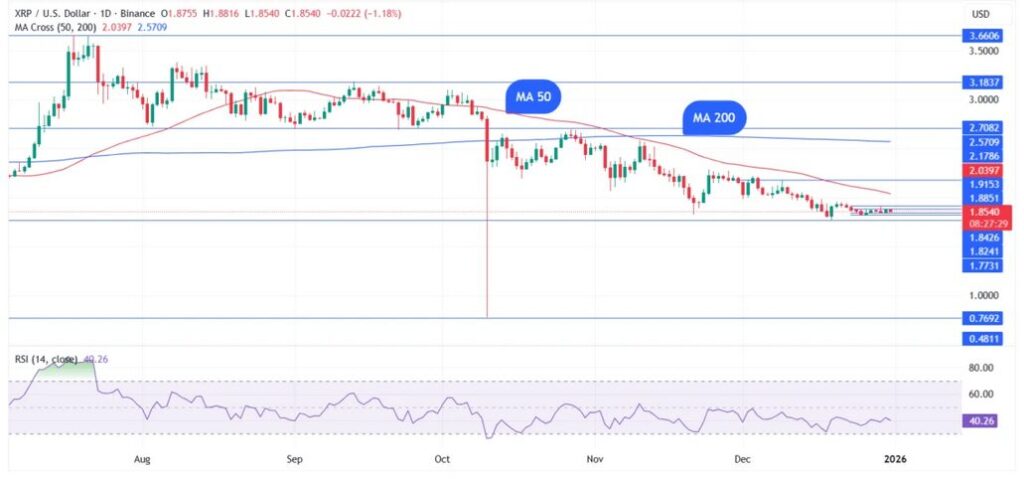
Alternatively, repeated failures to push XRP below $2.00 could exhaust sellers. In this case, the market may experience seller fatigue, creating conditions for a self-sustaining rebound.
Such a rebound would not necessarily signal a bullish trend reversal. Instead, it would likely be driven by:
- Short-covering by speculative sellers
- Tactical buying by range traders
- Temporary relief in investor sentiment
In this scenario, XRP could rebound toward $2.10–$2.15, where overhead supply is expected to reassert itself.
5. Broader Market Factors and Recent Developments
Beyond pure technicals, XRP is also influenced by broader crypto market conditions:
- Bitcoin dominance remains elevated, limiting altcoin inflows.
- Regulatory clarity surrounding Ripple continues to improve, but near-term impact is largely priced in.
- Liquidity across major exchanges has thinned compared to previous bull phases, increasing volatility risk.
Recent data from derivatives markets also indicates declining open interest, suggesting that speculative participation is decreasing rather than rotating bullishly.
6. Risk Management Implications for Traders and Investors
For active traders, the current environment demands discipline:
- Catching falling knives is risky when supply-demand dynamics are deteriorating.
- Waiting for clear confirmation—either a breakdown or a defended support—is critical.
- Position sizing and stop placement matter more than directional conviction.
For longer-term investors, patience may be the most valuable asset. Structural accumulation opportunities typically emerge after panic selling, not before it.
7. Conclusion: A Market at a Psychological Crossroads
XRP currently sits at a pivotal moment where psychology matters as much as price. The market is trapped between fear-driven selling and cautious hope for stabilization.
Whether $2.00 holds or fails will likely define XRP’s trajectory in the coming weeks. Until then, upside appears limited, downside risks remain asymmetric, and emotional trading is likely to be punished.