Main Points :
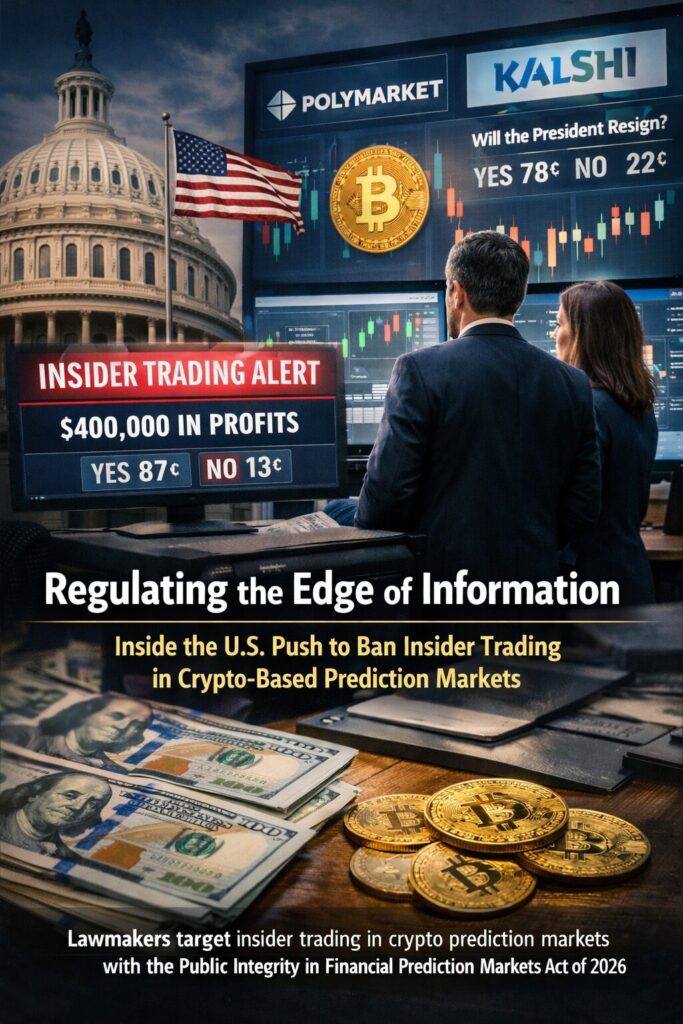
- U.S. lawmakers are preparing a new bill—the Public Integrity in Financial Prediction Markets Act of 2026—to prohibit insider trading by government officials in prediction markets.
- Crypto-based prediction markets such as Polymarket and Kalshi allow users to bet on political and policy outcomes using digital assets.
- A controversial trade on Polymarket, reportedly generating over $400,000 in less than 24 hours, triggered renewed scrutiny over insider access to non-public government information.
- Historically, prediction markets have lacked clear insider-trading rules, relying instead on the belief that informed participants improve forecast accuracy.
- The proposed legislation could significantly reshape how blockchain-based financial information markets operate, with implications for crypto investors, developers, and regulators worldwide.
1. Introduction: Why Prediction Markets Are Under the Spotlight
Prediction markets have long occupied a gray zone between finance, gambling, and information science. Platforms that allow participants to stake money on future events—from election outcomes to policy decisions—have existed for decades. However, the rise of blockchain technology and crypto settlement has transformed these markets into globally accessible, highly liquid venues operating 24/7.
In early January 2026, renewed attention focused on these markets after reports emerged that a U.S. congressman, Ritchie Torres, is preparing legislation aimed squarely at insider trading within prediction markets. The move follows allegations of suspicious trades on Polymarket that appear to have anticipated sensitive geopolitical events.
For readers interested in new crypto assets, alternative revenue models, and practical blockchain use cases, this development represents more than a political headline—it signals a potential structural shift in how information itself is priced on-chain.
2. What Are Prediction Markets? A Practical Overview
Prediction markets are financial platforms where participants buy and sell contracts that pay out based on the outcome of a future event. If the event occurs, the contract settles at $1; if not, it settles at $0. The market price therefore reflects the collective probability estimate of that outcome.
Crypto-based platforms such as Polymarket use stablecoins and smart contracts to handle settlement, enabling:
- Global participation without traditional brokerage accounts
- Near-instant settlement and transparent order books
- Composability with DeFi tools such as wallets and analytics dashboards
Supporters argue that these markets aggregate dispersed information more effectively than polls or expert forecasts. Critics, however, warn that when participants possess privileged information—especially government insiders—the market becomes distorted and ethically compromised.
3. The Proposed Law: Public Integrity in Financial Prediction Markets Act of 2026
According to individuals familiar with the draft, the proposed law—tentatively titled the Public Integrity in Financial Prediction Markets Act of 2026—would prohibit certain individuals from trading in prediction markets when they possess material, non-public information.
Who Would Be Covered
- Elected federal officials
- Politically appointed officers
- Employees of federal administrative agencies
What Would Be Prohibited
- Buying, selling, or exchanging prediction market contracts
- When contracts are tied to government policy, actions, or political outcomes
- On platforms engaged in interstate commerce
The structure closely mirrors insider-trading restrictions in traditional securities markets, adapting them to the unique mechanics of prediction contracts rather than stocks or derivatives.
4. The Polymarket Incident That Sparked the Debate
The legislative momentum reportedly stems from a high-profile Polymarket trade highlighted by market commentators, including Joe Pompliano. According to reports, a newly created account wagered more than $30,000 on the imminent removal of Venezuelan President Nicolás Maduro.
Within hours, U.S. authorities reportedly detained Maduro, and the trader exited the position with profits exceeding $400,000 in under 24 hours.
While no definitive evidence has proven government insider involvement, the timing raised concerns that someone with privileged access to sensitive diplomatic or security information may have exploited the market.
5. The Historical Argument: Do Insiders Improve Market Accuracy?
Interestingly, prediction markets have traditionally resisted insider-trading bans. The prevailing academic argument has been that insiders enhance accuracy by injecting high-quality information into prices. In theory, the market becomes more predictive, benefiting society at large.
However, this logic falters when insiders are public servants. When government officials profit personally from confidential information, public trust erodes—even if the market’s forecasts become more accurate.
This tension sits at the heart of the current debate: should prediction markets prioritize informational efficiency, or democratic integrity?
6. Regulatory Momentum Beyond This Bill
The proposed act does not exist in isolation. Over the past two years, U.S. regulators—particularly the Commodity Futures Trading Commission—have increased scrutiny of event-based contracts.
Kalshi, for example, operates under explicit regulatory approval, while Polymarket has navigated a more complex international compliance landscape. The new bill may accelerate a bifurcation:
- Regulated, permissioned prediction markets with strict participant rules
- Offshore or decentralized alternatives facing increasing access restrictions
7. Implications for Crypto Investors and Builders
For crypto-native investors, prediction markets have represented a novel yield opportunity—uncorrelated with traditional asset prices. For builders, they showcase how blockchains can price information itself.
If insider-trading bans are enforced:
- KYC and role-based access controls may become standard
- Wallet screening for politically exposed persons (PEPs) could increase
- Smart contracts may embed compliance logic directly
This could raise costs and reduce anonymity, but also legitimize prediction markets as a mainstream financial primitive.
8. Visual Context: Understanding the Market Landscape
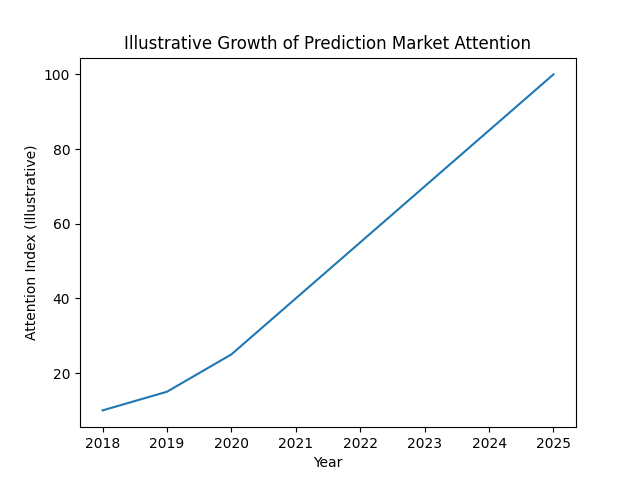
Illustrative Growth of Prediction Market Attention
Illustrative Distribution of Prediction Market Categories
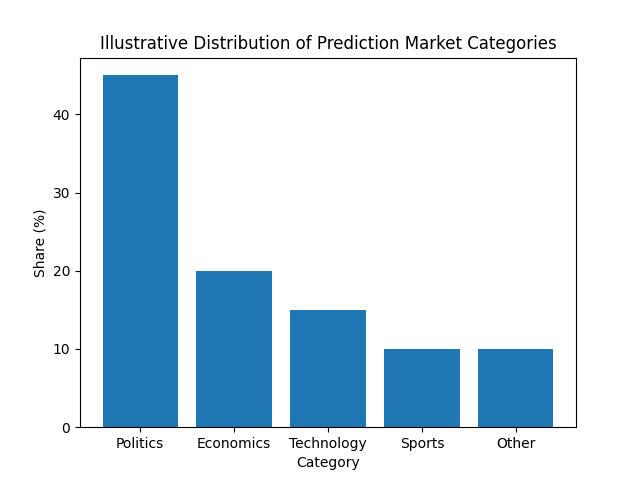
(Charts are illustrative and intended for conceptual understanding rather than precise measurement.)
9. Global Perspective: Why This Matters Beyond the U.S.
Although the bill targets U.S. officials, its impact could be global. Many crypto prediction markets operate internationally, and regulatory norms established in the U.S. often influence policies in Europe and Asia.
For Japanese residents, it is important to note that participation in prediction markets may be considered gambling under local law, and usage is not recommended.
10. Conclusion: A Turning Point for Information Markets
The proposed Public Integrity in Financial Prediction Markets Act of 2026 marks a potential turning point. By extending insider-trading principles into crypto-native information markets, lawmakers are acknowledging prediction markets as economically and politically significant systems.
For those seeking new crypto assets, revenue streams, and real-world blockchain applications, this moment underscores a broader trend: decentralization does not eliminate regulation—it reshapes it. The future of prediction markets will likely be defined not by whether they exist, but by how transparently and fairly they operate within evolving legal frameworks.