Main Points :
- Prediction markets remain conservative: Traders on Polymarket estimate only a 21% probability that Bitcoin will reach $150,000 by the end of this cycle.
- Lower targets dominate expectations: The most “safe” bet among traders is Bitcoin reaching $100,000 (80%), while probabilities fall sharply above $120,000.
- Four-year cycle skepticism is rising: Bitcoin’s annual decline in 2025 has weakened confidence in the traditional halving-driven bull cycle.
- Macro and regulatory tailwinds are forming: Potential U.S. interest-rate cuts, a new Federal Reserve chair, and clearer crypto regulations could reshape sentiment.
- Analysts remain strongly bullish: Major institutions forecast $150,000 in 2026, while more aggressive estimates reach $200,000–$250,000.
- For builders and investors: The gap between market pricing and analyst conviction highlights both opportunity and risk for long-term crypto strategies.
Introduction: When Markets and Analysts Disagree
Bitcoin has always lived at the intersection of conviction and doubt. In the current cycle, this tension is clearer than ever. According to prediction market data from Polymarket, traders collectively estimate only a 21% chance that Bitcoin will reach $150,000. This conservative stance contrasts sharply with the confidence expressed by major financial institutions and prominent crypto analysts, many of whom see $150,000 not as an upper bound, but as a milestone.
This divergence is more than a curiosity—it offers deep insight into how market participants interpret risk, macroeconomic shifts, and Bitcoin’s evolving role in global finance. For readers interested in discovering new crypto assets, identifying future revenue streams, or applying blockchain in practical ways, understanding this gap is essential.
Polymarket Data: A Snapshot of Collective Caution
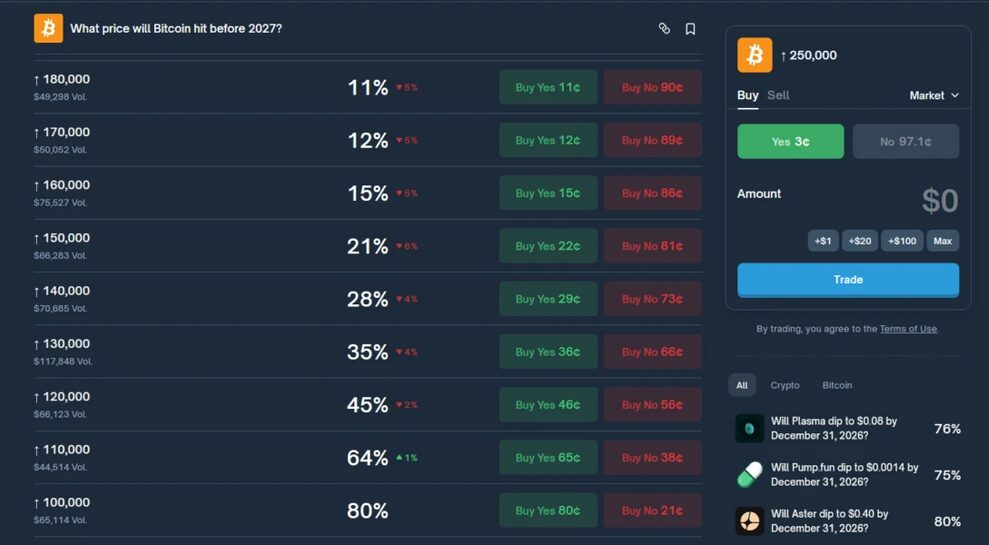
On Polymarket, traders are currently betting on the question: “How high will Bitcoin go by 2027?” The probability distribution paints a cautious picture:
- $100,000: ~80% probability
- $120,000: ~45% probability
- $130,000: ~35% probability
- $140,000: ~28% probability
- $150,000: ~21% probability
Notably, even the $120,000 level, which remains below Bitcoin’s more aggressive all-time-high projections, is treated as uncertain. This indicates that traders—who risk real capital—are pricing in significant structural uncertainty.
Prediction markets tend to reflect short-to-medium-term risk perception rather than long-term ideological belief. In that sense, Polymarket does not represent disbelief in Bitcoin, but rather skepticism about timing and velocity.
The Fading Certainty of the Four-Year Cycle
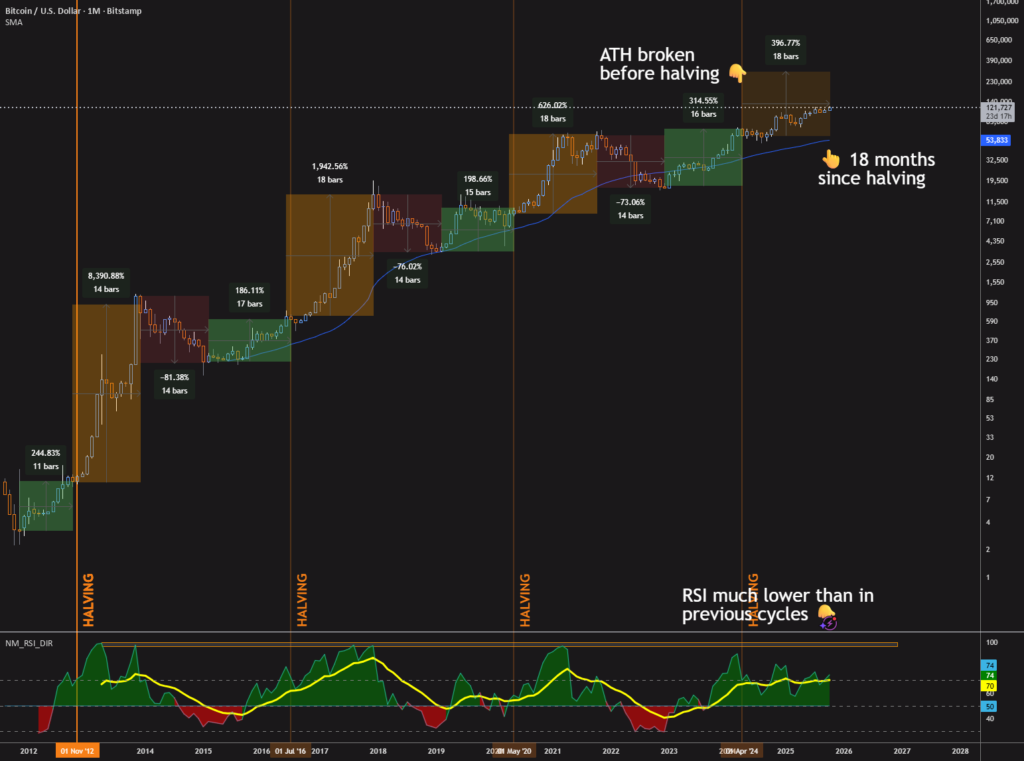
One reason for this caution lies in growing doubts about Bitcoin’s traditional four-year cycle, historically driven by halving events. For over a decade, Bitcoin’s market structure followed a recognizable pattern: accumulation, breakout, parabolic rise, and deep correction.
However, Bitcoin’s annual decline in 2025 challenged this framework. For many traders, this raised a critical question: Has Bitcoin outgrown its original cyclical identity?
As Bitcoin integrates into global financial systems—through ETFs, institutional custody, and sovereign-scale holdings—it may be transitioning from a speculative asset into a macro-sensitive monetary instrument. If so, price movements could increasingly resemble commodities or risk assets rather than a self-contained crypto cycle.
This uncertainty naturally depresses probability estimates for aggressive upside targets.
Macro Factors: Interest Rates, Liquidity, and Political Change
Despite traders’ caution, macroeconomic conditions may be quietly aligning in Bitcoin’s favor.
A key catalyst is the expected appointment of a new Federal Reserve chair by Donald Trump. Markets anticipate that a shift in leadership could accelerate interest-rate cuts, increasing global liquidity.
Historically, Bitcoin has performed well in environments where:
- Real yields decline
- Liquidity expands
- Confidence in fiat monetary stability weakens
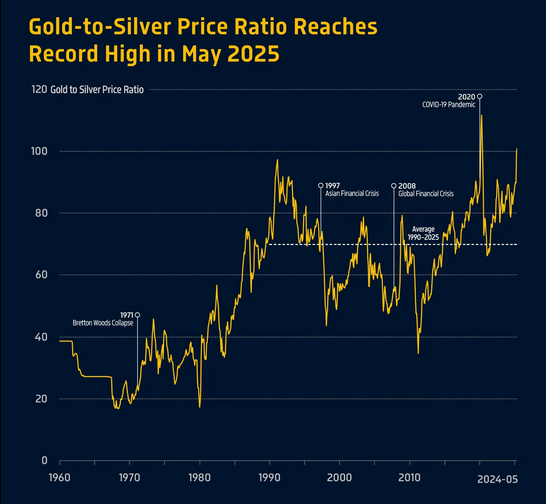
Supporting this thesis, gold and silver reached new all-time highs in late 2025, signaling renewed demand for scarce, non-sovereign stores of value. Bitcoin, often described as “digital gold,” lagged behind during this phase—suggesting potential catch-up rather than structural weakness.
Regulation as a Catalyst, Not a Constraint
Another factor underpinning analyst optimism is regulatory clarity. Proposed legislation such as the GENIUS Act and CLARITY Act aims to define the legal status of digital assets, exchanges, and custody frameworks.
For institutional investors, regulation is not an obstacle—it is a prerequisite. Clear rules enable:
- Pension funds and insurers to allocate capital
- Banks to offer crypto-linked products
- Corporations to integrate Bitcoin into treasury strategies
As compliance barriers fall, capital inflows can scale dramatically. This dynamic is often underestimated by retail-focused prediction markets but emphasized heavily in institutional research.
Analyst Forecasts: Why $150,000 Remains Central
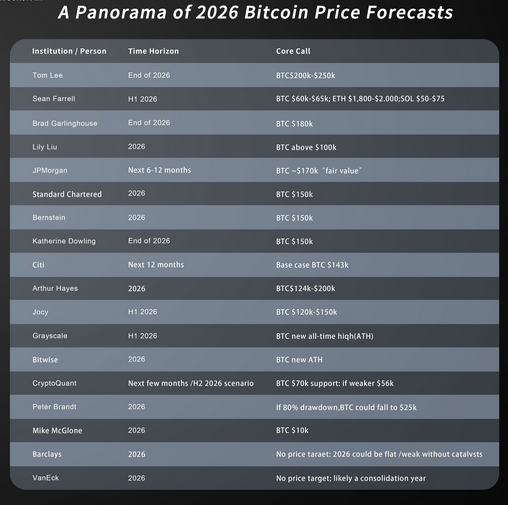
Several major institutions maintain a strong bullish outlook:
- Standard Chartered projects Bitcoin reaching $150,000 in 2026.
- Strategy continues aggressive accumulation, reinforcing long-term confidence.
- Bernstein aligns with similar price targets.
More aggressive projections come from Tom Lee, who estimates a range of $200,000 to $250,000, based on ETF inflows, supply scarcity, and macro liquidity.
These forecasts assume not speculative mania, but structural demand exceeding newly issued Bitcoin supply.
What This Means for Investors and Builders
The contrast between Polymarket probabilities and analyst forecasts reveals something critical: risk perception is fragmented.
- Short-term traders prioritize downside protection and timing risk.
- Institutions and strategists focus on multi-year capital flows and structural shifts.
For investors, this gap creates asymmetric opportunity—particularly for those willing to hold through volatility. For builders and entrepreneurs, it signals that Bitcoin’s next phase may be less about hype and more about integration, infrastructure, and real-world utility.
Bitcoin’s ultimate value may be shaped less by prediction markets and more by how deeply it embeds itself into payments, treasury management, and cross-border finance.
Conclusion: Probability Is Not Destiny
A 21% probability does not mean Bitcoin will not reach $150,000—it simply reflects present uncertainty. History shows that Bitcoin’s most powerful moves often occur when confidence is lowest and positioning is conservative.
Whether $150,000 arrives in 2026 or later, the broader trend is unmistakable: Bitcoin is evolving from a speculative experiment into a macro-relevant financial asset. For those seeking new crypto opportunities, future revenue models, or practical blockchain applications, the real question may not be if Bitcoin reaches $150,000—but how prepared we are when it does.